Brent Settles Below $100 on Trump's Iran Pause While CERAWeek Execs Say Damage Isn't Priced In
Brent crude settled below $100 for the first time since March 11 after Trump announced a five-day pause on U.S. strikes against Iranian energy infrastructure, claiming productive talks Tehran denies exist. Hours later at CERAWeek in Houston, Chevron's CEO told attendees the physical supply destruction from the Hormuz closure is not fully reflected in prices and will take months to unwind even after the strait reopens.
Mover Brief
The Crash and the Claim
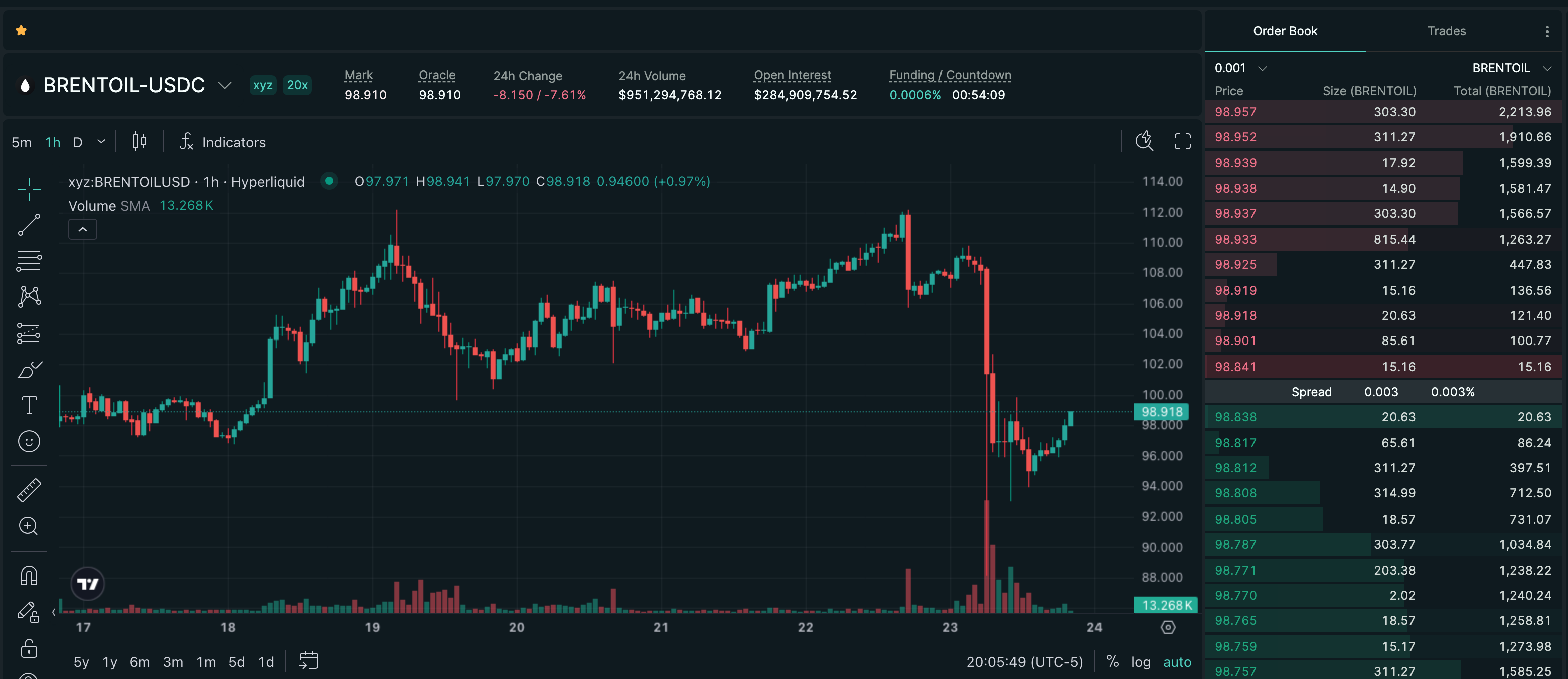
Brent swung from $113 to $94.20 on Monday — a 14% intraday range — after Trump announced he had instructed the "Department of War to postpone any and all military strikes against Iranian power plants and energy infrastructure for a five day period." He claimed the U.S. and Iran had engaged in "very good and productive conversations" toward a total resolution of hostilities.
Iran's Foreign Ministry categorically denied any dialogue with Washington. Parliament Speaker Ghalibaf called it "fakenews" designed to manipulate oil markets. The pause itself is narrow — it covers only American strikes on power plants, not Israeli military operations. Israel struck IRGC headquarters in central Tehran hours into the pause.
Brent settled at $99.94, its first close below $100 since March 11, while WTI dropped to $88.13. Equities moved the other direction — the S&P 500 gained 1.9%, the Dow added 2.1%, and the Nasdaq rose 2.2%. The market is treating a five-day pause on one category of strikes as a blanket de-escalation signal.
CERAWeek's Counter-Narrative
While futures traders were liquidating war premium, the people who actually move physical barrels were telling a different story at CERAWeek in Houston.
Chevron CEO Mike Wirth said the Hormuz impact is "not fully priced in": "There are very real physical manifestations of the closure of the Strait of Hormuz that are working their way around the world through the system." He added that even when the strait eventually reopens, physical supply recovery will take months — infrastructure doesn't restart overnight.
Saudi Aramco CEO Amin Nasser pulled out of CERAWeek entirely, staying in Riyadh as Iran's fourth week of strikes forces the Gulf's most powerful oil executives to manage an existential crisis from home. Aramco has already cut output by roughly 2 million barrels per day. Three other Gulf energy chiefs also withdrew. ADNOC's Sultan Al Jaber will address the conference virtually before traveling to Washington for emergency meetings on the Hormuz situation.
The disconnect is stark. Traders are pricing a diplomatic resolution that one side says doesn't exist. CEOs who operate the infrastructure are pricing years of repair work on damaged facilities, including QatarEnergy's LNG complex — a facility that handles a fifth of global LNG exports.
The Physical Supply Gap
The numbers underneath the headlines haven't changed. Over 11 million barrels per day remain disrupted — worse than the 1973 and 1979 oil crises combined, per the IEA. The 400-million-barrel emergency reserve release maxes out at 1.4 million bpd, replacing less than 13% of what Hormuz normally carries. Asia is facing shortages beyond what strategic reserves can offset, with nations implementing energy conservation mandates and work-from-home requirements.
Goldman Sachs raised its oil forecast on what it called the largest-ever supply shock, expecting Brent to average $110 through March and April. U.S. gasoline prices are near $4 per gallon, the highest since 2023. Energy Secretary Chris Wright faces CERAWeek on Monday tasked with explaining how a temporary sanctions waiver on Iran maintains military effectiveness while persuading oil CEOs to increase drilling.
Brent is still up 42% from a month ago at $71.06 pre-conflict. The five-day clock on Trump's pause is running, the counterparty denies it exists, and the physical barrels aren't coming back in five days regardless. Wirth's assessment — "the fundamentals are very tight out there, the markets are trading on scant information" — captures the gap between what futures are pricing and what the oil patch is living.
Sources & Provenance
Citations below are preserved as structured Postgres source rows for this brief.
Citations Preserved
7
Reference links carried forward from the published mover record.
Original Signal
Open source tweetMarket Route
Direct route preserved for readers who want to inspect the tracked Hyperliquid market behind this archive entry.
Already onboarded? Open tracked market- 1Fortune — Chevron CEO says Iran war impact isn't fully priced infortune.com
- 2CNBC — Oil tumbles 11% after Trump pauses Iran strikescnbc.com
- 3CNBC — Saudi Aramco CEO pulls out of CERAWeekcnbc.com
- 4Bloomberg — Goldman raises oil forecasts on largest-ever supply shockbloomberg.com
- 5Euronews — Oil prices slide after Trump announces Iran conversationseuronews.com
- 6Semafor — US energy secretary faces Iran fuel crisis at CERAWeeksemafor.com
- 7Coinpaper — Brent falls 14% after Trump postpones Iran strikescoinpaper.com
This content is for informational purposes only and does not constitute financial advice. Trading perpetual futures involves substantial risk of loss.
Trade BRENTOIL on Hyperliquid
Use referral code HIPERWIRE for 4% off trading fees on your first $25M in volume.
Live Market Metrics
Monitor real-time open interest and funding for BRENTOIL.