Historical analysis of significant volatility events on Hyperliquid.
HYPE dropped nearly 10% after peaking at $43 on the landmark S&P 500 perpetuals announcement, as a broad crypto selloff dragged Bitcoin below $70,000 for the first time since early February. The reversal hit an overbought token with RSI above 71 at the top of a 20% weekly run, turning a genuinely significant product launch into a textbook sell-the-news setup.
FARTCOIN fell to $0.1879, giving back the full rally from its March 10 lows as Bitcoin broke below $70,000 for the first time since early February. The post-FOMC washout sent $265 million in crypto positions into liquidation and pushed the Fear and Greed Index into extreme fear territory. Long-term Bitcoin holders accelerated exits, dumping over 1,650 BTC worth $117 million in a single session, removing the upstream bid that had carried every Solana memecoin bounce this month.
Silver fell 8% in 21 hours as the US-Iran conflict delivered the opposite of what metals bulls expected. The Strait of Hormuz disruption is pushing oil higher and feeding inflation, giving the Fed cover to stay hawkish at 3.50-3.75% with just one cut projected for 2026. The dollar is absorbing the crisis bid instead of precious metals, and silver's high beta is making it the biggest casualty in the complex.
Silver's post-FOMC selloff deepened sharply on March 19 as February producer price data came in at more than double the consensus forecast, validating the Fed's hawkish hold and removing any remaining hope for near-term rate cuts. The Hyperliquid perp dropped 13.74% in 24 hours to $66.91, nearly triple the decline in spot silver, as cascading liquidations in thin perp liquidity amplified the macro-driven repricing.
Uber and Rivian announced a partnership on March 19 to deploy up to 50,000 fully autonomous Rivian-powered robotaxis, with Uber reportedly committing up to $1.25 billion in investment. The deal is the first major commercial validation of Rivian's in-house autonomy stack and custom RAP1 chip, unveiled at the company's December 2025 AI Day, and adds Rivian to Uber's rapidly expanding multi-supplier robotaxi portfolio alongside NVIDIA, Zoox, and Lucid/Nuro.
Plasma's XPL fell 9% on its Hyperliquid HIP-3 perp as Bitcoin broke below $70,000 for the first time since late January, marking a third consecutive day of selling after the Fed held rates and Powell revised the 2026 inflation forecast higher on Iran-driven oil prices. The total crypto market shed $125 billion in 24 hours with the Fear and Greed Index hitting 23. XPL's thin perp book continues to amplify macro moves at roughly double BTC's rate, and the March 25 token unlock releasing 88.89 million XPL is now six days away.
FARTCOIN's HIP-3 perpetual fell 25% to $0.1628 as the Federal Reserve held rates but raised its 2026 inflation forecast to 2.7% from 2.4%, citing Iran-driven oil prices near $100 a barrel as a direct inflation risk. Bitcoin broke below $70,000 for the first time since early February, dragging the entire crypto market lower. Spot FARTCOIN dropped roughly 10%, but the thin HIP-3 order book amplified the move to more than double the spot decline.
Micron posted $23.86 billion in fiscal Q2 revenue and $12.20 in adjusted EPS, crushing consensus by double digits on both lines. The stock sold off anyway. CEO Sanjay Mehrotra warned that PC and smartphone units could decline in the low double digits in calendar 2026 as Micron's own pricing power — the thing printing record margins — chokes downstream device demand. A broader market rout driven by escalating Iran-Israel tensions on March 19 accelerated the move.
Alibaba shed 8.46% in 24 hours, extending a seven-session losing streak into its March 19 earnings print. Analysts expect EPS to fall roughly 48% year-over-year to around $1.59, even as revenue grows 8%, with ballooning AI infrastructure spending compressing margins. The selloff reflects pre-earnings positioning into what could be the company's weakest profit quarter in years.
Plasma's XPL fell 14.38% on its Hyperliquid HIP-3 perp over 23 hours after the Federal Reserve held rates at 3.5-3.75% and Chair Powell warned that inflation remains elevated with no clear path to cuts. Bitcoin dropped 5% and the total crypto market shed over $100 billion, but XPL's razor-thin perp liquidity tripled the macro impact. The March 25 token unlock releasing 88.89 million XPL worth roughly $9.5 million is now less than a week away.
The Federal Reserve raised its 2026 inflation forecast to 2.7% and signaled only one rate cut this year, sending Bitcoin below $71,000 and dragging MSTR down 9%. Strategy's average BTC cost basis of $75,696 per coin now sits above market for the first time since its record 22,337 BTC weekly acquisition. The preferred equity machine funding these buys is getting more expensive by the month.
GLDMINE dropped 8.91% as gold miners absorbed a double hit on March 18–19. The Federal Reserve held rates at 3.5%–3.75% and signaled only one cut for 2026, sending the dollar index above 100 and spot gold down nearly 3% to $4,856. At the same time, Brent crude near $109 per barrel is inflating the energy-intensive cost base that miners depend on, compressing margins from the other side.
Silver fell to its lowest level since early March after the Federal Reserve held rates at 3.50–3.75% and slashed its 2026 rate-cut projection to just one reduction. The hawkish hold, combined with upwardly revised inflation forecasts driven by the Strait of Hormuz oil shock, sent the dollar higher and crushed what remained of the metals bid.
FARTCOIN gave back its four-month support reclaim in under 24 hours, falling 12% to $0.1962 after failing at the $0.22 to $0.23 supply zone. The rejection coincided with a broader crypto selloff triggered by a hot February PPI print and Israeli strikes on Iranian energy infrastructure, which sent Bitcoin from $75,900 back below $71,000 and liquidated $158 million in long positions across the market in four hours.
PUMP slid 8.4% to $0.001961, erasing the March 16 bounce that followed Pump.fun's tokenized agent buyback announcement. No new catalyst drove the move. This is the fourth time in two weeks that PUMP has rallied on platform news and promptly reversed, as structural selling from team-linked wallets and retail distribution continues to overwhelm the buyback machine.
Brent crude pushed above $110 per barrel on March 18 after Israeli and U.S. forces struck Iran's South Pars gas field, the world's largest, for the first time since the war began. Iran retaliated within hours, firing missiles at Qatar's Ras Laffan Industrial City and causing extensive damage to the complex that houses roughly a fifth of global LNG export capacity. Tehran published a list of five additional Gulf energy targets across Saudi Arabia, the UAE, and Qatar, and the IRGC declared them legitimate targets.
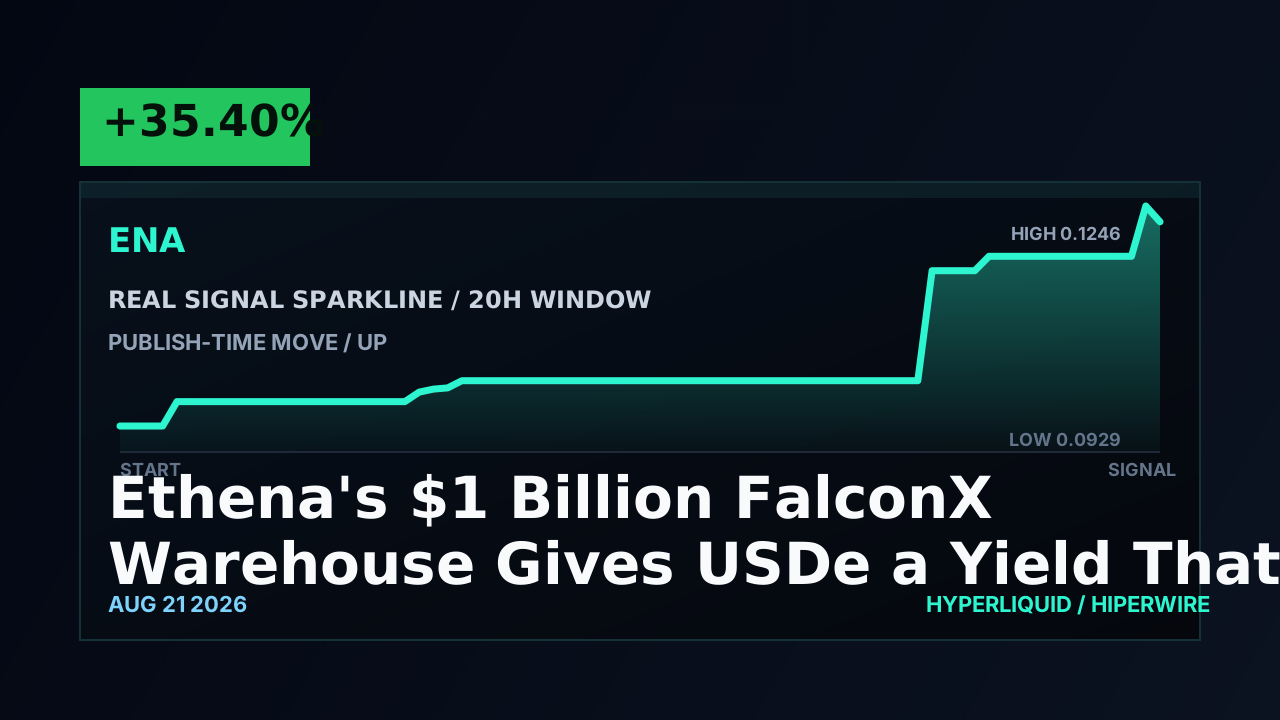
ENA slid nearly 10% over 21 hours to $0.1069, pushing within striking distance of its all-time low at $0.0943. No single catalyst drove the move. Instead, Ethena's governance token is caught in a broader altcoin wipeout that has dragged 38% of active altcoins near their all-time lows and erased $209 billion from the sector since late 2025. Monthly core contributor unlocks continue to drip supply into a market with no appetite for it.
Bitmine Immersion Technologies fell 8% on March 18 as Ethereum dropped 5.6% to $2,199 in a broad pre-FOMC risk-off move. Citigroup's March 17 downgrade of its 12-month ETH target from $4,304 to $3,175 — citing stalled legislation, weaker network activity, and shrinking ETF inflow estimates — set the tone overnight. No company-specific catalyst: BMNR is doing what it always does, amplifying Ethereum's moves through 4.6 million tokens on one balance sheet.
The hyna:ZEC perpetual on Hyperliquid dropped 11.24% to $251 over eight hours while spot Zcash held near $276 on major exchanges. The divergence traces to Hyperliquid's largest ZEC short — wallet 0xd475 — adding roughly $1 million to a $4.78 million position at 5x leverage on the overnight session of March 17-18. Thin HIP-3 liquidity amplified the move, creating a rare ~$25 perp-spot gap on a market doing just $545K in daily volume.
LIT dropped 11.35% over 20 hours to $1.172 on the Hyperliquid HIP-3 perp, reversing most of the 13% bounce that earlier today looked like a potential breakout. The fourth and supposedly strongest rally off the $1.00 floor this month has stalled at the same descending channel resistance near $1.25 that capped every prior attempt. Despite 54% of circulating supply locked in staking, the pattern has not changed: bounce, test resistance, fade.
Plasma's XPL dropped 12.73% on its Hyperliquid HIP-3 perp in six hours, erasing nearly all of a 12.89% pump from March 17. Spot XPL declined only about 4%, confirming this as a perp-specific liquidity event rather than a fundamental breakdown. The March 25 token unlock of 88.89 million XPL, worth roughly $10 million, adds a near-term supply overhang one week out.
FARTCOIN pushed through the $0.2145 level that defined its structure for four months, trading at $0.2162 after four consecutive sessions of testing the resistance. The reclaim coincides with Bitcoin touching $75,912 before pulling back below $75,000 as the derivatives-driven move unwinds. No token-specific catalyst — the question is whether the level holds as support again once the BTC bid fades.
LIT climbed 13.30% over 24 hours to $1.246 on the Hyperliquid HIP-3 perp, extending a 23.5% weekly rally that makes this the strongest of four bounces off the $1.00 psychological support level this month. No single catalyst triggered the move. The driver is structural: more than 54% of circulating LIT supply is now locked in the Lighter Liquidity Pool, up from 44% earlier in March, compressing available float while the broader crypto market rallies 7.2% on the week.
FARTCOIN is up 14.30% over 24 hours to $0.2097, pressing the $0.2145 resistance level for the third consecutive session on daily spot volume of $85 million — nearly half the token's $206 million market cap. Open interest has rebuilt from post-flush $60 million lows and influential traders are highlighting the setup, but no fundamental catalyst has emerged. The move remains a leveraged expression of Bitcoin's hold above $74,000 filtering through oversold Solana memecoins.
Bitcoin's derivatives-driven push past $75,000 on March 17 triggered the strongest altcoin rotation in weeks, with Zcash leading the privacy sector at a 17.9% daily gain. The move extends a 28.5% weekly run backed by ZODL's $25 million raise, Foundry's mining pool announcement, and a record shielded pool, but the $280 resistance that has capped every rally since February held again at $288. The FOMC rate decision on March 18 is the next binary catalyst.
Intel spiked 7.4% intraday on March 16 as traders front-ran an expected Nvidia partnership update at GTC 2026. Jensen Huang's keynote made zero mention of Intel, instead unveiling Nvidia's own Vera CPU and doubling down on vertical integration. INTC gave back all gains and then some, falling to $44.58 as the anticipated x86 collaboration remained conspicuously absent from the biggest AI hardware event of the year.
Zcash saw 127,000 coins leave centralized exchanges over 72 hours ending March 17 while network hashrate hit a record 14.03 Ghash/s. The on-chain accumulation signal arrives as ZEC consolidates at $266 after touching $288, with derivative funding rates still negative despite a 28.5% weekly gain. Shorts have not capitulated, and the supply squeeze from halved issuance, record shielded pool locks, and accelerating exchange outflows has room to extend.
The same 1000PEPE squeeze HIPERWIRE tracked through three legs yesterday is now unwinding. After running from $0.0033 to $0.003982 on a funding-rate-driven short squeeze, the HIP-3 perp stalled at the 50-day moving average near $0.0043 and has retraced to $0.003674 — a nearly 10% pullback that erases roughly half of Sunday's gains. No new catalyst is driving the decline. This is the mechanical outcome the prior coverage flagged: once funding normalized and the short side was flushed, the thin-book dynamics that produced the squeeze had nothing left to give.
FARTCOIN is up 13.31% over 21 hours to $0.2029, driven by whale wallets that have accumulated over 100 million tokens valued at roughly $30 million since late October. The token now leads all Solana memecoins in daily whale capital inflows at $383,000, with open interest climbing $13 million and price breaking above a descending daily trendline while the Fear and Greed Index sits at 18.
Zcash tagged $288 on March 17, its highest price since February 18, as the shielded pool reached a record 5.1 million ZEC locked in privacy-preserving addresses. That represents 31% of circulating supply effectively removed from the liquid float, tightening the supply picture at the same time daily volume has expanded past $600 million. The move that started as a thin-book Hyperliquid perp squeeze has broadened into a full market re-rate backed by three institutional catalysts stacked in the past month.
FARTCOIN is up 13.80% over 18 hours to $0.2037, extending a multi-day bounce that has now carried the token 40% off its early-March lows. The move came as Bitcoin broke above $74,000 for the first time since early February, powered by Strategy's $1.57 billion purchase of 22,337 BTC and a third consecutive week of spot ETF inflows totaling $763 million.
Zcash aggregate open interest across all venues jumped to $466 million on March 17 from a monthly low of $282 million, a 65% expansion that signals the rally has broadened well beyond the thin-book Hyperliquid perp squeeze that started it. ZEC touched $275, its highest since February 18 and a 40% recovery from the $195 double-bottom printed earlier this month. The institutional catalysts from the prior week, ZODL's $25M raise and Foundry's mining pool announcement, are now attracting real positioning rather than just speculative perp flow.
LIT climbed 8.42% over 22 hours to $1.168 on the Hyperliquid HIP-3 perp, marking its third bounce off the $1.00 psychological support level in March alone. No new fundamental catalyst is driving the move. The pattern is mechanical: the token drops into the $1.00-$1.08 zone on thin volume, attracts dip buyers, and rips back toward $1.15-$1.20 before fading again. Derivatives positioning is heavily skewed long at 72% on Binance, and open interest rose 7.44% during the bounce, but the descending channel that has guided LIT since late January remains intact.
Plasma's XPL token jumped 16.53% in 24 hours as the broader crypto market staged its strongest session in five weeks. Bitcoin reclaimed $74,000, the Fear and Greed Index climbed from 16 to 40, and high-beta altcoins ran hardest. XPL's outsized move relative to BTC reflects razor-thin HIP-3 perp liquidity amplifying the same macro catalyst that lifted everything.
XMR jumped 8% in 18 hours to $381.90 after reports that THORChain has integrated Monero for native cross-chain swaps, giving the most delisted large-cap in crypto its first significant decentralized liquidity venue. The move rides a broader risk-on wave with Bitcoin clearing $74,000 on institutional ETF inflows, but XMR's outperformance over BTC points to asset-specific demand layered on top of the macro tailwind.
Zcash's HIP-3 perp on Hyperliquid has extended its rally to 20% over 24 hours, pushing through the $250–$270 resistance corridor that capped every bounce since February. The move started as a TWAP-driven perp squeeze but now has two institutional catalysts behind it: Foundry Digital's announcement of a compliant, institutional-grade Zcash mining pool launching in April, and ZODL's $25 million seed round from Paradigm and a16z closed a week earlier. Spot ZEC remains at a discount to the perp, but the gap is narrowing as the fundamental story catches up to the positioning trade.
XRP punched through $1.47 on a 250% volume spike, extending a four-session breakout above its 2026 descending trendline. The move comes days after Mastercard added Ripple to its 85-company global crypto payments program and the Kurv KXRP ETF began trading on Cboe, giving the technical shift fundamental support for the first time this year.
WTI crude fell from above $102 to $92 on March 16 after the first concrete signs that Strait of Hormuz traffic is resuming. Treasury Secretary Bessent confirmed the U.S. is allowing Iranian tankers through, and the first non-Iranian cargo ship transited the strait on March 15 with its AIS beacon on for the first time since the war began. The selloff layers on top of the IEA's record 400 million barrel strategic reserve release and Trump's push for an allied coalition to escort commercial shipping through the chokepoint.
PUMP bounced 10.62% over 19 hours after Pump.fun launched a tokenized agent buyback feature on March 13 that routes AI agent revenue directly into token purchases and burns. The move comes two days after PUMP hit $0.001995 on persistent team wallet selling, and coincides with weekly platform fees climbing to a four-month high. The perp gained roughly double what spot did, reflecting thin liquidity on the HIP-3 market.
Zcash's HIP-3 perp on Hyperliquid ripped 14.7% in 23 hours after roughly $991,000 in TWAP buy orders stacked through a thin order book, catching net-short whales offside. Spot ZEC moved only about 4% in the same window, putting the perp at a significant premium and pointing squarely at derivatives positioning — not a fundamental re-rate — as the proximate driver. The afterglow of ZODL's $25 million seed round, announced March 9, is providing background bid, but the price action is a Hyperliquid-native story.
Treasury Secretary Scott Bessent told CNBC on March 16 that the US is allowing Iranian oil tankers to pass through the Strait of Hormuz, the first official confirmation that some crude supply is flowing despite the ongoing blockade. The USOIL perp dropped 8.46% in 23 hours as the market began unwinding a portion of the estimated $40-per-barrel geopolitical premium that has accumulated since the US-Israel strikes on Iran began February 28.
WTI crude reversed from $101 back to $93 in a single session after President Trump's call for a seven-nation naval coalition to reopen the Strait of Hormuz drew zero public commitments. The selloff accelerated after White House trade adviser Peter Navarro released a 13-page report claiming Iran's geopolitical risk has inflated oil prices by $5 to $15 per barrel for decades, projecting crude at 'well below $60' once the threat is removed. The reversal came despite a fresh drone strike on the UAE's Fujairah oil port, the clearest signal yet that profit-taking has overtaken supply panic.
WTI crude fell 8% on March 16 as President Trump called on NATO allies, China, Japan, and the UK to form a military coalition to reopen the Strait of Hormuz with warships. No country has publicly committed. The market is discounting a possible end to the strait blockade even as Iran keeps the waterway effectively closed and over 500 tankers remain idle in the Persian Gulf.
Bitmine Immersion Technologies added 61,000 ETH in a single week, pushing total holdings to 4,595,562 tokens — 3.81% of Ethereum's circulating supply — and disclosed that 5,000 of those came directly from the Ethereum Foundation in a $10.2 million OTC transaction. The stock is up roughly 10% as ETH itself recovered above $2,200, amplifying the move through Bitmine's concentrated treasury structure.
FARTCOIN is up nearly 14% over 17 hours to $0.1841, adding to last week's bounce with no token-specific catalyst. The move tracks directly to Bitcoin stabilizing above $70,000 after spot BTC ETFs pulled in $767 million over five consecutive days from March 9 to 13 — the first sustained inflow streak of 2026. With the broader Solana memecoin complex still down over 90% from cycle highs, any sustained Bitcoin bid tends to produce outsized moves in the most beaten-down speculative names.
The same 1000PEPE move flagged twice today as a perp-specific plumbing event just got confirmed by the underlying. Spot PEPE gained roughly 18% over the past 24 hours on $520 million in volume, closing the 12-point perp-spot gap that defined the earlier legs. The HIP-3 perpetual is now up 19.65% over 15 hours to $0.003982, tracking spot rather than diverging from it. No named catalyst has emerged — this appears to be a momentum-driven bid amplified by four months of documented whale accumulation.
The same thin-book squeeze flagged hours ago has widened. 1000PEPE is now up 14.02% over 13 hours on the Hyperliquid HIP-3 perpetual, reaching $0.003799, while spot PEPE has moved roughly 2% over the same window. The divergence is the story — this is a perp-specific event playing out on a shallow order book, not a shift in PEPE's broader market structure.
ADA gained 9% in 23 hours with no ADA-specific catalyst, tracking Bitcoin's recovery from $64,000 to $72,000 after $285 million in cross-market short liquidations. The move reverses part of the selloff documented in the March 10 whale distribution event, when large holders offloaded 260 million ADA into a hostile macro tape. Cardano is outperforming the broader alt complex — most majors gained 2-5% — and the forward-looking bid may be tied to the Midnight mainnet launch scheduled for March 26.
1000PEPE moved up 9.12% over 11 hours to $0.003636, with no identifiable catalyst behind the move. Funding had been running at -0.22% per 8 hours on the HIP-3 perp, a rate that punishes shorts hard enough to force position closure on a thin order book. Open interest expanded to $895K, suggesting fresh positioning rather than a simple unwind.
Bitmine Immersion Technologies dropped 9.6% over 24 hours on no company-specific news, tracking a broader ETH pullback from intraday highs. The stock holds 4.53 million ETH, representing 3.76% of total Ethereum supply, making it the highest-beta ETH equity play available. With Ethereum struggling to sustain gains above $2,100, BMNR's concentrated treasury amplified a roughly 3% crypto move into a near-10% drawdown.
LIT dropped 8.96% over 23 hours to $1.077 on the Hyperliquid HIP-3 perp, fully reversing a 9% bounce from earlier in the week and pushing the token back toward its all-time low. The nearest catalyst is a March 13 governance proposal to move Lighter's decision-making away from traditional DAO structures toward a more centralized model, a shift that could alienate DeFi-native holders at a time when the protocol's credibility is already strained by Justin Sun's unresolved $152 million liquidity withdrawal.
The hyna-deployed IP perpetual on Hyperliquid printed a 52.9% gain in six hours, but ICP spot barely moved. With open interest under $5,000 and daily volume in the low single-digit thousands, the IP perp is one of the thinnest books on the platform. This is a market microstructure event, not a fundamental repricing of Internet Computer.
The hyna:SUI perpetual on Hyperliquid fell 47% in 21 hours, trading at a steep discount to SUI spot near $1.00. The move was driven by a liquidation cascade in an extremely thin HIP-3 market with under $250k in daily volume, not by any fundamental SUI catalyst.
PUMP reversed its recent multi-chain expansion bounce, sliding 8.23% over 22 hours to $0.001995. The sell-off came just a day after the token rallied on speculation that Pump.fun would expand beyond Solana. The proximate pressure: team-linked wallets have now deposited over $14 million worth of PUMP to centralized exchanges since February, directly counteracting the platform's $310 million buyback program.
Rivian unveiled the full R2 lineup at SXSW on March 12, and the market sold the news hard. The launch variant costs $57,990 with spring deliveries, but the $45,000 base model that investors had been pricing in won't ship until late 2027 — an 18-month gap that undercuts the mass-market thesis. RIVN is down 8.6% after running up 11.6% into the event, erasing the entire pre-reveal rally.
USA Rare Earth gave back a chunk of its March rally on no negative news, dropping 8% on volume roughly a fifth of its 30-day average. The pullback comes days before the company reports Q4 earnings, where analysts expect a wider loss than last quarter's already-disappointing miss. The move looks like pre-earnings de-risking compounded by a thin order book — not a change in the fundamental story.
The S&P 500 index fell roughly 1% on March 12 after Iran's new Supreme Leader Mojtaba Khamenei declared the Strait of Hormuz must remain closed, sending Brent crude back toward $100. But on Hyperliquid, the USA500 HIP-3 perp dropped 13.49% to $5,865 — more than thirteen times the underlying move — exposing the thin-book dynamics that define these markets under stress.
LIT climbed 9.2% over 19 hours to $1.117 on the Hyperliquid HIP-3 perp, bouncing from just above its all-time low with no single confirmed catalyst. The timing aligns loosely with Lighter's March 9 Partner Attribution launch, which lets third-party developers build custom trading frontends on Lighter's infrastructure. But the move happened on just $112K in 24-hour volume on this specific perp, making it more a function of thin liquidity than strong directional conviction.
Brent crude pushed back above $100 per barrel on March 12 after Iranian drones struck fuel storage tanks at Oman's Port of Salalah, the key alternative route tankers had been using to avoid the closed Strait of Hormuz. The IEA's record 400-million-barrel reserve release, announced the previous day, failed to hold prices below $90. Goldman Sachs responded by more than doubling its Hormuz disruption assumption from 10 to 21 days.
Brent crude extended above $97 on March 11 after Iran's IRGC claimed direct attacks on three commercial vessels in the Strait of Hormuz and declared that no oil would transit the waterway. The IEA's unanimous 400-million-barrel strategic reserve release, the largest in the agency's history, failed to cap the move. JPMorgan analysts noted that emergency releases peak at 1.4 million barrels per day against a 16 million barrel shortfall from the strait closure.
Henry Hub natural gas reversed its 10% warm-weather pullback in a single session, ripping 8% back above $3.28 per MMBtu as the Strait of Hormuz remains effectively closed to LNG tankers. The geopolitical premium from the ongoing US-Iran conflict is overwhelming seasonal softness, with QatarEnergy's Ras Laffan complex still offline and no restart timeline in sight.
WTI crude bounced 7.6% in five hours on March 11, erasing much of the prior session's 11% collapse. Fresh attacks on commercial vessels near the Strait of Hormuz reminded the market that the IEA's historic 400 million barrel reserve release is arithmetic noise against 16 million barrels per day of blocked supply.
Brent crude rebounded roughly 8% on March 11 after Iran launched what state media called its most intense operation since the war began, three vessels were hit by projectiles near the Strait of Hormuz, and U.S. intelligence reported Iran is now laying mines in the waterway. The bounce erased most of the previous session's 11% crash, which had been driven by Trump's premature de-escalation signals. Even the IEA's announcement of a record 400-million-barrel strategic reserve release failed to cap the move.
Oil snapped back after Iran attacked three commercial vessels attempting to transit the Strait of Hormuz on March 11, confirming the physical blockade is intensifying despite Trump's ceasefire rhetoric the day before. The USOIL perp gained 7.91% in 24 hours as supply disruption risk repriced back into crude. The IEA announced a record 400 million barrel strategic reserve release to stabilize markets, but it capped the rally rather than reversing it.
WTI crude climbed back above $86 on March 11 after three cargo ships were struck by projectiles near the Strait of Hormuz and the U.S. Navy sank 16 Iranian minelayers overnight. The IEA's unanimous decision to release 400 million barrels from strategic reserves — the largest coordinated release in the agency's history — failed to cap the rally. Markets are repricing the Hormuz disruption as a durable supply shock rather than the short-lived event that yesterday's diplomatic signals implied.
WTI crude reclaimed the mid-$80s after Iran's IRGC announced plans to mine the Strait of Hormuz and three cargo ships were struck by projectiles in and near the waterway. The U.S. military responded by destroying 16 Iranian minelaying vessels. The IEA simultaneously approved a record 400-million-barrel emergency reserve release, but fresh evidence of physical supply disruption overwhelmed the bearish signal.
Oracle shares continued higher after Q3 fiscal 2026 results showed the company's best combined revenue and EPS growth in over 15 years, with cloud infrastructure accelerating to 84% year-over-year. Behind the headline beat sits a balance sheet carrying $108 billion in debt rated Baa2 by Moody's — two notches above junk — and $248 billion in off-balance-sheet data center lease obligations, all directed at an AI infrastructure buildout that management says will sustain through fiscal 2027.
CRWV is up 10.48% over 24 hours, trading at $81.76 on Hyperliquid. CoreWeave launched Flexible Capacity Plans on March 10, a new tiered GPU pricing model that directly addresses the market's biggest concern about rigid contract structure, while management presented at the Cantor Global Technology Conference. The move comes after a brutal 26% selloff since the Q4 earnings miss on February 26, and the perp is trading at a notable premium to the underlying equity.
Oracle shares extended their post-earnings move to over 13% on March 11 after JPMorgan upgraded the stock from neutral to overweight with a $210 price target. The upgrade followed fiscal Q3 results that beat on every major line, with cloud infrastructure revenue growing 84% and remaining performance obligations reaching $553 billion. Wall Street's consensus target of $274 implies the stock remains deeply discounted relative to analyst expectations.
The km:RTX perpetual dropped 25.79% over 18 hours to $154.30 while RTX Corporation stock on the NYSE closed at $207.00 on March 10 with no corresponding selloff. This is a liquidity-driven dislocation specific to a thinly-traded HIP-3 market, not a signal about the aerospace and defense conglomerate's fundamentals.
Oracle reported fiscal Q3 2026 results that topped Wall Street expectations on both revenue and earnings, sending shares up roughly 10% in extended trading. Cloud infrastructure revenue hit $4.9 billion, growing 84% year-over-year and accelerating from 68% growth the prior quarter. Management raised fiscal 2027 revenue guidance to $90 billion, backed by $553 billion in remaining performance obligations.
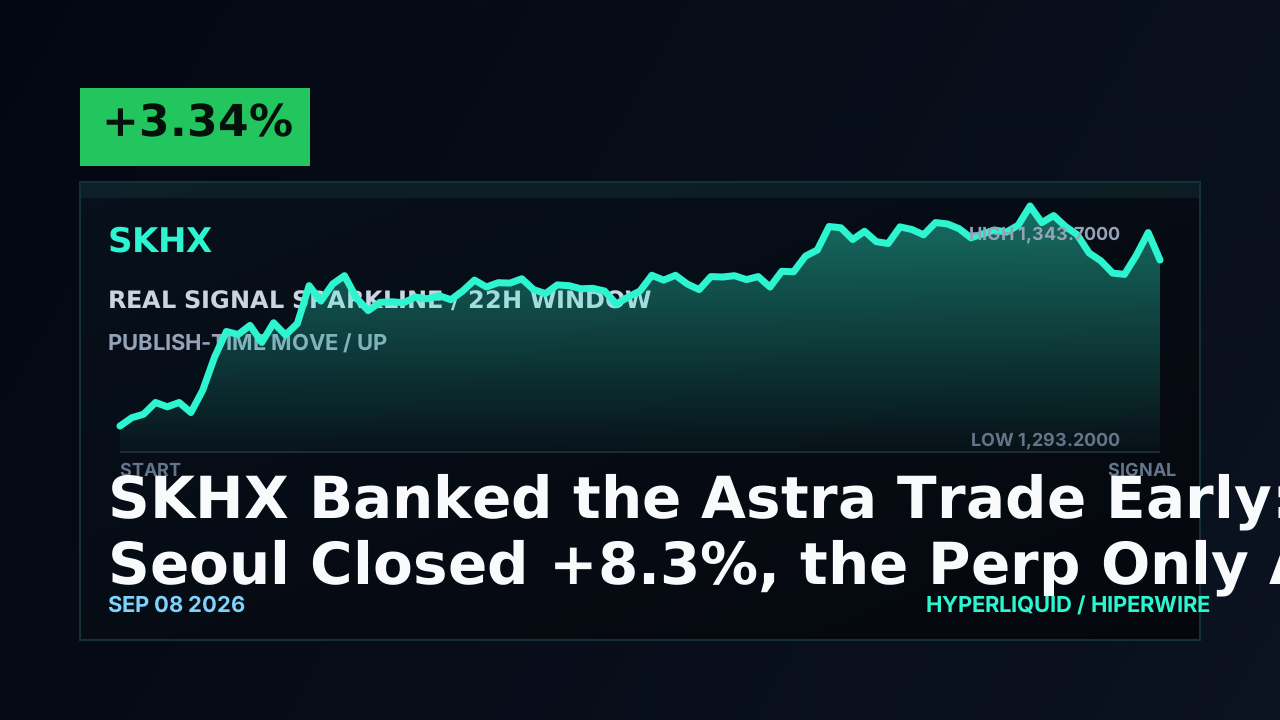
SK hynix gained over 12% on the Korean exchange on March 10 after announcing the world's first 1c LPDDR6 DRAM, a day after reports confirmed the company as the dominant supplier for NVIDIA's Vera Rubin HBM4. The move also catches a broader KOSPI recovery after the index suffered a historic 12% single-day crash last week on Iran war risk-off.
USA Rare Earth added three senior executives on March 9, including a chief legal officer from Freshfields and a policy chief from Siemens Government Technologies, in the clearest signal yet that the company is moving to deploy its $3.1 billion in combined public and private capital. The hires came four days after USAR acquired the remaining minority stake in its Round Top rare earth deposit for $73 million, consolidating full ownership of a project the Department of Commerce is backing with up to $1.6 billion under the CHIPS Act.
Cardano dropped 3.39% in an hour as large holders continued a multi-week distribution pattern that has now totaled 260 million ADA since late February. The selling comes against a hostile macro backdrop — the US-Iran conflict has pushed oil above $90 and triggered a broad crypto risk-off, with Bitcoin's Fear and Greed Index sitting at 18. ADA is now trading below both its 50-day and 100-day EMAs inside a descending channel, with on-chain activity metrics at multi-month lows.
WTI crude rebounded nearly 10% off session lows near $78, part of one of the widest single-day price ranges in crude oil futures history. The March 10 session saw WTI trade from under $80 to $120 and back as the market whipsawed between Strait of Hormuz closure fears and a rapid sequence of diplomatic de-escalation signals, from a UN maritime stability memorandum to Trump floating sanctions relief for oil producers.
Energy Secretary Chris Wright posted on X that the U.S. Navy escorted an oil tanker through the Strait of Hormuz, triggering the sharpest crude selloff since the Iran war began two weeks ago. Brent dropped from nearly $98 to below $80 intraday as the geopolitical risk premium that had built from the mid-$60s unwound in hours. Wright's post was subsequently deleted, and the Energy Department has not clarified the Navy's role.
USA Rare Earth added three senior executives on March 9 — a chief legal officer, a chief global policy officer, and a head of investor relations — signaling that the company is operationalizing its landmark $1.6 billion funding commitment from the Department of Commerce. The hires follow a $73 million all-stock acquisition of Texas Mineral Resources announced March 5, which consolidated 100% ownership of the Round Top heavy rare earth deposit. USAR is up 14.65% over the past 24 hours as the pieces of a fully domestic mine-to-magnet platform visibly come together.
Plasma's XPL token added nearly 12% in 16 hours on no single confirmed catalyst, extending a 27% weekly run that began after bulls absorbed a $10.79 million token unlock on February 25. The move comes on thin Hyperliquid HIP-3 perp liquidity and growing anticipation around Plasma's Q2 2026 network upgrade.
Brent crude gave back a large chunk of its war-driven spike on March 10 after a UN-brokered Memorandum of Maritime Stability committed regional powers to keeping Strait of Hormuz shipping lanes open. President Trump reinforced the reversal by telling CBS the Iran campaign was very complete and running ahead of schedule. The combination triggered algorithmic selling that dragged Brent from near $120 to the low $80s in under 48 hours, unwinding much of the geopolitical risk premium that had built up since late February.
Crude oil gave back weeks of geopolitical gains in a single session after a UN-brokered maritime stability agreement defused the Strait of Hormuz crisis. WTI fell from nearly $120 to under $80 as the war premium that had gripped energy markets since late February evaporated overnight. G7 signals of a coordinated strategic reserve release and an emergency IEA meeting added further downside pressure.
FARTCOIN is up roughly 8% over 18 hours, reclaiming $0.159 after weeks of relentless selling took the Solana-native memecoin down more than 93% from its January 2025 all-time high of $2.48. There is no FARTCOIN-specific catalyst behind the move. The token is riding a broader crypto risk-on bounce triggered by geopolitical relief and deeply oversold conditions across the Solana memecoin complex.
Micron Technology caught a dual analyst upgrade on March 9, with Susquehanna hiking its price target 52% from $345 to $525 and Citi raising to $430. The moves came on rapidly strengthening DRAM and NAND pricing trends, with average selling prices tracking well above January expectations heading into fiscal Q2 earnings on March 18.
SanDisk ripped more than 10% on the back of its upcoming Bloomberg 500 index inclusion, effective March 12. The addition triggers another round of passive buying for a stock that has already gained over 1,000% since spinning out of Western Digital a year ago, and the timing lands squarely in a quarter where the entire memory sector is bid on structural NAND supply shortages and AI-driven demand.
PUMP gained 7.68% over 23 hours as the Pump.fun platform rolled out an update turning its mobile app into a multi-asset trading hub. The March 3 expansion added support for tokens from competing Solana launchpads like Raydium and Meteora, plus bridged assets including WBTC and USDC. Whale accumulation of roughly $4.34 million in PUMP coincided with the update, while the platform's ongoing buyback program continues to compress circulating supply.
Dogecoin snapped back above $0.099 after President Trump signaled the Iran conflict was nearing its end, sparking a risk-on rally across crypto and equities. DOGE had been one of the most beaten-down large-cap tokens heading into March, down over 40% in three weeks with heavy short positioning. The geopolitical shift unwound crowded bearish bets and pushed the token back toward the psychologically significant $0.10 level.
Monero initially showed relative strength as Bitcoin cratered toward $65,000 on escalating Iran-Israel tensions and Trump tariff fears. That resilience just snapped. XMR dropped 15.8% in three hours to $293, punching through the $300 level that had held since early March. Thin exchange liquidity from years of privacy coin delistings likely amplified the move.
Micron Technology is up 13.5% in 24 hours after S&P Dow Jones confirmed the chipmaker's addition to the S&P 100 index, effective March 23. The inclusion triggered a cascade of analyst price target increases, with Stifel setting a new street-high $550 target. The move comes just eight days before Micron reports fiscal Q2 earnings that analysts expect to show 137% year-over-year revenue growth.
Circle Internet Group posted $0.43 EPS against a $0.25 consensus estimate on $770 million in quarterly revenue, up 77% year over year. The stock has nearly doubled off its $50 low in weeks, driven less by a fundamental rerating than by hedge funds scrambling to cover roughly 13% of the float sold short heading into the print. Geopolitical tailwinds from rising oil prices and a higher-for-longer rate outlook add a secondary bid, since Circle earns yield on the reserves backing USDC's $78 billion supply.
WTI crude oil has reversed sharply from its $120 spike, falling more than 12% to $88 as President Trump signaled the Iran war could end very soon and announced plans to waive oil-related sanctions on select countries to boost global supply. The move erases a large chunk of the war premium that built up after Iran effectively shut down the Strait of Hormuz, threatening roughly 20% of global crude shipments. Traders are now repricing the conflict as a short-lived disruption rather than a prolonged supply crisis.
Rivian is up nearly 10% in the last day as the stock extends a post-earnings rally ahead of the March 12 R2 SUV reveal at SXSW. The move follows a 26.7% single-day jump after Q4 results beat expectations and management guided for 62,000 to 67,000 deliveries in 2026, a sharp reversal from three consecutive years of declining production. Deutsche Bank upgraded RIVN to buy, UBS moved from sell to neutral, and the market is now pricing in the possibility that the $45,000 R2 actually ships on time.
Oil's war premium is cracking. The USOIL perp reversed 14.72% in under 24 hours after Trump signaled the Iran conflict could end soon, unwinding much of the historic run driven by the Strait of Hormuz closure. USO swung from an intraday peak near $124 back to $104, testing whether the market overpriced a prolonged supply disruption.
WTI crude has given back nearly all of its Iran-war spike after two rapid-fire policy signals from the White House. President Trump told CBS he is considering a U.S. takeover of the Strait of Hormuz, and on Monday announced temporary sanctions waivers on Russian and Venezuelan oil to boost global supply. Traders liquidated the conflict premium within hours, sending crude from triple digits back to the mid-$80s.
Micron Technology gained over 8% as Citi lifted its price target to $430, memory-sector peers rallied hard, and the Street positioned for what channel checks suggest could be a double-beat quarter on March 18. HBM supply for all of 2026 is already locked under contract, and the Q2 guide points to $18.7 billion in revenue at 68% gross margins.
HYPE jumped 11% after BitMEX founder Arthur Hayes published a $150 price target, arguing Hyperliquid's revenue-to-buyback loop makes it crypto's most aggressive capital return story. The call lands as platform open interest crosses $6 billion and the token absorbs a $316 million contributor unlock without breaking down.
Brent crude spiked to $119.50 as the Iran war shut down tanker traffic through the Strait of Hormuz, then reversed $31 in a single session after President Trump told CBS News he was considering taking over the waterway and declared the conflict essentially over. BRENTOIL on Hyperliquid fell 14.64% as traders liquidated the supply-disruption premium that had pushed crude from $60 to $120 in a matter of days.
SanDisk ripped 15% over 23 hours as the Bloomberg 500 announced it would add SNDK to the index effective March 12, pulling passive fund flows into a stock already riding a structural NAND flash shortage driven by AI data center buildouts. The move also marks a sector-wide bounce after memory stocks sold off nearly 7% on March 3 over energy price fears.
WTI crude swung from a session high near $119 to the mid-$80s on March 9 after Trump told CBS the Iran war ends very soon and announced sanctions waivers plus Navy escorts for Strait of Hormuz tankers. The USOIL perp, which tracks the USO ETF, shed 16% in 24 hours as weeks of supply-disruption pricing unwound in a single session.
WTI crude shed more than 16% in 24 hours after touching a multi-year high near $120. The catalyst was a single interview: President Trump told CBS he is considering having the U.S. military take control of the Strait of Hormuz, the chokepoint through which roughly 20% of global oil flows. Markets immediately stripped out the conflict premium that had built since the U.S.-Israel strikes on Iran began February 28, sending crude back to the mid-$80s.
West Texas Intermediate crude oil collapsed from a session high near $119.50 to below $85 in a single trading day — the sharpest intraday reversal in years. The catalyst was a rapid shift in war sentiment after President Trump told CBS News the conflict in Iran was "very complete, pretty much" and threatened Iran with consequences twenty times harder if it continued blocking the Strait of Hormuz. The war premium that had driven oil up 50% in ten days evaporated in hours.
Circle Internet Group stock has nearly doubled from its February lows after a 72% earnings-per-share beat, and 13% short interest is adding mechanical fuel to the rally. The USDC issuer posted $770 million in Q4 revenue on 77% year-over-year growth, catching hedge funds offsides on the wrong side of a crowded short.
Brent crude gave back its entire war-premium spike in a single session, falling from $119.50 to below $91 after President Trump said the Iran conflict would end very soon and G7 leaders confirmed strategic petroleum reserves were on the table. The 20% intraday reversal produced a $30 round-trip in under 24 hours, one of the largest single-session oil swings in decades.
BRENTOIL dropped 24% in under a day as the market rapidly unwound the war premium that sent crude from $70 to nearly $120 in ten days. Trump's declaration that the Iran operation was very complete, combined with G7 discussions on strategic reserve releases, triggered the sharpest single-session reversal in oil since the 2022 Russia spike. At $86.75, Brent has retraced most of the Strait of Hormuz closure panic — but the strait itself remains closed to commercial traffic.
China's 15th Five-Year Plan draft calls for 110 gigawatts of nuclear capacity by 2030, a 76% increase from the 62 GW online at the end of 2025. The target, disclosed at this week's National People's Congress session, implies roughly 10 GW of annual additions — an unprecedented buildout pace that would require nearly doubling the country's reactor fleet in five years. Nuclear-linked assets moved immediately, with NLR up 7.5% as the market prices in a demand shock across the entire value chain from uranium feedstock to reactor construction.
West Texas Intermediate crude collapsed from near $120 to the low $80s on March 9 after President Trump told CBS the Iran war was 'very complete' and floated a US takeover of the Strait of Hormuz. The remarks triggered an immediate liquidation of the geopolitical risk premium that had built over ten days of conflict, producing the largest single-session percentage drop in crude oil futures on record.
Micron ripped over 13% in the past 24 hours after Citigroup raised its price target from $385 to $430, citing memory prices running hotter than expected. The move came alongside a broad sector rebound in memory names — SanDisk jumped 11.6% and Western Digital gained 6.8% — after last week's selloff that took MU down 5.7%. With Q2 earnings on March 18 and 2026 HBM capacity already fully booked, the setup into the print is getting crowded in the best way.
WTI crude hit $119 a barrel overnight as the Strait of Hormuz remained effectively closed, then fell to the mid-$80s after Trump told CBS the Iran conflict was nearly finished. The single-session reversal stripped weeks of war premium out of crude in a matter of hours, marking the largest intraday oil price swing in recent history.
Intel CFO David Zinsner told the Morgan Stanley TMT Conference that the company is now marketing its 18A manufacturing node to external foundry customers — a strategic reversal from mid-2025 when Intel had shelved those plans. Zinsner said the company is close to closing deals worth billions per year in foundry revenue, with 18A yields running at or ahead of internal targets. INTC jumped 6.1% on March 4 and has continued grinding higher, now up 20% year-to-date.
The SKHX perp bounced 15% in 21 hours as traders buy the dip on South Korea's worst equity crash since 2008. The Iran war drove KOSPI down roughly 20% over four sessions last week, triggering circuit breakers and dragging SK Hynix into the selloff despite fundamentals that remain arguably the strongest in global semis.
SanDisk jumped over 20% as the memory stock rebounded sharply from last week's selloff, powered by confirmation that SNDK will join the Bloomberg 500 index on March 12. The broader memory sector moved in lockstep, with Micron and Western Digital also posting strong gains. Underneath the index catalyst sits a structural NAND shortage that Nomura says won't ease before 2028.
Taiwan Semiconductor bounced sharply off its early-March lows on Monday as the entire chip complex staged a broad recovery from last week's geopolitical selloff. The move coincides with TSMC securing environmental clearance for a new AI-focused mega fab in Tainan and anticipation of the company's February monthly revenue report, due March 10.
URNM ripped more than 10% in 24 hours as the uranium mining sector caught a fresh bid following reports that Japan and the United States are negotiating a nuclear energy project worth up to $100 billion as part of Japan's $550 billion investment package. The deal, which would center on Westinghouse reactors, lands on top of a sector already running hot from the January Section 232 proclamation and tightening physical supply.
WTI crude hit $119.48 in early Monday trading as markets priced in a total supply cutoff from the Iran war. Hours later, Trump told CBS the U.S. is considering taking over the Strait of Hormuz to force shipping lanes open. Traders liquidated the war premium instantly, sending crude to as low as $81 — the largest single-day reversal in oil market history.
Brent crude reversed from a $119 spike to below $90 in a single session after Trump declared the Iran war will end very soon and G7 energy ministers convened to discuss a coordinated release of strategic petroleum reserves. The war premium that took ten days to build unwound in hours as the market repriced the conflict timeline.
Circle Internet Group has doubled off its $50 low, fueled by a decisive Q4 earnings beat, an Iran-driven repricing of rate cut expectations that directly benefits its reserve income model, and growing institutional interest in USDC as the settlement layer for AI agent payments. The 18% move over the last day is the latest leg of an 86% monthly run — the stock's first four-week winning streak since its IPO.
USA Rare Earth gained nearly 10% over the past day as escalating military conflict in Iran refocused investors on the vulnerability of Chinese-dominated rare earth supply chains. The move extends a broader March rally driven by geopolitical risk repricing and a fresh acquisition that consolidates USAR's position as the only U.S.-listed pure-play heavy rare earth developer. With NdPr prices having doubled since January and a Pentagon ban on Chinese-sourced rare earths in defense hardware taking effect in 2027, the strategic premium on domestic supply is compounding.
SK hynix is up double digits on the Hyperliquid perp as the weekend delivered a company-specific catalyst strong enough to cut through the Iran-war panic gripping Korean equities. The Korea Economic Daily reported Saturday that Nvidia has confirmed SK hynix and Samsung as the sole HBM4 suppliers for its next-generation Vera Rubin AI accelerator, with SK hynix taking roughly 70% of the allocation and Micron shut out of the flagship tier entirely. The perp market, trading 24/7, is pricing in the news ahead of Monday's KRX open — and ahead of Nvidia's formal Vera Rubin unveil at GTC on March 16.
WTI crude crashed from a spike high near $119 to the low $80s in a single session after President Trump told CBS the Iran war is essentially over and floated a US takeover of the Strait of Hormuz. The Hyperliquid OIL perp tracked the unwind, falling 22.76% to $87.35 as traders liquidated the conflict bid that had built up since US-Israeli strikes began on February 28.
USENERGY dropped 6.64% on March 9 as the geopolitical risk premium that had been propping up energy names for nearly two weeks began to unwind. President Trump told CBS News the war on Iran was "very complete, pretty much," triggering a 6% intraday collapse in WTI crude from above $100 to a session low near $84. Energy stocks, which had been among the few sectors in the green since the U.S.-Israel strikes began on February 28, reversed hard as traders repriced the conflict's duration.
WTI crude posted the largest single-day dollar swing in history on March 9, whipsawing $38 between a high of $119.48 and a low of $81.19 before settling at $94.77. The morning spike was driven by an 80% drop in Strait of Hormuz shipping traffic and a 3 million barrel-per-day production loss in Iraq's southern oilfields. The afternoon reversal came on two catalysts: reports that G7 nations discussed releasing 300 to 400 million barrels from strategic petroleum reserves, and Trump telling CBS the U.S. is considering taking over the Strait of Hormuz while calling the Iran war very complete.
South Korea's benchmark Kospi triggered its second circuit breaker in four sessions on Monday as oil topped $110 a barrel amid the escalating US-Israel-Iran conflict and near-closure of the Strait of Hormuz. EWY traded as low as $119.55 intraday before reversing sharply, recovering more than 11% from the session low to reclaim $133 after Saudi Aramco moved roughly 4.6 million barrels of crude onto spot markets and Korean retail investors bought an estimated 4.6 trillion won during the panic.
Samsung Electronics bounced sharply off panic lows on March 9 after the KOSPI plunged over 8% intraday, triggering a circuit breaker for the second time in four sessions. The sell-off, driven by escalating US-Israeli airstrikes on Iran and oil topping $100 a barrel, has wiped roughly 25% off the Korean benchmark since late February. Samsung hit an all-time high of 223,000 KRW just ten days ago on the back of its HBM4 deal with NVIDIA — the speed of the reversal and the violence of the bounce suggest the market is still repricing geopolitical risk in real time.
Brent crude retreated from near $120 to the low $90s after President Trump told CBS News the Iran conflict is "very complete, pretty much" and floated the idea of seizing the Strait of Hormuz. The pullback accelerated as G7 finance ministers convened to discuss a coordinated release of up to 400 million barrels from strategic reserves. The Strait remains effectively closed, Iraqi output has collapsed 60%, and the G7 has not yet agreed to act — but the market heard what it wanted to hear.
Crude oil collapsed more than 24% from session highs near $120 after President Trump told CBS News the U.S. is considering seizing control of the Strait of Hormuz. The remark triggered an immediate liquidation of the conflict premium that had built up since Iran effectively closed the waterway following the start of the U.S.-Israel military campaign on February 28. WTI fell from $119.48 to the mid-$80s in a matter of hours, the largest single-day percentage drop in the history of crude oil futures.
WTI crude reversed nearly a quarter of its value in under a day after President Trump told CBS News the U.S. is considering seizing control of the Strait of Hormuz — the chokepoint through which 20% of global oil flows. The statement triggered an immediate unwind of the conflict premium that had driven prices from the mid-$60s to an intraday high of $119.48, as traders repriced the probability that Iranian blockade threats would persist. G7 discussions about a coordinated release of 300 to 400 million barrels of strategic reserves added further weight.
Hyperliquid has become the de facto venue for 24/7 commodity price discovery as the US-Iran conflict enters its second week, and HYPE is the direct beneficiary. Weekend perp volume hit $720 million — an all-time high — led by oil, silver, and gold contracts that traders can't access on traditional exchanges until Monday. The surge in platform fees is accelerating HYPE's buyback-and-burn mechanics, with $9.22 million in tokens removed from circulation in the past seven days alone.
Micron Technology ripped higher after Susquehanna lifted its price target from $345 to $525 and Citi raised to $430, both citing sold-out HBM capacity and surging DRAM pricing into the March 18 quarterly report. The stock had pulled back 15% from its early-February all-time high near $438, and the coordinated upgrade cycle is resetting expectations for what could be a record revenue print.
Brent crude dropped more than 21% in 16 hours on Hyperliquid's BRENTOIL perp, unwinding the geopolitical risk premium that built up during the Strait of Hormuz crisis. The selloff accelerated after President Trump told CBS the military operation against Iran was very complete and ahead of schedule, while G7 leaders confirmed strategic petroleum reserve releases were under active discussion.
Sandisk is ripping into the Bloomberg 500 index reconstitution date. The March 12 effective date is pulling passive fund demand forward, compounding a broader tech rebound from the energy-scare selloff that hit memory names on March 3. Underneath the index mechanics, the fundamental story keeps getting stronger — NAND undersupply now extends through 2028, and Sandisk just guided Q3 revenue at $4.4–4.8 billion, implying 45–58% sequential growth off an already record quarter.
Crude gave back its entire Strait of Hormuz war premium on March 9 after G7 finance ministers announced an emergency meeting to discuss releasing 300 to 400 million barrels from strategic petroleum reserves. WTI reversed from session highs near $118 to trade below $96, erasing over a week of conflict-driven gains in a single session. The proposed release would be the largest coordinated intervention in oil markets since the 2022 Russia-Ukraine response.
WTI crude gave back a massive chunk of its war premium after G7 finance ministers signaled readiness for a coordinated strategic petroleum reserve release of up to 400 million barrels. The reversal marks the first real pushback against the 50% spike built since the US-Israel strikes on Iran and the closure of the Strait of Hormuz.
Crude oil's historic 30% spike on the Strait of Hormuz closure reversed almost entirely within 17 hours, with CL dropping from $115 to $87. G7 finance ministers floated a coordinated release of up to 400 million barrels from strategic reserves, and the market front-ran the headline before anyone agreed to release a single barrel.
Henry Hub natural gas fell sharply over a 13-hour window, dropping 10.34% to $3.153 per MMBtu as updated weather forecasts called for above-average temperatures across the eastern U.S. through mid-March. The selloff comes after a strong run from the $3.13 swing low to $3.67, and represents a broader seasonal unwind as the market prices in fading winter heating demand and rising domestic production.
SanDisk reclaimed 13.6% in 12 hours after last week's 17% drawdown that swept through global memory stocks on Iran-war energy fears. The selloff logic centered on oil disruptions compressing margins at Korean fabs, but SNDK manufactures through Kioxia's joint venture in Japan — a distinction the market is starting to price in ahead of Wednesday's Cantor conference.
Zcash bounced 8% over 19 hours after touching multi-week lows near $197, riding a broader crypto relief rally led by Bitcoin's climb back above $67,000. The move comes as ZEC's shielded pool holds near 30% of circulating supply — up from 11% a year ago — tightening available float and giving the oversold bounce more room to work. Dash's integration of Zcash's Orchard privacy pool into its Evolution chain, expected to go live this month after completing security audits, adds a near-term technical catalyst.
The SEMI basket on Hyperliquid has dropped nearly 39% as the escalating US-Israel-Iran conflict sends oil past $100 a barrel, shuts down the Strait of Hormuz, and triggers the worst KOSPI crash since 2008. Draft AI chip export controls and a dismal US jobs report have compounded the damage, hitting the semiconductor sector from every direction simultaneously.
WTI crude oil ripped past $100 a barrel for the first time since 2022 as the US-Iran war effectively shut down the Strait of Hormuz, the chokepoint through which roughly 20% of the world's daily oil supply flows. Gulf producers including Iraq, Kuwait, and the UAE are already cutting output as onshore storage fills up with nowhere to export. CL, the Hyperliquid perp tracking WTI, jumped 12.63% over 20 hours to $104.80 as the crisis deepened over the weekend.
WTI crude ripped 19% after Israel struck 30 Iranian fuel depots overnight, the first direct targeting of oil infrastructure since the US-Israel war on Iran began nine days ago. The move pushed WTI above $100 for the first time since 2022 and capped the largest weekly gain in crude oil futures history. With the Strait of Hormuz effectively closed and Gulf producers now cutting output as onshore storage fills, the supply side of the oil market is in genuine crisis.
SEMI, a basket tracking roughly 30 U.S.-listed semiconductor companies, dropped 19% in seven hours as the Strait of Hormuz crisis entered its second week with no sign of resolution. Iran's closure of the strait and the drone strike on Qatar's Ras Laffan LNG complex have cut off a critical energy artery for the chip fabs in Taiwan and South Korea that produce the vast majority of the world's advanced semiconductors.
Plasma's XPL token dropped 9.32% over 24 hours to $0.0963, erasing the bounce that followed its late-February token unlock. The move comes amid a brutal altcoin rout triggered by macro fears — Trump tariff uncertainty, geopolitical escalation, and a Bitcoin slide toward $63,000 have pushed the crypto Fear and Greed Index to 10, deep into Extreme Fear territory. With BTC dominance near 58% and the Altcoin Season Index at just 19, capital is fleeing high-beta names like XPL for perceived safety in Bitcoin.
NATGAS ripped nearly 10% in 24 hours after Iranian drone strikes forced QatarEnergy to halt production at the world's largest LNG export complex. The shutdown pulled roughly one-fifth of global LNG supply offline, and traffic through the Strait of Hormuz has collapsed 86%, compounding the disruption. Henry Hub reclaimed $3 despite warm domestic weather as the geopolitical premium overwhelmed bearish fundamentals.
Crude oil just posted its sharpest weekly gain in over two years after Operation Epic Fury — the coordinated US-Israeli strikes on Iran launched February 28 — effectively closed the Strait of Hormuz to commercial traffic. WTI breached $90 for the first time since 2023, and Brent briefly topped $94. The chokepoint handles roughly one-fifth of global oil supply, and tanker transits have collapsed from 24 per day to near zero in under a week.
WTI crude oil ripped above $90 per barrel for the first time since 2023 as the Strait of Hormuz remains effectively closed following the US-Israel strikes on Iran. With roughly 20 million barrels per day of seaborne oil normally transiting the chokepoint, the shutdown has triggered the biggest weekly gain in crude futures history. Iraq has shut down 1.5 million barrels per day of production and Kuwait is cutting output after running out of storage, turning what started as a geopolitical risk premium into a tangible supply crisis.
XPL dropped 15.57% over 24 hours as the broader crypto market extended its tariff-driven selloff, with Bitcoin sliding toward $64,000 and altcoins bearing the worst of the damage. Plasma's high beta to BTC and thin perp liquidity amplified the move, while an approaching $10 million token unlock on March 25 adds supply pressure to an already fragile tape.
Iranian drone strikes forced QatarEnergy to shutter the world's largest LNG export facility at Ras Laffan Industrial City, knocking roughly 20% of global liquefied natural gas supply offline overnight. QatarEnergy declared force majeure on deliveries to affected buyers. European benchmark gas prices jumped nearly 50%, Asian LNG cargoes spiked 39%, and Henry Hub followed the global bid higher, reclaiming the $3 handle after weeks of weather-driven softness.
The SPACEX perpetual contract on Hyperliquid fell 8% over 24 hours to $1,711, implying a total company valuation of roughly $1.71 trillion. The pullback follows a week of intensifying skepticism around SpaceX's reported $1.75 trillion IPO target, with analysts at PitchBook and Bloomberg putting concrete numbers to the extreme multiples required to justify it. A Starship V3 booster anomaly during ground testing on March 2 added execution risk to the narrative.
LIT dropped 8.62% in 24 hours to $1.125 as a market-wide risk-off wave hit altcoins particularly hard, compounding a longer structural decline that has seen the token lose roughly half its value since its late-December launch. With Bitcoin falling below $71,000 and the Fear & Greed Index sitting at 18, LIGHTER's thin liquidity profile and ongoing market share erosion made it especially vulnerable.
Micron has dropped over 9% in 20 hours as Iran's closure of the Strait of Hormuz triggered a historic selloff in Korean memory stocks, with SK Hynix falling 9.6% and Samsung losing 11.7% in a single session. A worse-than-expected February jobs report compounded the damage, and the combination of spiking energy costs for semiconductor fabs and mounting recession fears has put the entire memory complex under pressure heading into Micron's March 18 earnings.
SanDisk shed 9% over 15 hours to trade at $523.70, caught in a violent sector-wide selloff after the worst single-day crash in KOSPI history sent shockwaves through global memory stocks. The trigger: Iran's disruption of the Strait of Hormuz and the resulting spike in LNG prices, which directly threaten the operating costs of the South Korean fabs that produce most of the world's NAND flash.
Plasma's XPL token has dropped 19% over the past 20 hours on its Hyperliquid perpetual market, falling to $0.099 and erasing the rally that followed the February 27 token unlock. The reversal comes amid persistent macro weakness across crypto, with Bitcoin near $68,000 and the Fear and Greed Index sitting at 18 in extreme fear territory.
USA Rare Earth slid 10% over 14 hours to $17.47, caught between dilution concerns from its $73 million all-stock acquisition of Texas Mineral Resources and a brutal broader sell-off driven by the escalating Iran conflict. The move erases the early-March bounce that geopolitical tailwinds had briefly provided.
Brent crude tore nearly 10% higher over the past 20 hours, pushing past $91 a barrel on Hyperliquid as the U.S.-Iran military conflict choked off traffic through the Strait of Hormuz. The strait handles roughly one-fifth of the world's oil supply, and daily vessel traffic has collapsed from 138 ships to single digits, triggering the sharpest supply shock since the 2020 pandemic demand crash.
Pump.fun's native token PUMP slid 10.48% over 12 hours to $0.001863, with 24-hour trading volume falling 23.8% alongside the price. The sell-off comes as traders position ahead of a March 14 vesting release worth roughly $19 million while the platform continues to hemorrhage market share to rival LetsBonk.fun.
ENA is down nearly 10% over the past day, trading at $0.1055 after Ethena's largest token unlock in months dropped 171.88 million tokens into an already fragile market. The sell-off compounds weeks of whale distribution and extreme fear across crypto, leaving Ethena squeezed between strong protocol fundamentals and relentless supply-side pressure.
USOIL ripped 15.25% in just 17 hours on Hyperliquid, pushing past $109 as the U.S.-Iran war enters its most dangerous phase yet. The catalyst is straightforward and severe: the Strait of Hormuz is effectively closed to commercial shipping, roughly 200 tankers are stranded in the Persian Gulf, and President Trump just demanded unconditional surrender from Iran, killing any hope of a quick resolution.
OIL is up 15.39% over the last 17 hours on Hyperliquid, trading at $89.52 as the escalating war between the US-Israel coalition and Iran has effectively shut down the Strait of Hormuz, the single most important oil chokepoint on the planet. Roughly 20% of global oil consumption passes through that strait every day, and right now almost nothing is getting through.
CL, the WTI crude oil perpetual on Hyperliquid, surged 15.20% over 17 hours to $90.65 as the U.S.-Iran conflict effectively shut the Strait of Hormuz, the chokepoint handling roughly 20% of global oil supply. This is the sharpest weekly oil rally since 2020, and Hyperliquid's CL perp is seeing record volume as traders pile into the macro trade.
Plasma's XPL token fell 13.82% over 24 hours to $0.1065 as a broad crypto market rout — driven by geopolitical shocks, a massive options expiry, and resuming ETF outflows — hit low-liquidity altcoins hardest. XPL's shallow order books turned a marketwide downdraft into an outsized single-day loss.
The SPACEX perpetual on Hyperliquid surged 11.11% over 17 hours to $1,879, implying a $1.879 trillion total company valuation. The move came as a cascade of IPO-related developments hit in rapid succession: Bloomberg reported Citigroup joining the underwriting syndicate, X and xAI cleared $17.5 billion in debt from the balance sheet, and Forge Global secondary shares repriced to $595.51 implying a $1.41 trillion valuation.
SK Hynix dropped 10.75% over 14 hours on Hyperliquid as the KOSPI suffered its worst two-day crash since 2008, driven by US-Israel strikes on Iran and Tehran's threats to shut the Strait of Hormuz. The selloff exposed a critical vulnerability for Korean chipmakers that import 97% of their energy through those contested waters.
Samsung Electronics plunged 11.7% on March 4 as the KOSPI index suffered its worst single-day crash in history — a 12.06% collapse that eclipsed even the September 11, 2001 selloff. The catalyst: an escalating US-Israeli military campaign against Iran and fears that the Strait of Hormuz, the chokepoint for one-fifth of global oil supply, could shut down entirely. On Hyperliquid, the SMSN perp is down 9.73% over the past 22 hours, currently trading at $123.
Zcash dropped 8.27% over 22 hours to $229.20 after getting slapped back from the $250 level during the broader crypto market's post-breakout cooldown. The rejection is the latest chapter in ZEC's struggle to reclaim meaningful resistance zones — and traders who chased the March 4 rally are now underwater.
FARTCOIN is trading at $0.1667, down 8.65% in just nine hours and 26% over the past week. The Solana-based meme coin is getting dragged through the wreckage of a broader crypto selloff sparked by the U.S.-Israel military strikes on Iran — and leveraged long holders are paying the price.
CRWV is down 8.15% over the past 24 hours, trading at $73.67 on Hyperliquid. The GPU cloud infrastructure company continues to hemorrhage value — now down roughly 26% over five trading days — as the market digests a toxic cocktail of ballooning capital spending, wider-than-expected losses, and an approaching securities fraud deadline.
The iShares MSCI South Korea ETF dropped over 10% in 22 hours on Hyperliquid after South Korea's KOSPI benchmark posted its worst single-day crash in history — a 12% plunge driven by Iran's drone strike on Qatar's Ras Laffan LNG complex and the cascading energy crisis that followed. At $125.10 on Hyperliquid's perp market, EWY is reflecting a market that just watched a fifth of the world's LNG supply go offline in a region it depends on for survival.
1000PEPE slid 9.04% over 21 hours on Hyperliquid, falling to $0.003422 while Bitcoin rallied past $72,000 on the same day. The move is a textbook case of the rotation that has defined 2026 so far: capital fleeing high-beta memecoins and consolidating into BTC, which now commands nearly 58% of total crypto market cap.
Dogecoin dropped nearly 10% over the past 22 hours on the Hyperliquid hyna:DOGE perpetual, sliding from $0.1034 to $0.0934. The move comes as a convergence of macro risk-off sentiment, aggressive whale selling, and sector-wide meme coin weakness dragged DOGE toward its critical $0.088 support — a level that, if broken, could open the door to sub-$0.08 prices for the first time since early 2024.
FARTCOIN ripped 8.14% over the past 24 hours to $0.1822, riding a broad crypto rally sparked by Middle East geopolitical tensions that pushed Bitcoin toward $74,000. The Solana-native meme coin joined a sector-wide rotation where Dogecoin led the top 100 with a 15% surge, PEPE added 8.8%, and BONK gained 7.5%. No FARTCOIN-specific catalyst here — this is pure high-beta meme coin behavior catching a macro tailwind.
The ANTHROPIC perpetual on Hyperliquid surged 13.92% in the past 24 hours to $627 — implying a $627 billion total company valuation — after reports confirmed Anthropic's annualized revenue run rate blew past $19 billion, more than doubling from $9 billion at the end of 2025. The catalyst is clear: Anthropic is printing revenue faster than almost any enterprise software company in history, and the market is repricing accordingly.
XMR ripped 8% in under a day to $374.60, smashing through the $340–$360 resistance band that had capped it for weeks. The catalyst: a broad crypto risk-on move sparked by Iran-US peace talk headlines, layered on top of a privacy coin narrative that has been quietly building all quarter.
Coinbase stock ripped as much as 15% on March 4 after President Trump publicly sided with the crypto industry in its high-stakes fight with banks over stablecoin yield legislation. COIN broke back above $200 for the first time since late January, dragging the entire crypto-equity complex higher alongside a Bitcoin rally above $73,000.
Hyundai Motor ripped 10% higher on its Hyperliquid perp market as South Korean equities staged their biggest single-day rebound in history. The move was pure mean reversion — bargain hunters piled into a market that had just suffered an 18% two-day wipeout triggered by the Iran–Strait of Hormuz crisis and an oil price shock that hit Korea's import-dependent economy squarely in the jaw.
EWY ripped 9.26% over 21 hours on Hyperliquid, tracking what turned out to be the largest single-day point gain in KOSPI history. The KOSPI surged 9.63% on March 5, closing at 5,583.90 — just one day after crashing 12.1% in what the Korean press is calling Black Wednesday. South Korean retail investors — the so-called Donghak Ants — showed up in force to buy the dip while foreign institutions kept dumping.
Micron Technology (MU) ripped 8.89% over 21 hours on Hyperliquid perps, recovering nearly all of a brutal geopolitics-driven sell-off from the prior session. The bounce came as Iran signaled willingness to negotiate a quick end to the U.S.-Israel conflict, reversing the fear trade that had cratered semiconductor stocks — and it didn't hurt that Micron dropped a landmark AI memory product announcement right into the chaos.
SNDK surged 11.48% over 19 hours on Hyperliquid, pushing to $612.40 after a violent two-day whipsaw driven by fears — and then the dismissal — of NVIDIA's rumored SRAM-based inference chips threatening NAND flash demand. The move overshot the ~6% spot recovery on March 4, with leverage amplifying the bounce on thin perp order books.
Zcash ripped nearly 10% in under 20 hours on Hyperliquid, pushing to $240 as two catalysts landed simultaneously: Binance opened a new ZEC/U spot trading pair with zero maker fees, and a broader crypto rally driven by Bitcoin surging past $74,000 on massive ETF inflows gave privacy coins a fresh bid.
Dogecoin ripped 8.99% over the past 24 hours to $0.0978, riding the sharpest single-day crypto rally in weeks. The catalyst wasn't a Doge-specific event — it was geopolitics. Reports that Iran had reached out to the CIA to discuss ceasefire terms sent Bitcoin above $71,000 and dragged the entire altcoin complex higher, with memecoins like DOGE catching an outsized bid from returning risk appetite.
SMSN — the Hyperliquid perp tracking Samsung Electronics' KRW-denominated stock converted to USD — ripped 9.91% over 17 hours to $131.40. The move is a textbook dead-cat-bounce-or-recovery trade after Samsung shed roughly 20% across two sessions in the worst KOSPI crash on record.
SK Hynix (SKHX) ripped nearly 10% higher on March 5, snapping back from the worst two-day rout in KOSPI history. The catalyst is straightforward: an overnight US equity rally took the edge off Middle East panic, and institutional buyers piled back into the most-shorted Korean semiconductor names. At $646.70 on Hyperliquid's HIP-3 perp, SKHX is still well below last week's highs — but the bounce is real.
The ANTHROPIC perp on Hyperliquid ripped 19.15% in 24 hours to $613.90, implying a total company valuation of roughly $614 billion — a staggering premium to the $380 billion Series G closed just weeks ago. Three converging catalysts hit at once: a revenue run rate approaching $20 billion, a high-profile talent poach from OpenAI, and a Pentagon standoff that paradoxically boosted the company's brand.
CRCL surged 13.5% in 24 hours, touching a 52-week high of $103.71 as an unlikely catalyst — U.S. and Israeli airstrikes on Iran — turned Circle's stablecoin treasury into one of the market's most direct bets on higher-for-longer interest rates. The move caps a stunning run that's seen Circle stock rally over 60% in five days off the back of blowout Q4 earnings.