Diplomatic Deal and Trump's 'War Complete' Comments Drain the Hormuz Premium from Crude
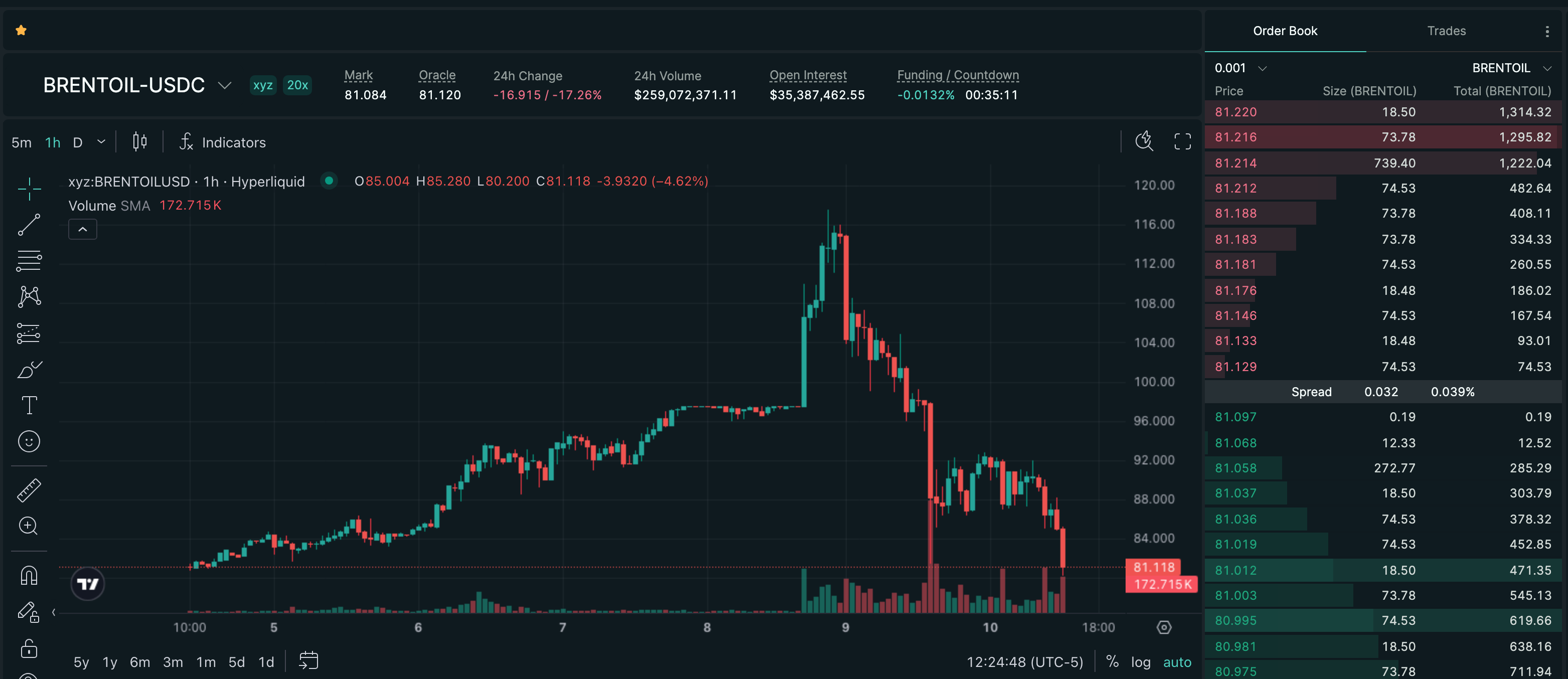
Brent crude gave back a large chunk of its war-driven spike on March 10 after a UN-brokered Memorandum of Maritime Stability committed regional powers to keeping Strait of Hormuz shipping lanes open. President Trump reinforced the reversal by telling CBS the Iran campaign was very complete and running ahead of schedule. The combination triggered algorithmic selling that dragged Brent from near $120 to the low $80s in under 48 hours, unwinding much of the geopolitical risk premium that had built up since late February.
Mover Brief
The Catalyst: A $30 Round Trip
Brent crude completed one of the most violent reversals in recent commodity history on March 10. After touching $119.50 on March 9 — its highest level since mid-2022 — the benchmark collapsed back toward $81, erasing most of the war premium in a single session.
Two events converged. First, the United Nations and a coalition of neutral regional mediators announced a Memorandum of Maritime Stability late Monday evening, securing commitments to reopen Strait of Hormuz shipping lanes. Second, Trump told CBS News the Iran operation was "very complete, pretty much" and running "well ahead of its initial four- to five-week timeline." Markets read both signals as confirmation that the supply disruption was peaking, and algorithmic selling cascaded through the session.
The result was a roughly $30 round trip on Brent in under 48 hours — from pre-spike levels near $60, up to $119, and now back below $90. WTI followed the same arc, settling around $82-86.
How the Hormuz Shock Built the Premium
The war premium that just evaporated had built rapidly. After U.S.-Israeli strikes on Iran in late February — including operations that effectively destroyed Iran's navy and air force — Tehran's remaining leverage was geographic: the Strait of Hormuz, a narrow chokepoint through which roughly 20% of the world's petroleum transits daily.
Iran threatened to attack any tanker transiting the strait, and by early March traffic had slowed to a near-standstill. The disruption was immediate and severe. CNN called it "the biggest oil disruption in history" as Brent blew through $100 and kept running. Trading desks were pricing $150 scenarios by March 8. Gasoline prices nationally hit $3.49, up more than $0.50 since the conflict began.
The Supply Response
The diplomatic breakthrough did not arrive in a vacuum. Saudi Aramco had already signaled it could reroute up to 5 million barrels per day through its East-West pipeline to Red Sea terminals, bypassing Hormuz entirely. The kingdom reportedly had 150 million barrels of storage available according to JP Morgan estimates, giving Aramco a buffer its neighbors lacked.
Meanwhile, the IEA was coordinating a strategic petroleum reserves release among G7 nations, though India notably opted out. The UAE's pipeline to the port of Fujairah added another 3.5 to 5.5 million bpd of alternative export capacity. Together, these supply-side assurances gave the diplomatic signal enough credibility to break the panic bid.
What to Watch
The war premium is largely drained, but crude at $81 is still well above the ~$60 level where Brent traded before the Iran conflict began. That residual premium reflects real uncertainty: Trump's messaging has been contradictory, telling CBS the operation was nearly complete while later promising Republicans the U.S. would fight until Iran was "totally, decisively defeated".
The Memorandum of Maritime Stability is a commitment, not a guarantee. If Hormuz shipping actually resumes at pre-crisis volumes, Brent probably drifts back toward the $60-70 range where fundamentals justify it. If the ceasefire framework breaks down or Iran retaliates asymmetrically, the war premium reprices overnight. The $30 move in both directions proves how thin the liquidity is and how fast this market can reprice geopolitical risk.
Sources & Provenance
Citations below are preserved as structured Postgres source rows for this brief.
Citations Preserved
7
Reference links carried forward from the published mover record.
Original Signal
Open source tweetMarket Route
Direct route preserved for readers who want to inspect the tracked Hyperliquid market behind this archive entry.
Already onboarded? Open tracked market- 1CNBC: Oil falls more than 10% on emergency reserves anticipationcnbc.com
- 2NBC News: Oil prices fall and stocks rise in dramatic reversalnbcnews.com
- 3MarketMinute: Oil Prices Crater as Diplomatic Breakthrough Defangs Hormuz Shockmarkets.financialcontent.com
- 4OilPrice.com: Brent Falls Below $90 as Trump Signals War May Endoilprice.com
- 5Al Jazeera: Shutdown of Hormuz Strait raises fears of soaring oil pricesaljazeera.com
- 6AGBI: How Aramco can keep oil flowing during Iran conflictagbi.com
- 7Energy Update: India Opts Out of IEA Strategic Oil Reserves Releaseenergyupdate.com.pk
This content is for informational purposes only and does not constitute financial advice. Trading perpetual futures involves substantial risk of loss.
Trade BRENTOIL on Hyperliquid
Use referral code HIPERWIRE for 4% off trading fees on your first $25M in volume.
Live Market Metrics
Monitor real-time open interest and funding for BRENTOIL.