Brent Pulls Back 20% From Spike as Trump Signals Iran War Winding Down
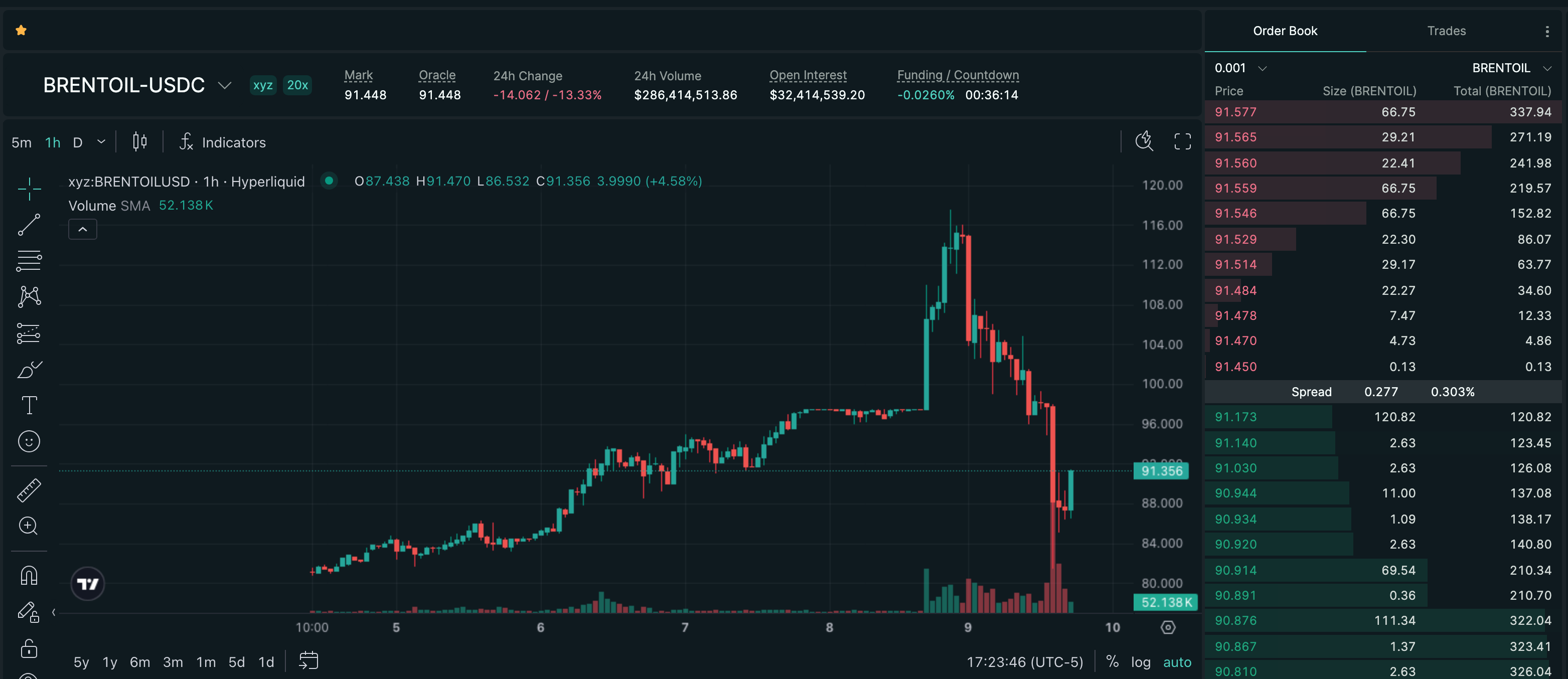
Brent crude retreated from near $120 to the low $90s after President Trump told CBS News the Iran conflict is "very complete, pretty much" and floated the idea of seizing the Strait of Hormuz. The pullback accelerated as G7 finance ministers convened to discuss a coordinated release of up to 400 million barrels from strategic reserves. The Strait remains effectively closed, Iraqi output has collapsed 60%, and the G7 has not yet agreed to act — but the market heard what it wanted to hear.
Mover Brief
The Reversal
Brent crude futures hit $119.50 early Monday — up nearly 30% on the session — as the Strait of Hormuz crisis entered its second week with commercial shipping at a near-total standstill. Then two headlines landed in quick succession and the bid evaporated.
First, the Financial Times reported that G7 finance ministers would hold a call to discuss coordinating an emergency oil reserve release through the IEA, with three member states — including the U.S. — already supporting the move. U.S. officials were reportedly scoping a release of 300 to 400 million barrels, roughly a quarter to a third of the IEA system's public stocks.
Second, Trump told CBS News that ships are moving through the Strait, that he is "thinking about taking it over," and that the war is "very complete, pretty much." Brent settled around $99, then cratered another 9.5% in extended trading to roughly $89.
What the Strait Actually Looks Like
The rhetoric moved faster than the tankers. Maritime intelligence from Windward recorded just two outbound Iranian-flagged vessels transiting on March 8 and zero inbound crossings — the lowest traffic of the entire conflict. That is down from a pre-crisis baseline of 153+ daily transits, meaning the waterway that carries roughly 20% of the world's oil is operating at about 1% capacity.
One dark transit was detected: a commercial tanker carrying approximately one million barrels switched off its AIS transponder around March 4 and reappeared on March 9, suggesting a small number of operators are running blackout passages to capture extreme freight premiums. Cape of Good Hope transits have surged 89% as shippers reroute around the Middle East entirely.
China is especially exposed. CSIS notes that 40% of China's crude and 30% of its LNG comes through Hormuz, with 55 Chinese-flagged vessels trapped inside the Persian Gulf. Beijing has publicly called for keeping the strait open but received no special treatment from Tehran.
The Supply Picture Is Still Broken
Even if the diplomatic mood music is turning, the physical supply deficit is real. Iraq — OPEC's second-largest producer — has seen output from its three main southern oilfields fall 70% to 1.3 million barrels per day. Gulf Arab producers are cutting production not by choice but because they are running out of storage, unable to export through the strait.
OPEC+ agreed on March 1 to add 206,000 barrels per day in April, but that is a rounding error against a disruption affecting roughly 20 million barrels per day of flow. The G7 reserve discussion, while real, produced no agreement — France's Roland Lescure said the group was "not there yet" on a deal.
What This Pullback Means
The 20% drawdown from the spike high is a classic pattern: the market priced in a worst-case disruption, then de-escalation rhetoric — even unconfirmed — triggered a violent unwind of speculative longs. Trump's "very complete" framing gave leveraged traders an excuse to take profits.
But Brent at $91 still prices in a massive supply premium over the pre-crisis ~$60 level. If the Strait actually reopens and Iraqi production recovers, there is significant downside left. If the ceasefire talk proves premature and Hormuz stays shut, the $120 spike was just the opening move. The next real catalyst is whether G7 reserve releases materialize and whether tanker traffic actually resumes — not what any head of state says on television.
Sources & Provenance
Citations below are preserved as structured Postgres source rows for this brief.
Citations Preserved
7
Reference links carried forward from the published mover record.
Original Signal
Open source tweetMarket Route
Direct route preserved for readers who want to inspect the tracked Hyperliquid market behind this archive entry.
Already onboarded? Open tracked market- 1CSIS: No One, Not Even Beijing, Is Getting Through the Strait of Hormuzcsis.org
- 2CNBC: Oil prices decline after nearly hitting $120 as Trump discusses Strait of Hormuzcnbc.com
- 3CNBC: G7 energy ministers to meet to discuss release of oil reservescnbc.com
- 4CoinDesk: Oil pulls back from 25% spike as G7 discusses emergency reserve releasecoindesk.com
- 5Windward: March 9 Iran War Maritime Intelligence Dailywindward.ai
- 6CNBC: OPEC+ to raise oil output slightly even as Iran war disrupts shipmentscnbc.com
- 7TVP World: G7 holds off on tapping oil reserves amid Middle East wartvpworld.com
This content is for informational purposes only and does not constitute financial advice. Trading perpetual futures involves substantial risk of loss.
Trade BRENTOIL on Hyperliquid
Use referral code HIPERWIRE for 4% off trading fees on your first $25M in volume.
Live Market Metrics
Monitor real-time open interest and funding for BRENTOIL.