Brent Holds $100 as Ukrainian Drones Knock Out 40% of Russia's Oil Exports
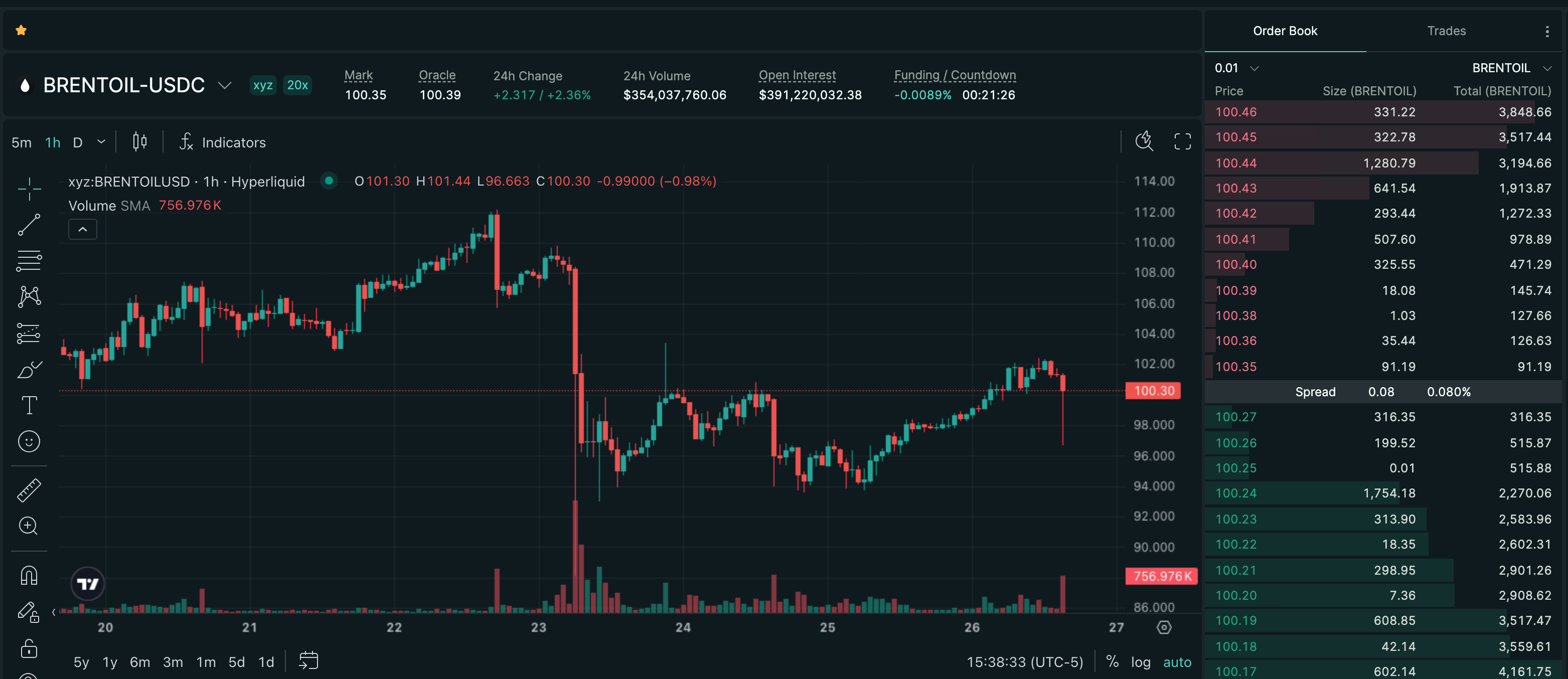
Brent crude recovered above $100 as a second supply shock compounded the ongoing Strait of Hormuz crisis. Ukrainian drone strikes have disabled roughly 40% of Russia's oil export capacity — about 2 million barrels per day — in what Reuters called the most severe Russian oil disruption in modern history. The twin supply squeeze is colliding with a bearish EIA inventory build of 6.9 million barrels, capping the move.
Mover Brief
Russia's Export Collapse
Ukrainian drone strikes have knocked out approximately 40% of Russia's oil export capacity — roughly 2 million barrels per day — according to Reuters calculations published Wednesday. Reuters called it the "most severe oil supply disruption" in modern Russian history.
The damage spans Russia's entire western export network. Loadings at Primorsk and Ust-Luga, Russia's two largest Baltic Sea terminals, were suspended again this week after a second round of drone attacks triggered fires at port infrastructure. In the Black Sea, Novorossiysk — with capacity of around 700,000 barrels per day — is running behind its loading schedule from earlier strikes. The Druzhba pipeline, Russia's overland route to Hungary and Slovakia via Ukraine, has been effectively offline since January.
At least 50 tankers are now stacked offshore in the Gulf of Finland with nowhere to load. Russia's remaining functional export routes — pipelines to China and the Pacific port of Kozmino — carry roughly 1.9 million barrels per day, meaning Moscow can still supply its most important buyer but has lost most of its access to the global seaborne market.
The timing is brutal. This is hitting alongside the Hormuz closure, creating the first simultaneous disruption to both of the world's major oil export corridors in decades.
Hormuz Gets a Yuan Toll Booth
While Ukraine reshapes Russia's export picture, the Strait of Hormuz is evolving from a blockade into something arguably more disruptive: a toll regime.
Iran allowed 10 oil tankers through the Strait this week — a "present" to the United States, according to President Trump — but the gesture came with strings. Lloyd's List Intelligence reported that at least two vessels paid transit fees settled in Chinese yuan, with Iran requiring manifests, crew details, and destination information for what it described as "sanctions screening" and "geopolitical vetting." An Iranian lawmaker framed it plainly: "We provide its security, and it is natural that ships and oil tankers should pay such fees."
Trump extended his pause on striking Iranian energy infrastructure by 10 days to Monday, April 6, characterizing negotiations as "going very well." Iran's Foreign Minister Araghchi reiterated that Tehran has no intention of negotiating. The gap between the two sides isn't narrowing.
The de-escalation trade that flushed Brent into the mid-$90s earlier this week keeps getting faded. Each round of optimism — Trump's initial pause, the 15-point plan, now the extension — gets met with an Iranian rejection, and the war premium returns.
The Inventory Headwind
The EIA's Weekly Petroleum Status Report dropped a bearish number into this bullish setup: U.S. crude inventories rose 6.9 million barrels for the week ending March 20, against expectations of a 0.5 million-barrel build. It was the fifth consecutive weekly increase. Cushing, Oklahoma — the WTI delivery hub — added 3.4 million barrels alone, the largest weekly build there since January 2023.
The inventory picture explains why Brent's move has been more measured than the headline geopolitics might suggest. Bank of America raised its 2026 Brent forecast to $77.50 from $61, but their base case still assumes flows normalize by April — a scenario that looks increasingly detached from reality given Iran's posture and Russia's crippled export network. Nearly 200 million barrels have already been removed from global supply through the Hormuz disruption alone, erasing about half of last year's 400-million-barrel inventory build.
The macro tension is clear: physical supply is getting tighter by the week, but U.S. domestic storage is swelling because crude at $100+ is destroying demand faster than disruptions can tighten the market. Something has to give.
Sources & Provenance
Citations below are preserved as structured Postgres source rows for this brief.
Citations Preserved
6
Reference links carried forward from the published mover record.
Original Signal
Open source tweetMarket Route
Direct route preserved for readers who want to inspect the tracked Hyperliquid market behind this archive entry.
Already onboarded? Open tracked market- 1Reuters via The Moscow Times — Ukrainian Drone Strikes Halt 40% of Russia's Oil Export Capacitythemoscowtimes.com
- 2Fortune — Iran Charging a Yuan Toll for Strait of Hormuz Transitfortune.com
- 3CBS News — Trump Extends Iran Energy Strike Pause to April 6cbsnews.com
- 4U.S. Energy Information Administration — Weekly Petroleum Status Reporteia.gov
- 5Investing.com — BofA Raises Brent Oil Price Forecast on Hormuz Disruptionsinvesting.com
- 6Reuters via US News — At Least 40% of Russia's Oil Export Capacity Haltedusnews.com
This content is for informational purposes only and does not constitute financial advice. Trading perpetual futures involves substantial risk of loss.
Trade BRENTOIL on Hyperliquid
Use referral code HIPERWIRE for 4% off trading fees on your first $25M in volume.
Live Market Metrics
Monitor real-time open interest and funding for BRENTOIL.