Brent Up 9% in 24 Hours as IEA Warns the Worst of Hormuz Is Still Ahead
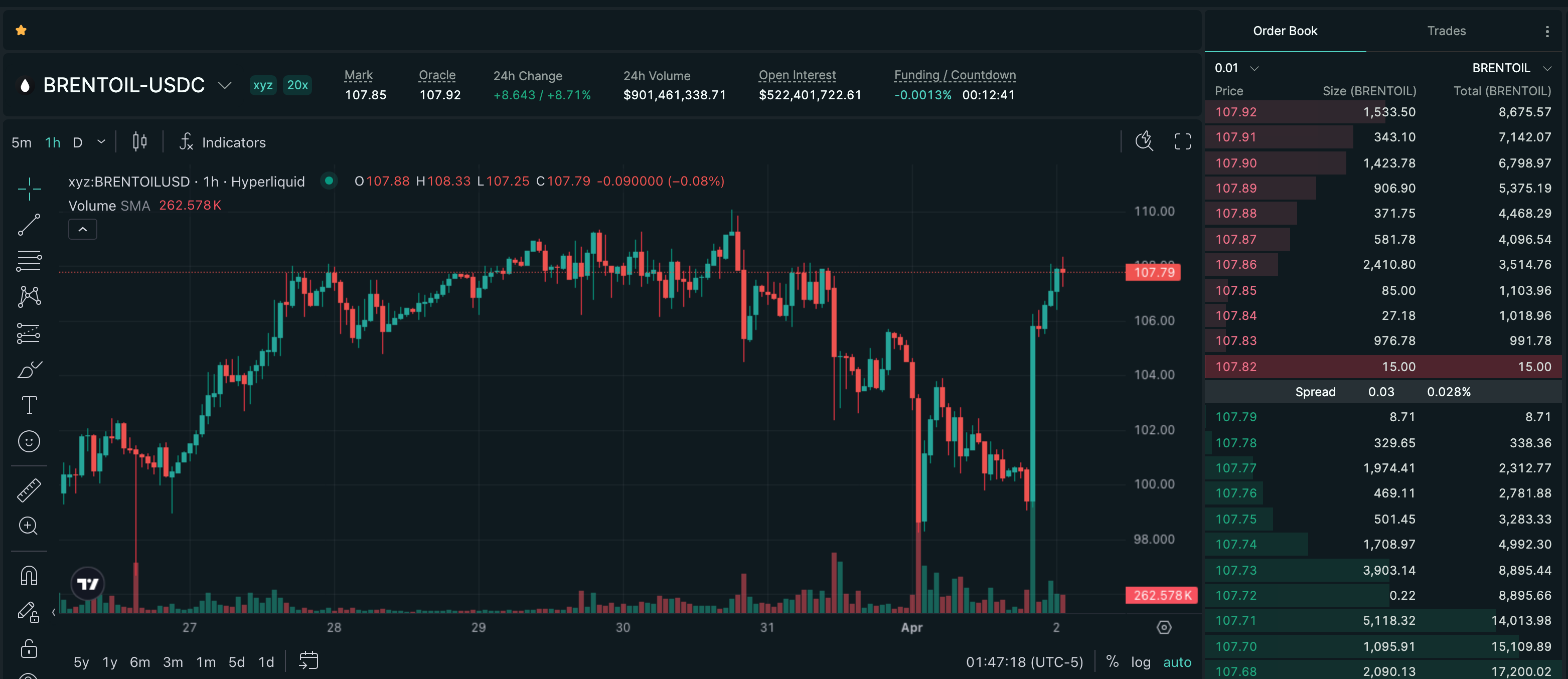
Trump's prime-time address on April 1 promised two to three more weeks of strikes against Iran instead of any ceasefire timeline, reversing a brief slide toward $100 and extending Brent's 24-hour gain past 9% to $107.90. The IEA warned that supply losses through the Strait of Hormuz will double in April now that pre-war cargo buffers are fully exhausted.
Mover Brief
The Speech That Killed the Ceasefire Trade
Going into Trump's April 1 address, Brent had been sliding toward $100 on growing expectations that the president would announce a de-escalation. Earlier in the day he had indicated the war could wind down in weeks, and the June Brent contract fell 2.8% to around $101 as traders began unwinding the war premium. The prime-time speech delivered the opposite.
Trump told the nation the U.S. would "hit them extremely hard over the next two to three weeks" and vowed to "bring them back to the Stone Ages, where they belong." He offered no ceasefire timeline, no diplomatic off-ramp, and explicitly threatened Iran's power grid and oil infrastructure if no deal materializes. When asked about allied concerns over energy costs, he told them to "get your own oil."
Brent reversed sharply. By early European trading on April 2, it had climbed above $107, erasing days of de-escalation positioning in a single session. As Takashi Hiroki at Monex Tokyo put it: "The market has shown disappointment because the speech was far less than what the market expected. There were no concrete details about the end of the hostilities with Iran."
The IEA's Supply Warning
The fundamental story underneath the geopolitical whiplash is supply destruction on a scale not seen in half a century. The Strait of Hormuz has been effectively closed since early March, with the IRGC enforcing a total blockade using naval mines, fast-attack boats, and coastal missile batteries. At least 28 vessels have been attacked, 12 seafarers killed or missing, and Gulf Arab states have been forced to cut output by at least 10 million barrels per day — roughly 10% of global supply.
IEA Executive Director Fatih Birol warned on April 1 that "the next month, April, will be much worse than March" because the cargo that was already in transit or in regional storage when the blockade started is now gone. March alone saw Brent post its biggest monthly gain since 1988 — approximately 63%. The IEA has coordinated a release of 400 million barrels from strategic reserves across member states, but that backstop is finite against an ongoing disruption that the agency itself describes as the largest since the 1970s oil crisis.
Global Contagion
The oil move is pulling every correlated asset with it. South Korea's Kospi dropped 4% overnight — the sharpest single-session fall in months for an economy that imports virtually all of its crude. Tokyo's Nikkei 225 fell 2%. Hong Kong's Hang Seng slid 1%. U.S. futures pointed to losses of 1–1.5% at the open.
Gold fell 2.5% to $4,691 and silver dropped 5.6%, a counterintuitive move during geopolitical escalation that likely reflects forced liquidation across risk assets rather than any genuine easing of safe-haven demand. The dollar strengthened to 159.37 yen, which itself feeds back into oil dynamics — a stronger dollar makes crude more expensive for the rest of the world. Domestic U.S. gas prices have crossed $4 per gallon, adding direct consumer-level political pressure to the equation.
The Bearish Case Nobody Is Trading
One data point cuts against the trend: U.S. crude inventories built 5.5 million barrels last week, well above expectations. Under normal supply conditions, that kind of build would pressure front-month contracts meaningfully. But normal supply conditions ended when a fifth of global seaborne oil trade went offline.
Trump's own rhetoric also contains the seeds of a possible reversal. He said the conflict could end in two to three weeks, with "core strategic objectives nearing completion." Israeli PM Netanyahu separately stated the campaign was "beyond the halfway point." If any credible ceasefire materializes, the unwind could be just as violent as the run higher — Brent demonstrated earlier this week that it can shed $7 in a single session on de-escalation rumors alone. For now, though, the market is pricing the IEA's base case: April will be worse than March, and there is no off-ramp in sight.
Sources & Provenance
Citations below are preserved as structured Postgres source rows for this brief.
Citations Preserved
6
Reference links carried forward from the published mover record.
Original Signal
Open source tweetMarket Route
Direct route preserved for readers who want to inspect the tracked Hyperliquid market behind this archive entry.
Already onboarded? Open tracked market- 1CNBC — Brent surges nearly 6% as Trump's Iran speech stokes escalation fearscnbc.com
- 2Euronews — Markets disappointed as Trump promises continued Iran strikeseuronews.com
- 3CNBC — IEA warns April oil supply crunch will worsencnbc.com
- 4Al Jazeera — Trump tells allies 'get your own oil'aljazeera.com
- 5Wikipedia — 2026 Strait of Hormuz crisisen.wikipedia.org
- 6Gulf News — Brent, WTI jump nearly 5% after Trump's Iran speechgulfnews.com
This content is for informational purposes only and does not constitute financial advice. Trading perpetual futures involves substantial risk of loss.
Trade BRENTOIL on Hyperliquid
Use referral code HIPERWIRE for 4% off trading fees on your first $25M in volume.
Live Market Metrics
Monitor real-time open interest and funding for BRENTOIL.