Iran Halts Hormuz Traffic Hours After Ceasefire Crashed Brent's War Premium
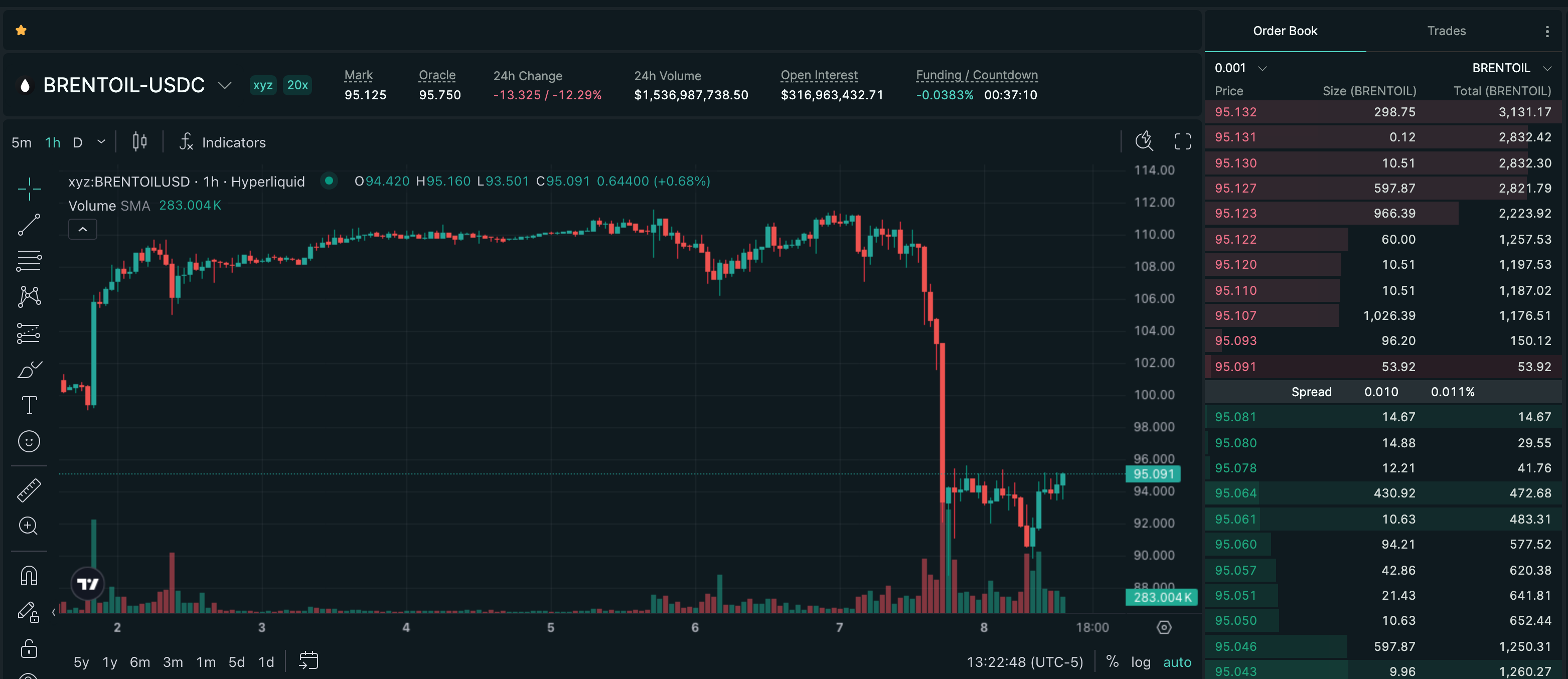
The Pakistan-brokered two-week ceasefire between the US and Iran wiped more than 15% off Brent crude in its first hours, compressing the estimated war premium from $14 per barrel to under $6. But less than 24 hours in, the deal is already under strain. Iran suspended tanker traffic through the Strait of Hormuz citing Israel's continued strikes on Lebanon, and Lloyd's insurers say trade is highly unlikely to simply resume. Futures priced in a reopening that the physical market has not delivered.
Mover Brief
Pakistan's Last-Minute Deal
The ceasefire arrived with less than 90 minutes to spare. Pakistan's PM Shahbaz Sharif and Army Chief General Asim Munir brokered a two-week pause between Washington and Tehran on the evening of April 7, just before Trump's 8 p.m. ET deadline — a deadline backed by a threat to bomb every bridge and power plant in Iran.
Under the terms, Iran agreed to allow coordinated safe passage through the Strait of Hormuz under Iranian military management for 14 days. Iran and Oman would charge transit tolls, with Iranian revenue earmarked for war damage reconstruction. Brent crude crashed below $95 from above $109 — its largest single-day percentage decline since 2020.
Iran also submitted a 10-point permanent peace counterproposal, the first time Tehran has negotiated rather than simply rejected. The demands are sweeping: US non-aggression commitments, all sanctions lifted, Iran's nuclear enrichment program accepted, frozen assets returned, and ratification through a binding UN resolution. Trump called it "a workable basis on which to negotiate." Formal talks are set for Islamabad on April 10.
The Deal Is Already Cracking
Within hours of the first tankers passing through Hormuz, Iran's semi-official news agency reported that tanker transit had been suspended. The stated reason: Israel's continued assault on Lebanon. Netanyahu explicitly excluded Lebanon from the ceasefire, despite Pakistan's mediator position stating otherwise, and launched approximately 100 targets in Beirut within a 10-minute window — killing at least 112 people.
Washington and Tehran are now giving flatly contradictory accounts. White House Press Secretary Karoline Leavitt insisted shipping was resuming, calling closure reports "completely unacceptable" and "false." Iranian state media says the opposite. Pentagon officials have noted potential Iranian withdrawal if Israeli strikes continue. Iran, the UAE, and Kuwait all reported attacks within hours of the announced truce.
The ceasefire technically covers US-Iran hostilities only, not the Israel-Hezbollah front. That structural gap is already doing real damage to the agreement's credibility.
Futures Priced In What the Strait Hasn't Delivered
The oil market moved fast. The estimated war risk premium compressed from roughly $14 per barrel to $4–6, driving the S&P 500 up 2.3%, the Nikkei up 5%, and the Kospi up 5.9%. Equities treated the ceasefire as a hard de-escalation. The physical oil market is telling a different story.
Lloyd's Market Association head Neil Roberts warned that "it is highly unlikely that trade into the Gulf will simply resume." Marine insurance — the prerequisite for any commercial tanker transit — has not normalized. Hundreds of ships remain queued outside the strait. Greek and Liberian-flagged vessels were among the first to transit under the new arrangement, but volumes are a fraction of the 150+ daily transits that moved through Hormuz before the war began in late February.
Brent at $95 is still roughly 30% above pre-war levels, but the sell-off has outpaced the physical reopening by a wide margin. The key variable now is whether the Islamabad talks on April 10 produce concrete progress — and whether tanker counts actually tick up. If they don't, futures may need to reprice the premium they just removed.
Sources & Provenance
Citations below are preserved as structured Postgres source rows for this brief.
Citations Preserved
6
Reference links carried forward from the published mover record.
Original Signal
Open source tweetMarket Route
Direct route preserved for readers who want to inspect the tracked Hyperliquid market behind this archive entry.
Already onboarded? Open tracked market- 1Al Jazeera — US-Iran ceasefire deal terms and 10-point proposalaljazeera.com
- 2CBS News — Live updates on Hormuz closure claims and White House responsecbsnews.com
- 3NBC News — Ceasefire sends oil tumbling, war premium analysisnbcnews.com
- 4CNN — Oil prices and markets react to ceasefire, Lloyd's insurance warningedition.cnn.com
- 5CNBC — Oil prices plunge on Hormuz safe passage agreementcnbc.com
- 6OilPrice.com — Crude falls below $100 on ceasefire announcementoilprice.com
This content is for informational purposes only and does not constitute financial advice. Trading perpetual futures involves substantial risk of loss.
Trade BRENTOIL on Hyperliquid
Use referral code HIPERWIRE for 4% off trading fees on your first $25M in volume.
Live Market Metrics
Monitor real-time open interest and funding for BRENTOIL.