Crude Crashed on a Ceasefire, but Hormuz Is Still Barely Open
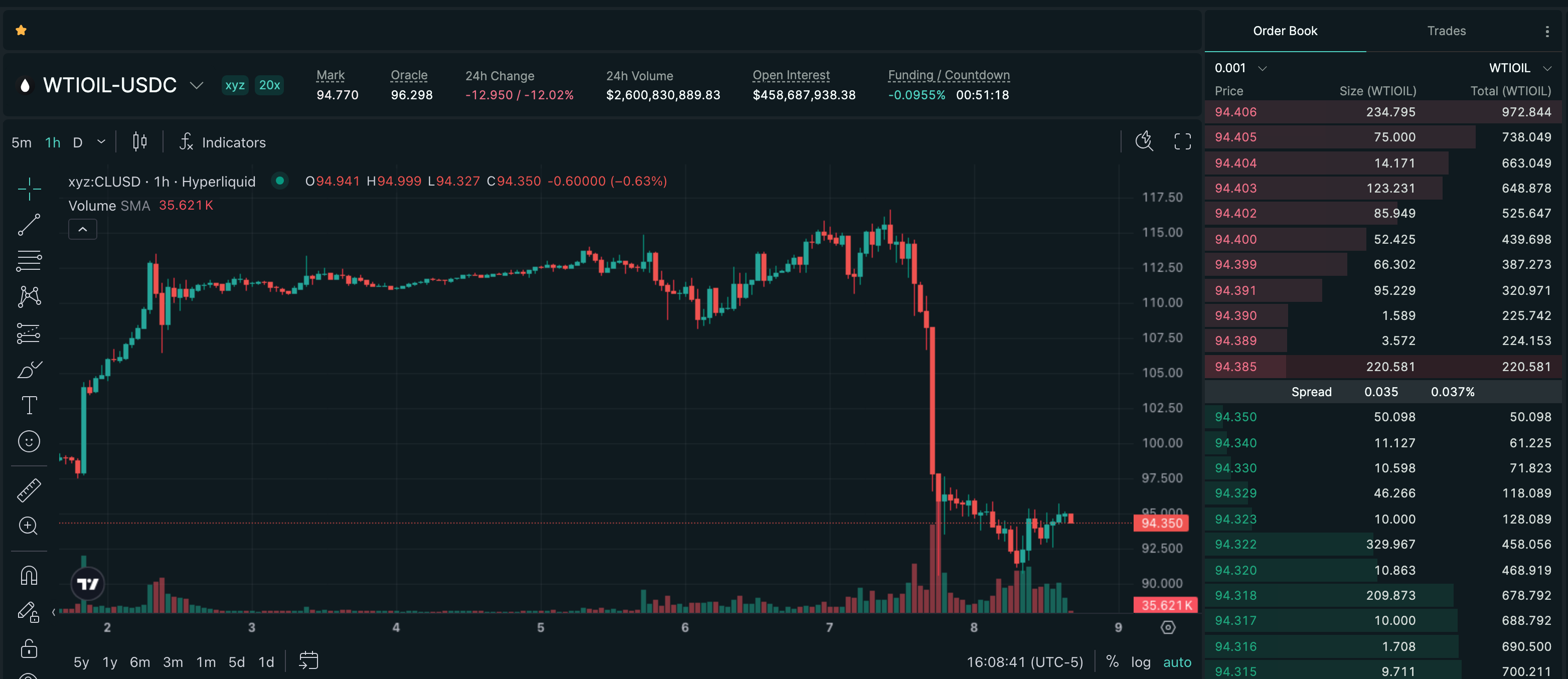
WTI dropped over 15% after Trump announced a two-week ceasefire with Iran, but only four ships crossed the Strait of Hormuz on Wednesday versus 135 a day pre-blockade. With roughly 1,000 vessels queued, Iran imposing an unprecedented per-barrel transit toll payable in crypto, and war-risk insurers still on the sidelines, the physical supply chain is weeks away from normalization even if the ceasefire holds.
Mover Brief
The Physical Disconnect
WTI dropped as much as 16.4% to $94.41 after Trump announced a two-week ceasefire with Iran that includes safe passage through the Strait of Hormuz. The move erased roughly $22 per barrel of war premium that had accumulated since the blockade began in March.
But the oil market's pricing and the physical supply chain are telling two very different stories. Only four ships crossed Hormuz on Wednesday — normal throughput is around 135 vessels a day carrying approximately 15.8 million barrels of crude. Roughly 1,000 merchant ships remain stuck inside the Persian Gulf, and Hapag-Lloyd's CEO said it would take "at least six weeks" to restore a fully normal shipping network. The ceasefire window is two weeks.
The bottleneck is not just logistical. War-risk insurers have not cleared tankers for Hormuz transit, and without that coverage most commercial operators will not move regardless of what the ceasefire text says. The handful of ships that did cross appear to be opportunistic transits under military coordination — not the beginning of a supply normalization.
Iran's Hormuz Toll Booth
For the first time in its history as an international waterway, the Strait of Hormuz now has a toll. Iran's Oil, Gas and Petrochemical Exporters' Union set the fee at $1 per barrel for every tanker transiting the strait, with payments accepted in stablecoins, bitcoin, and Chinese yuan — explicitly not in dollars. Separate reports indicate Iran's IRGC has been charging individual vessels up to $2 million for safe passage.
Oman initially planned to levy its own fee but quickly reversed course, stating that ships crossing the strait cannot be charged. The precedent Iran is setting matters beyond this ceasefire: if monetizing the chokepoint sticks, it fundamentally changes the cost structure of Middle Eastern oil exports even after hostilities end. A $1/bbl toll on 15.8 million barrels a day works out to nearly $5.8 billion a year in revenue — paid in crypto, routed around sanctions.
What Five Dollars of Risk Premium Buys You
The war premium in crude compressed from roughly $14 per barrel to about $5 in 24 hours. Whether that remaining cushion is adequate depends entirely on what happens in Islamabad on Friday, where Pakistan is hosting direct U.S.-Iran talks.
Implied volatility in Brent futures went from below 30% in December to around 90% and has not meaningfully retreated. Physical Brent traded as high as $140 per barrel during the blockade peak while futures stayed significantly lower — a spread that reflected traders betting the disruption was temporary. That bet is now being tested in the other direction: futures have priced in a reopening that physical supply cannot deliver within the ceasefire's two-week window.
Krishna Guha at Evercore warned that "the ceasefire could fall apart" and that an inflation shock is still coming regardless. If talks collapse Friday, crude reprices the entire flush in the other direction — with 1,000 ships still sitting in the Gulf as collateral.
Sources & Provenance
Citations below are preserved as structured Postgres source rows for this brief.
Citations Preserved
6
Reference links carried forward from the published mover record.
Original Signal
Open source tweetMarket Route
Direct route preserved for readers who want to inspect the tracked Hyperliquid market behind this archive entry.
Already onboarded? Open tracked market- 1NBC News — Oil plunges on Iran ceasefire, gas price relief timelinenbcnews.com
- 2Euronews — Shipping companies seek clarity on Hormuz reopeningeuronews.com
- 3Washington Examiner — Iran to charge fees for Strait of Hormuz transitwashingtonexaminer.com
- 4Bitcoin News — Iran charges crypto and yuan tolls for Hormuz passagenews.bitcoin.com
- 5The Conversation — Iran ceasefire and oil market volatility analysistheconversation.com
- 6CNN Business — Oil plunges and markets surge on Iran ceasefirecnn.com
This content is for informational purposes only and does not constitute financial advice. Trading perpetual futures involves substantial risk of loss.
Trade CL on Hyperliquid
Use referral code HIPERWIRE for 4% off trading fees on your first $25M in volume.
Live Market Metrics
Monitor real-time open interest and funding for CL.