WTI Rebounds as Fresh Hormuz Attacks Overpower the IEA's Largest-Ever Reserve Release
WTI crude climbed back above $86 on March 11 after three cargo ships were struck by projectiles near the Strait of Hormuz and the U.S. Navy sank 16 Iranian minelayers overnight. The IEA's unanimous decision to release 400 million barrels from strategic reserves — the largest coordinated release in the agency's history — failed to cap the rally. Markets are repricing the Hormuz disruption as a durable supply shock rather than the short-lived event that yesterday's diplomatic signals implied.
Mover Brief
Fresh Attacks Undo Yesterday's Selloff
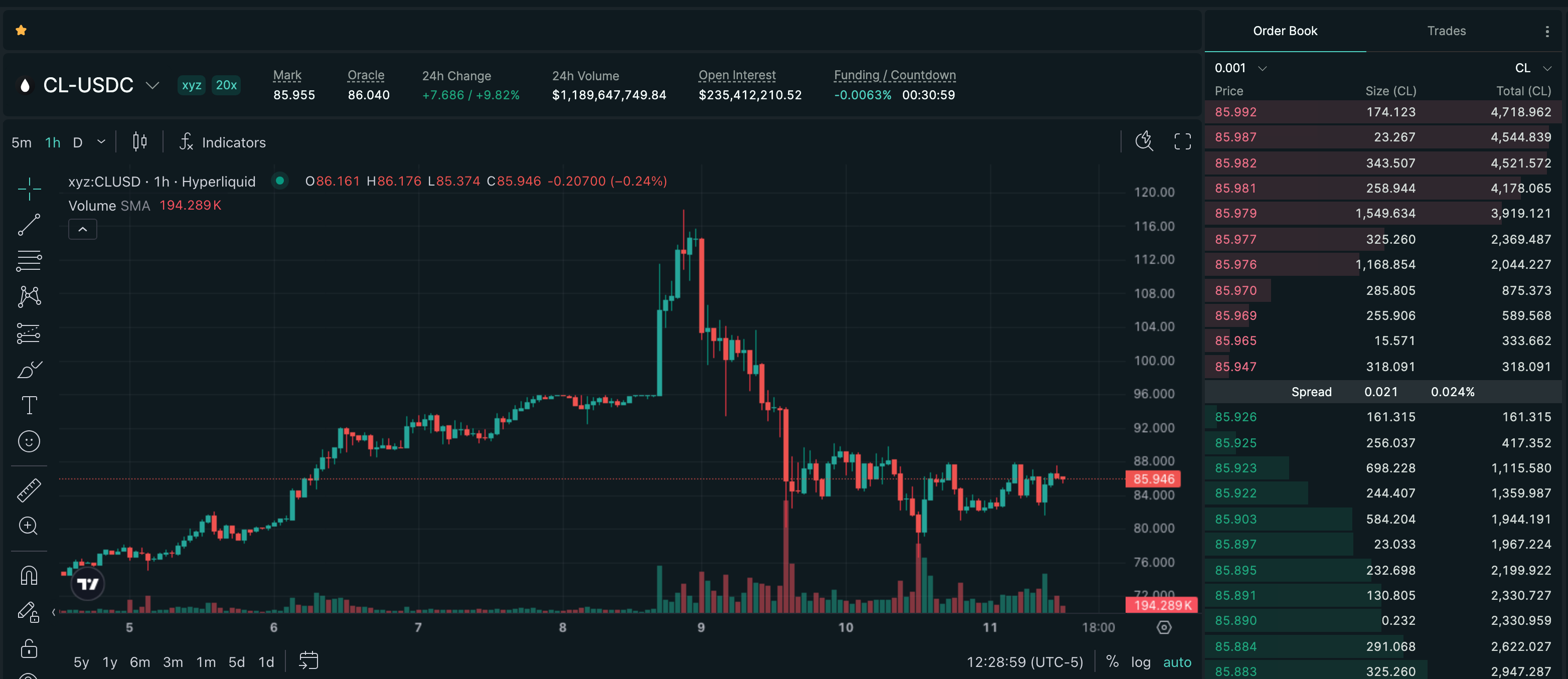
WTI traded from a session low of $81.82 to nearly $89 on March 11, erasing much of the prior day's crash from $120 to $83. The catalyst was physical, not rhetorical: the UK's Maritime Trade Operations confirmed three cargo ships were struck by projectiles off Iran's coast, with one vessel ablaze inside the Strait of Hormuz itself. A separate ship was hit off the UAE coast.
Overnight, CENTCOM confirmed it had sunk 16 Iranian mine-laying vessels in the waters between Iran and Oman. Intelligence indicated Iran was actively preparing to deploy mines in the strait — though no mines have been confirmed placed yet. Trump warned that if any mines were deployed and not removed, Iran would face consequences "at a level never seen before."
The message from the price action is clear: yesterday's diplomatic off-ramp — the UN maritime stability memorandum, Trump's claim the war was "very complete, pretty much" — hasn't actually stopped the shooting. Three burning cargo ships and a minelaying campaign are not what a resolved crisis looks like.
A Record Reserve Release That Cannot Keep Up
The IEA's 32 member countries unanimously agreed to release 400 million barrels from emergency stockpiles — more than double the 182 million barrels released after Russia's 2022 invasion of Ukraine. Japan began releasing reserves Monday. The UK committed 13.5 million barrels, South Korea 22.46 million. IEA executive director Fatih Birol called it "an emergency collective action of unprecedented size."
And oil prices went up anyway.
The math explains why. The 400 million barrels sound massive, but they represent roughly four days of global production and just 16 days of the volume that normally transits through the Strait of Hormuz. Meanwhile, the strait's near-closure is choking off approximately 15 million barrels of crude and 5 million barrels of refined products every single day. The reserve release is a tourniquet on an arterial bleed — visible, well-intentioned, and insufficient. Until physical tanker traffic resumes through Hormuz, no stockpile draw can offset the flow deficit.
A War Premium That Refuses to Die
The past 72 hours have delivered one of the most violent two-way stretches in crude oil history. WTI went from the low $60s to $120 on Hormuz closure fears, crashed $40 in a single session on diplomatic hopes, and is now climbing again as the physical reality on the water overrides the political narrative from Washington.
The core problem is structural. Iran has linked Strait of Hormuz passage to its diplomatic stance rather than granting unconditional access. The UN's Maritime Stability memorandum was signed by neutral regional powers, not by Tehran. Iraq and Kuwait remain at severely reduced output with force majeure still in effect. And Iran still retains an estimated 80% of its small boat and minelaying fleet — the 16 vessels CENTCOM destroyed were a fraction of Iran's asymmetric naval capability.
The $86 handle represents a market caught between two competing narratives: diplomatic de-escalation signals that suggest the crisis is winding down, and physical supply disruptions that are visibly intensifying. For now, barrels in the water — or more precisely, barrels not in the water — are winning the argument over words from podiums. Until tankers are actually transiting Hormuz again, crude remains a headline-driven instrument with no stable equilibrium.
Sources & Provenance
Citations below are preserved as structured Postgres source rows for this brief.
Citations Preserved
6
Reference links carried forward from the published mover record.
Original Signal
Open source tweetMarket Route
Direct route preserved for readers who want to inspect the tracked Hyperliquid market behind this archive entry.
Already onboarded? Open tracked market- 1CNBC — IEA agrees to release record 400 million barrelscnbc.com
- 2CNBC — U.S. forces sink 16 Iranian minelayers near Strait of Hormuzcnbc.com
- 3Al Jazeera — IEA agrees release of 400M barrels from strategic reservesaljazeera.com
- 41News — Cargo ship ablaze after projectile strike in Strait of Hormuz1news.co.nz
- 5Military Times — US destroys 16 Iranian mine-laying boats, CENTCOM confirmsmilitarytimes.com
- 6NPR — IEA members to tap into oil reserves amid Iran warnpr.org
This content is for informational purposes only and does not constitute financial advice. Trading perpetual futures involves substantial risk of loss.
Trade CL on Hyperliquid
Use referral code HIPERWIRE for 4% off trading fees on your first $25M in volume.
Live Market Metrics
Monitor real-time open interest and funding for CL.