WTI Crude Breaks $100 as Strait of Hormuz Closure Chokes Global Supply
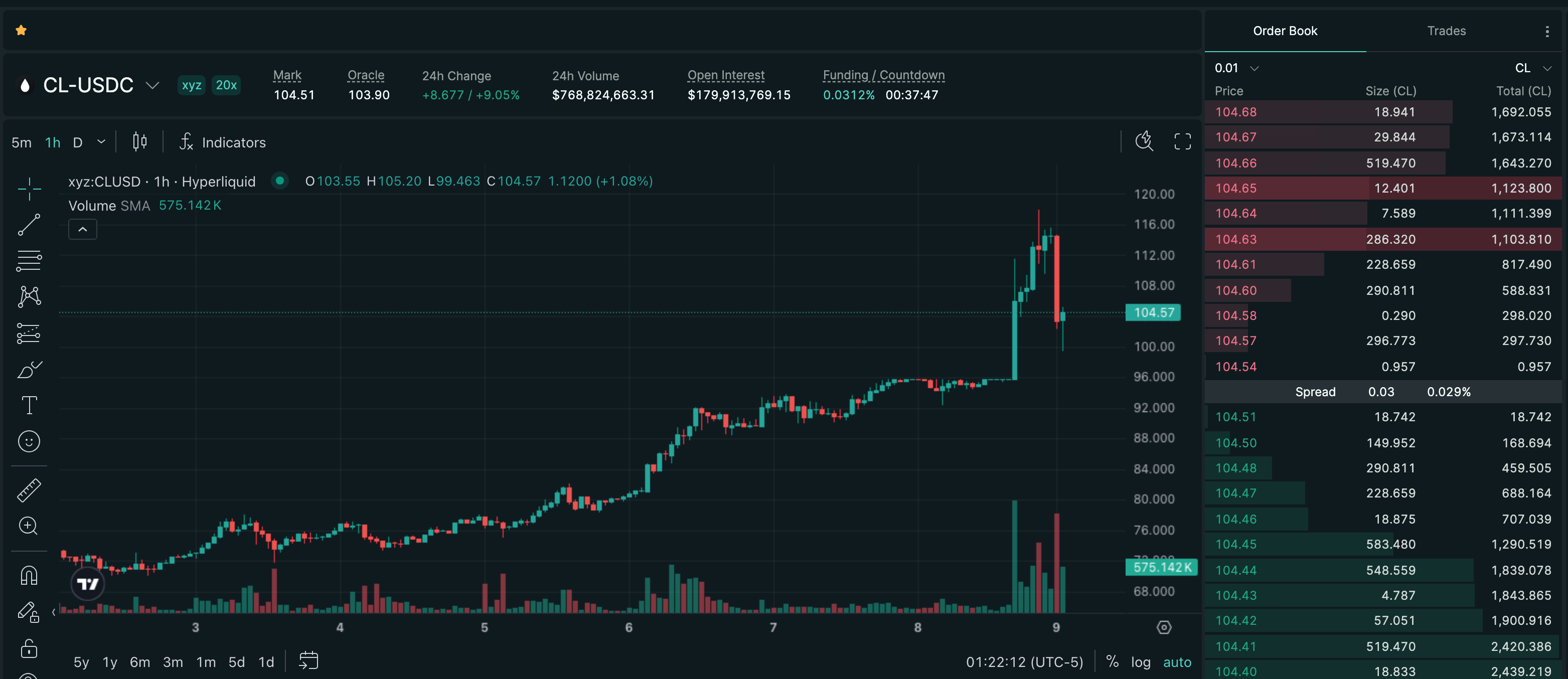
WTI crude oil ripped past $100 a barrel for the first time since 2022 as the US-Iran war effectively shut down the Strait of Hormuz, the chokepoint through which roughly 20% of the world's daily oil supply flows. Gulf producers including Iraq, Kuwait, and the UAE are already cutting output as onshore storage fills up with nowhere to export. CL, the Hyperliquid perp tracking WTI, jumped 12.63% over 20 hours to $104.80 as the crisis deepened over the weekend.
Mover Brief
The Catalyst: Hormuz Goes Dark
The price action traces directly to the escalating US-Israel military campaign against Iran and Iran's retaliatory shutdown of the Strait of Hormuz. After US and Israeli strikes killed Supreme Leader Ayatollah Ali Khamenei and other top officials, the IRGC declared complete control of the strait and threatened to set any unauthorized vessel on fire.
The numbers tell the story. Crude tanker transits through Hormuz dropped to just three or four per day by late last week, down from an average of 24. Over 150 ships anchored outside the strait rather than risk passage. On March 4, Iran signaled it would allow only Chinese-owned vessels to transit, and the bulk carrier *Iron Maiden*, operated by Cetus Maritime Shanghai, passed through flying a "CHINA OWNER" signal. Everyone else is stuck.
On March 7, the Maltese-flagged chemicals tanker PRIMA was struck by an Iranian drone while attempting the crossing — a message to anyone still considering the run.
Gulf Storage Is Full, Production Is Falling
The strait closure created a second-order problem that's arguably more bullish than the blockade itself: Gulf producers are physically running out of places to put their oil.
Iraq has already cut 1.5 million barrels per day as its storage tanks fill. Kuwait followed with its own production cuts, and the UAE is in the same position. As much as 140 million barrels of oil are effectively stranded — produced but unshippable. Middle Eastern producers only have about 25 days of effective storage capacity with the strait blocked, meaning these aren't temporary pauses. They're forced shutdowns with no clear timeline for recovery.
Qatar's energy minister told the Financial Times the war could "bring down the economies of the world" and predicted all Gulf energy exporters would shut down production within weeks, pushing crude to $150 a barrel.
Historic Moves in Context
The scale of this rally is without precedent in modern oil markets. WTI posted a 35% weekly gain — the largest in the history of the futures contract dating back to 1983. Crude blew through $100 on Sunday and pushed toward $115 before pulling back slightly.
Trump called the price spike a "small price to pay" for defeating Iran. Meanwhile, the S&P 500 futures collapsed as the equity market priced in the downstream inflation shock. The macro picture is a textbook stagflation setup: supply destruction driving commodity prices higher while growth expectations crater.
The CL perp on Hyperliquid captured this move in real time — a 12.63% rip over 20 hours with $768 million in 24-hour volume on the HIP-3 market alone. For perp traders, the question now is whether the strait reopens (Trump has floated US Navy escorts for tankers, but IRGC control makes that operationally questionable) or whether we're headed for the $120–$150 range that Gulf officials are warning about.
What to Watch
Three things determine where CL goes from here.
First, Hormuz transit data. If tanker crossings stay at single digits per day, storage constraints will force deeper production cuts and prices have room to run well past current levels. Any credible reopening — a ceasefire, a successful US Navy convoy — would trigger a sharp pullback.
Second, SPR releases. The US Strategic Petroleum Reserve is an obvious policy lever, but it's been drawn down significantly over the past four years. Any release would be a temporary Band-Aid on a structural supply problem.
Third, watch OPEC+ discipline outside the Gulf. With Gulf members forced offline, the question is whether non-Gulf OPEC+ members ramp production to capture share, or hold the line. That decision could define the $100–$150 trading range for weeks.
Sources & Provenance
Citations below are preserved as structured Postgres source rows for this brief.
Citations Preserved
8
Reference links carried forward from the published mover record.
Original Signal
Open source tweetMarket Route
Direct route preserved for readers who want to inspect the tracked Hyperliquid market behind this archive entry.
Already onboarded? Open tracked market- 1CNBC: Oil surges above $110, Trump says 'small price to pay'cnbc.com
- 2CNBC: Oil surges 35% for biggest weekly gain in futures historycnbc.com
- 3Al Jazeera: Iran war threatens prolonged impact on energy marketsaljazeera.com
- 4Euronews: Hormuz shutdown keeps oil on upward trajectoryeuronews.com
- 5CNBC: Kuwait cuts oil production as Hormuz closure disrupts marketcnbc.com
- 6Windward: March 8 Iran War Maritime Intelligence Dailywindward.ai
- 7Wikipedia: 2026 Strait of Hormuz crisisen.wikipedia.org
- 8Axios: Oil tops $100 a barrel as Iran war escalatesaxios.com
This content is for informational purposes only and does not constitute financial advice. Trading perpetual futures involves substantial risk of loss.
Trade CL on Hyperliquid
Use referral code HIPERWIRE for 4% off trading fees on your first $25M in volume.
Live Market Metrics
Monitor real-time open interest and funding for CL.