WTI's War Premium Unwinds as a Surprise Crude Build Meets the OPEC+ Glut
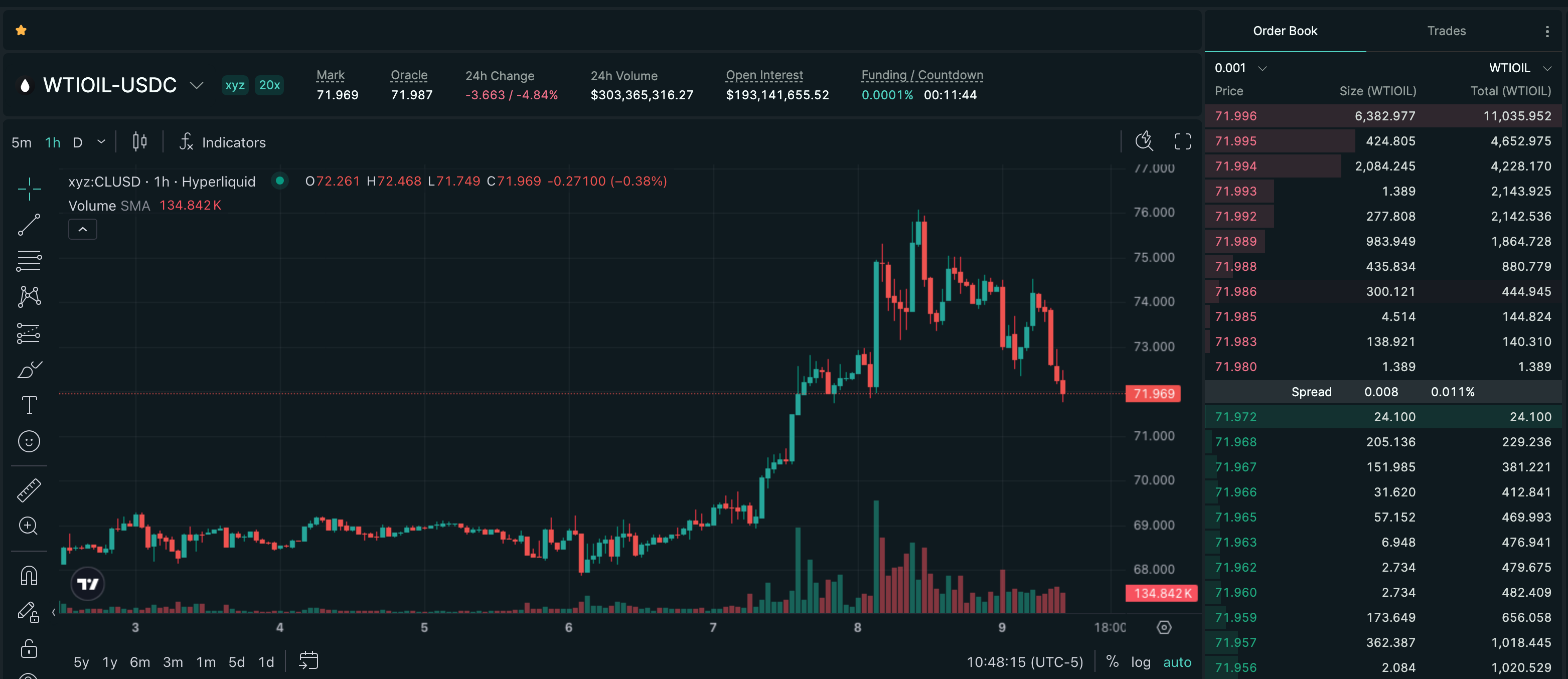
WTI built a two-day war premium after Trump declared the US-Iran ceasefire over and threatened the Strait of Hormuz, pushing crude as high as $76. At $71.91, down 5.14% on the day, CL has handed the entire spike back. The reversal came on a surprise EIA inventory build — the first in 11 weeks — that collided with rising OPEC+ output and a softening demand outlook. The bid was a risk premium, not a physical shortage, and the barrels pulled it out.
Mover Brief
The War Premium That Cracked
West Texas Intermediate spent the last two sessions trading a geopolitical bid, not a supply-and-demand story. Oil jumped after President Trump declared the US-Iran ceasefire 'over', dismissed further talks as a waste of time, and floated seizing the Kharg Island export terminal and reimposing a naval blockade on tankers transiting the Strait of Hormuz. WTI settled 4.4% higher at $73.52 and printed as high as roughly $76 intraday, stretching the two-day move past 7%.
At $71.91, down 5.14% on the day, CL has now given the entire spike back. The premium leaked out about as fast as it went in, with roughly $303 million in 24-hour volume trading through the CL perp as the reversal played out.
The Build That Broke It
The trigger for the reversal was physical, not political. The EIA reported that US commercial crude inventories rose by about 3.0 million barrels for the week ending July 3 — the first build in 11 weeks and a sharp miss against the 1.1-to-1.9 million-barrel draw the market expected. Exports slowed to 3.3 million barrels per day, the weakest since November, while domestic production climbed to 13.86 million bpd, near last year's record high.
The build landed on top of OPEC+ lifting August quotas by another 188,000 bpd — the latest in a run of output hikes — alongside Saudi price discounting aimed at defending market share. Supply is normalizing into softer demand, and a single bearish inventory print was enough to expose how thin the geopolitical bid actually was.
Risk Premium vs. the Glut
This is the same tension that has defined WTI for weeks: a geopolitical risk premium stacked on top of a market that is fundamentally long. The premium prices a tail — a Hormuz closure that physically removes barrels — but the underlying data keeps pointing the other way. The EIA's July Short-Term Energy Outlook cut its Q3 Brent forecast to roughly $74, and the IEA is modeling a demand contraction of over 1.1 million bpd.
Until an actual disruption shows up in the barrels, every de-escalation headline and every bearish inventory report pulls crude back toward the mid-$60s the fundamentals imply. The tell from here is whether the next Hormuz headline can hold a bid, or fades into the same glut that just erased two days of gains.
Sources & Provenance
Citations below are preserved as structured Postgres source rows for this brief.
Citations Preserved
6
Reference links carried forward from the published mover record.
Original Signal
Open source tweetMarket Route
Direct route preserved for readers who want to inspect the tracked Hyperliquid market behind this archive entry.
Already onboarded? Open tracked market- 1NBC News — Oil surges after Trump says Iran ceasefire is 'over'nbcnews.com
- 2CNBC — Oil jumps more than 4% after Trump threatens Iran and Hormuz blockadecnbc.com
- 3EIA Weekly Petroleum Status Report (week ending July 3, 2026)eia.gov
- 4Rigzone — US crude oil stocks rise week on weekrigzone.com
- 5TradingKey — USOIL market movers, OPEC+ quota and IEA demand outlooktradingkey.com
- 6EIA Short-Term Energy Outlook (July 2026)eia.gov
This content is for informational purposes only and does not constitute financial advice. Trading perpetual futures involves substantial risk of loss.
Trade CL on Hyperliquid
Use referral code HIPERWIRE for 4% off trading fees on your first $25M in volume.
Live Market Metrics
Monitor real-time open interest and funding for CL.