Circle's Post-Earnings Run Extends as Rate Repricing and AI Payments Compound
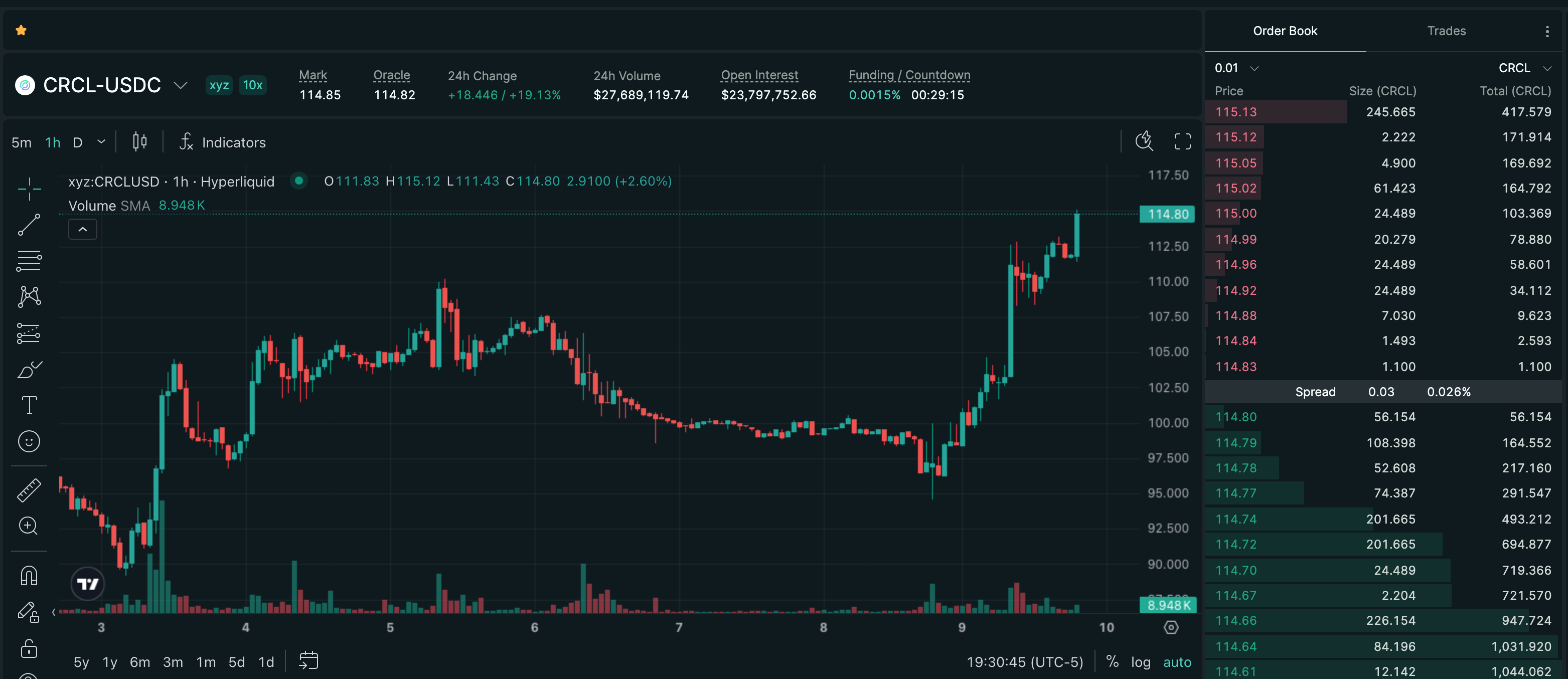
Circle Internet Group has doubled off its $50 low, fueled by a decisive Q4 earnings beat, an Iran-driven repricing of rate cut expectations that directly benefits its reserve income model, and growing institutional interest in USDC as the settlement layer for AI agent payments. The 18% move over the last day is the latest leg of an 86% monthly run — the stock's first four-week winning streak since its IPO.
Mover Brief
The Q4 Beat
The foundation of this move was laid on February 25, when Circle reported Q4 results that blew past Wall Street estimates. Revenue came in at $770 million, up 77% year-over-year, beating consensus by a comfortable margin. EPS landed at $0.43 against a $0.25 estimate — a 72% beat that triggered a 35% single-day surge on the heaviest volume since the stock's June 2025 peak.
The numbers underneath were equally strong. USDC circulation hit $75.3 billion, up 72% from the prior year, with on-chain volume exploding 247% to $11.9 trillion. Adjusted EBITDA reached $167 million — a 412% increase from Q4 2024. Q4 net income hit $133 million, up from $4 million a year earlier. Full-year revenue climbed 64% to $2.7 billion, though stock-based compensation from the IPO vesting produced a full-year net loss of $70 million on paper.
The stock cleared a double-bottom formation at $88.56 on March 2, delivering a 15% advance on more than twice its typical daily volume. It has not looked back since.
Higher Rates as Revenue
Circle's business model has an unusual macro sensitivity: because it earns reserve income on the U.S. Treasuries backing USDC, higher interest rates flow directly to the top line. That dynamic turned the Iran conflict into a stock catalyst.
Israeli and U.S. airstrikes on Iran pushed crude oil up roughly 6% over five days and 24% year-to-date. Mizuho analysts Dan Dolev and Alexander Jenkins raised their CRCL price target from $90 to $100, arguing that rising oil prices reduce the odds of rate cuts in 2026. CME FedWatch data shows the probability of no rate cuts this year roughly doubled in recent sessions.
The logic is straightforward: if the Fed holds rates higher for longer, Circle's $75.3 billion reserve pool keeps generating outsized yield. Reserve income already accounted for $733 million in Q4 alone, up 69% year-over-year. Even a 68 basis-point decline in the reserve return rate was more than offset by the 100% growth in average USDC in circulation.
Separately, USDC surpassed USDT in monthly transaction volume during the latest round of geopolitical volatility — traders rotating into dollar-pegged assets during uncertainty tend to favor USDC's regulated, transparent reserve structure.
AI Agents and the USDC Moat
Beyond the macro tailwind, Circle is positioning aggressively in AI agent payments — a nascent market where USDC already dominates. Over the past nine months, AI agents have processed 140 million payments totaling $43 million, with 98.6% settling in USDC. The average transaction value is $0.31, highlighting why micro-payment infrastructure matters.
On March 4, Circle launched its Nanopayments testnet, enabling gas-free USDC transfers down to $0.000001 — purpose-built for autonomous AI-to-AI settlement. CEO Jeremy Allaire framed this as the "convergence between AI and stablecoins and blockchain" during the earnings call, and Bloomberg reported Circle is looking to outpace Tether and Ripple in this category.
With over 400,000 AI agents now equipped with purchasing capabilities, the installed base is small but growing fast. If USDC maintains its 98.6% share as this market scales, it becomes a structural demand driver for circulation growth independent of rate cycles — exactly the kind of diversification investors want to see.
Risks on the Table
The rally is not without headwinds. Insiders have been selling: President Heath Tarbert sold $11.5 million in stock on March 2 at $94.23 per share, and Director M. Michele Burns sold $2.6 million worth at $105 on March 4. Both transactions occurred well below current levels, but the pattern is worth noting in a stock that has doubled in weeks.
The CLARITY Act remains stalled in the Senate. The American Bankers Association rejected the White House's compromise framework on March 5, and the bill has no markup scheduled. A revised version that would cap yield only on peer-to-peer activity rather than idle balances would actually benefit Circle — Monness Crespi reiterated a Buy with a $125 target on that reading — but passage is far from certain. Meanwhile, Canaccord Genuity cut its target from $247 to $160 while maintaining a Buy, reflecting the broad uncertainty around regulatory outcomes.
Sources & Provenance
Citations below are preserved as structured Postgres source rows for this brief.
Citations Preserved
7
Reference links carried forward from the published mover record.
Original Signal
Open source tweetMarket Route
Direct route preserved for readers who want to inspect the tracked Hyperliquid market behind this archive entry.
Already onboarded? Open tracked market- 1Circle Q4 & FY2025 Earnings Press Releasecircle.com
- 2The Block — Circle Reports $770M Q4 Revenue, USDC at $75Btheblock.co
- 3CoinDesk — How the Iran War and Trader Positioning Drive Circle's Surgecoindesk.com
- 4Mizuho — Middle East Tensions, Higher Oil Boost CRCL Sharescoindesk.com
- 5CryptoTimes — Circle Launches USDC Nanopayments Testnet for AI Agentscryptotimes.io
- 6Phemex — AI Agents Process 140M Payments, 98.6% in USDCphemex.com
- 7HedgeCo — The CLARITY Act Impasse and the Federal Tug-of-War Over Stablecoinshedgeco.net
This content is for informational purposes only and does not constitute financial advice. Trading perpetual futures involves substantial risk of loss.
Trade CRCL on Hyperliquid
Use referral code HIPERWIRE for 4% off trading fees on your first $25M in volume.
Live Market Metrics
Monitor real-time open interest and funding for CRCL.