CRCL Bounces Off the Open USD Crash as Bernstein and ARK Buy the Dip
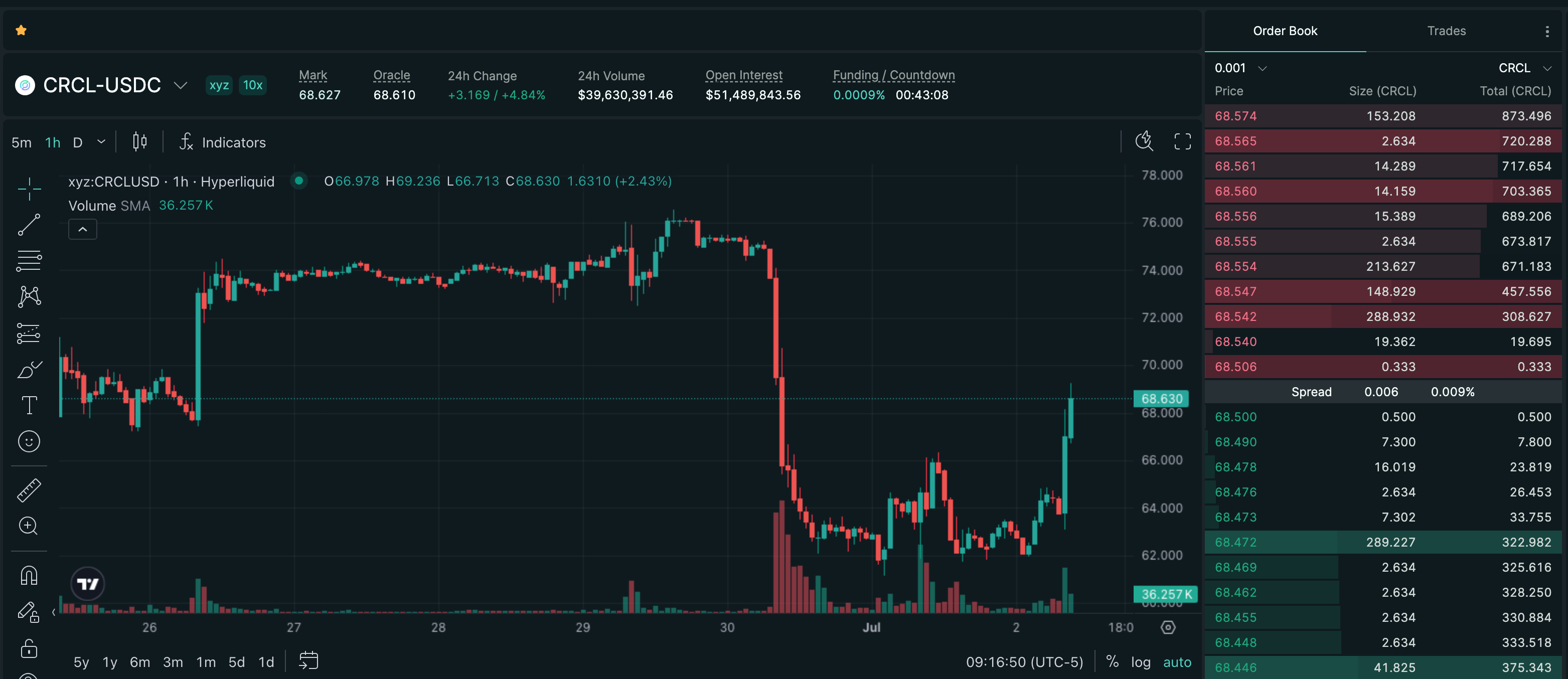
After two sessions of getting shredded on the Open USD launch, CRCL is catching a bid. The buyers aren't just short-covering algos: Bernstein reiterated a $190 target, ARK bought $17.8M into the weakness, and multiple desks called the selloff overdone. The bounce is real, but the thing that caused the crash — a 140-company stablecoin built to hand USDC's reserve income to distributors — hasn't gone anywhere.
Mover Brief
The Rebound Has Names Behind It
CRCL is up 10.98% over 14 hours to $68.86 on Hyperliquid, clawing back part of the two-session wipeout that followed the Open USD launch. What makes this bounce more than a thin-book snap is who showed up to buy. ARK Invest bought 287,609 shares — roughly $17.8M — at $61.95 on July 1, spreading the position across ARKF, ARKK and ARKW and buying directly into the weakness. On the sell-side, Bernstein kept its Outperform rating and $190 target — 203% upside — arguing that the scale of the OUSD coalition validates stablecoins as a category rather than immediately killing Circle. Their framing: stablecoin networks are winner-take-all businesses built over years of liquidity and regulatory work, not something a launch-day press release unwinds.
What OUSD Actually Attacks
The crash wasn't a vague competition scare. Open USD is engineered to hit the exact mechanism that makes Circle a public company: float income on reserves. Launched June 30 by a 140-plus company consortium including Stripe, Visa, Mastercard, BlackRock and Coinbase, OUSD promises zero mint and redeem fees, no size limits, and — the part that matters — 100% of the Treasury interest earned on reserves handed back to the partners who distribute it. Circle keeps that yield on USDC; OUSD gives it away to win distribution. Stripe committing to make OUSD its default business stablecoin means merchant volume can route through the new token from day one, which is why the market treated this as structural rather than cosmetic.
The Overhang That Didn't Clear
The bull case is genuinely strong on the numbers: USDC processed $5.3T in the first half of 2026, up about 140% over 2025's full-year pace, holds roughly 28% of the dollar stablecoin base, and lifted its transaction-volume share from about 40% to 60%. But the bear case that triggered the selloff is still live. Coinbase's roughly $908M-a-year distribution agreement with Circle comes up for renewal around August 2026 — and Coinbase, which earns about half of USDC's reserve income (close to 20% of its own revenue), is now on the OUSD partner list. BlackRock manages Circle's reserve fund and is simultaneously backing the rival. Jefferies flatly told clients not to buy the dip, and insiders sold heavily in late June. Down roughly 40% on the month, this move reads as a relief rally inside a fight that hasn't been settled.
Sources & Provenance
Citations below are preserved as structured Postgres source rows for this brief.
Citations Preserved
5
Reference links carried forward from the published mover record.
Original Signal
Open source tweetMarket Route
Direct route preserved for readers who want to inspect the tracked Hyperliquid market behind this archive entry.
Already onboarded? Open tracked market- 1The Block — Bernstein sees 203% upside for Circle despite OUSD debuttheblock.co
- 2Benzinga — Cathie Wood's ARK buys $17.8M of CRCL into the selloffbenzinga.com
- 3TechTimes — Open USD targets Circle's reserve yield with 140-partner coalitiontechtimes.com
- 4CoinDesk — Jefferies warns against buying the Circle dip as OUSD raises competition fearscoindesk.com
- 5Blockhead — Visa, Stripe, BlackRock among 140 firms backing Open USDblockhead.co
This content is for informational purposes only and does not constitute financial advice. Trading perpetual futures involves substantial risk of loss.
Trade CRCL on Hyperliquid
Use referral code HIPERWIRE for 4% off trading fees on your first $25M in volume.
Live Market Metrics
Monitor real-time open interest and funding for CRCL.