CoreWeave's Q1 Beat Buried by Light Q2 Guide and a Capex Walk-Up
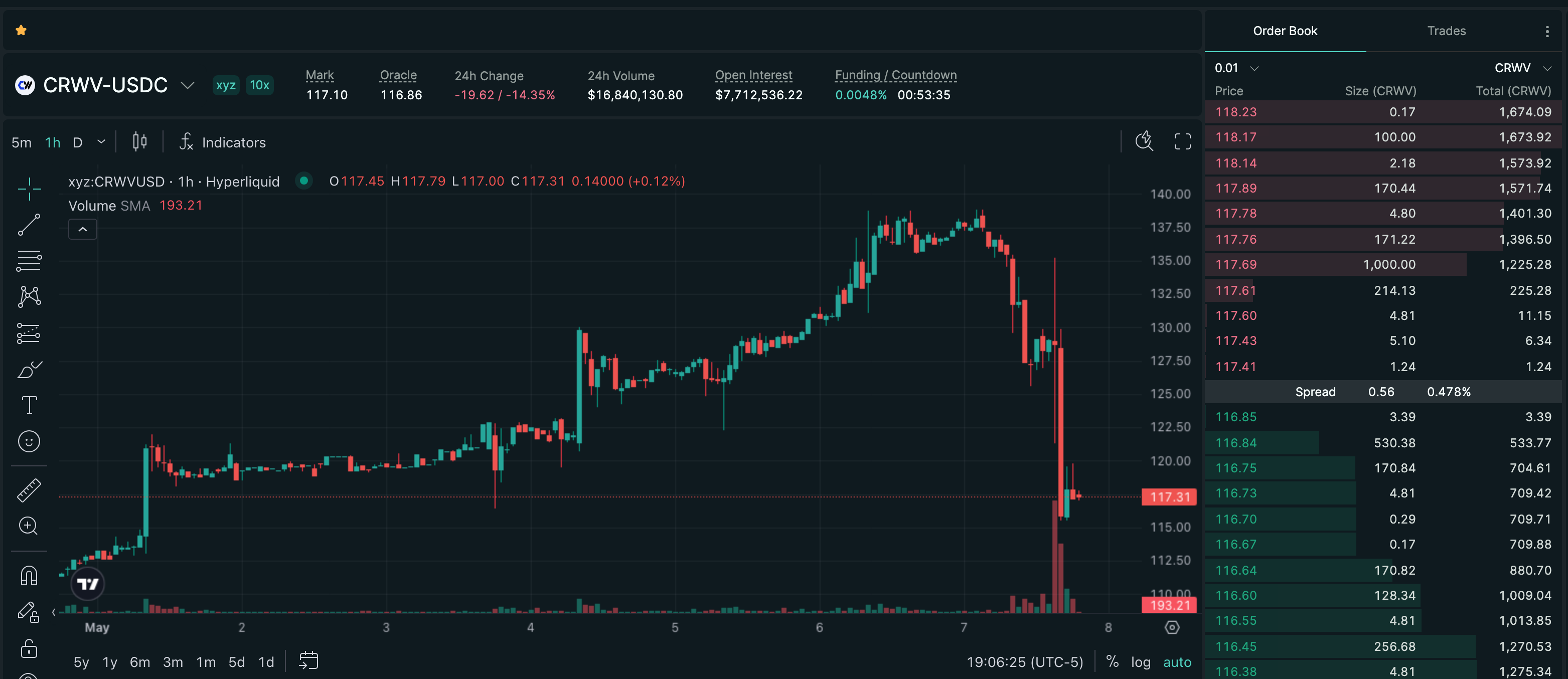
CoreWeave printed a revenue beat for Q1 2026 — $2.08 billion against a $1.97 billion consensus — but the rest of the release pulled the stock the other way. Q2 guidance landed at a $2.45-2.6 billion range, with the $2.53 billion midpoint trailing the $2.69 billion LSEG consensus, and 2026 capex was nudged up to $31-35 billion from a prior $30-35 billion floor on higher component costs. The $99.4 billion backlog and Meta's incremental $21 billion commitment kept the long-term story intact, but near-term margins are the variable getting repriced.
Mover Brief
The Print
CoreWeave reported Q1 2026 after the close on May 7 with revenue of $2.08 billion versus a $1.97 billion LSEG consensus, more than doubling from $981.8 million a year earlier. The bottom line went the other way: an adjusted loss of $1.12 per share against a $0.90 expected loss, with net loss widening to $740 million from $315 million in the year-ago quarter.
The operational story stayed strong. Revenue backlog hit a record $99.4 billion, up from $66.8 billion at year-end, contracted power reached roughly 3.5 gigawatts, and the company now has 10 clients committed to spending at least $1 billion. The headline-grabbing add was Meta's incremental $21 billion commitment running 2027 through 2032, on top of a prior $14.2 billion arrangement.
Why the Beat Didn't Save It
Two numbers did the damage. Q2 revenue guidance landed at $2.45-2.6 billion, with the $2.53 billion midpoint roughly $160 million short of the $2.69 billion LSEG consensus. And 2026 capex got walked up to $31-35 billion from the prior $30-35 billion range, with management attributing the floor revision to higher component prices.
The CFO explicitly flagged that adjusted operating income came in "lower than expected as a result of deploying infrastructure ahead of our expectations" — a confirmation that margin compression is real, not a one-quarter timing issue. For a name where the bear case has always been the cost of building faster than cash flow, a soft Q2 print plus more spend is the worst-possible combination of variables to move in tandem. CRWV tumbled 10% in extended trading before extending lower into the next session.
The Bull Case Hasn't Broken
Strip the price action away and the structural story is unchanged. The $99.4 billion backlog is the largest in the company's history, the customer base is broadening past OpenAI and Microsoft into a 10-name $1B+ club, and CoreWeave reiterated its $12-13 billion full-year revenue target along with the $30 billion-plus annualized run-rate by end of 2027.
It also still has the cheaper cost of capital it unlocked in March — the $8.5 billion investment-grade DDTL facility priced fixed-rate paper at 5.9% versus the 9% it was paying as recently as July 2025. That financing arc is what makes the current capex hike survivable. The question the market is asking after this print is one of timing: how long does margin compression run before the backlog converts into operating leverage, and at what cost in equity dilution or further debt issuance along the way.
Sources & Provenance
Citations below are preserved as structured Postgres source rows for this brief.
Citations Preserved
6
Reference links carried forward from the published mover record.
Original Signal
Open source tweetMarket Route
Direct route preserved for readers who want to inspect the tracked Hyperliquid market behind this archive entry.
Already onboarded? Open tracked market- 1CNBC: CoreWeave Q1 2026 earnings reportcnbc.com
- 2Sherwood News: Q1 results, backlog nearing $100 billionsherwood.news
- 3CNBC: Meta's incremental $21 billion CoreWeave commitmentcnbc.com
- 4TipRanks: CRWV plunges after disappointing guidancetipranks.com
- 5Yahoo Finance: 2026 capex hike and margin pressurefinance.yahoo.com
- 6Stocktitan: Q1 revenue doubles, backlog hits $99.4Bstocktitan.net
This content is for informational purposes only and does not constitute financial advice. Trading perpetual futures involves substantial risk of loss.
Trade CRWV on Hyperliquid
Use referral code HIPERWIRE for 4% off trading fees on your first $25M in volume.
Live Market Metrics
Monitor real-time open interest and funding for CRWV.