DRAM Falls Below Its Inception Average as the Memory Bear Market Deepens
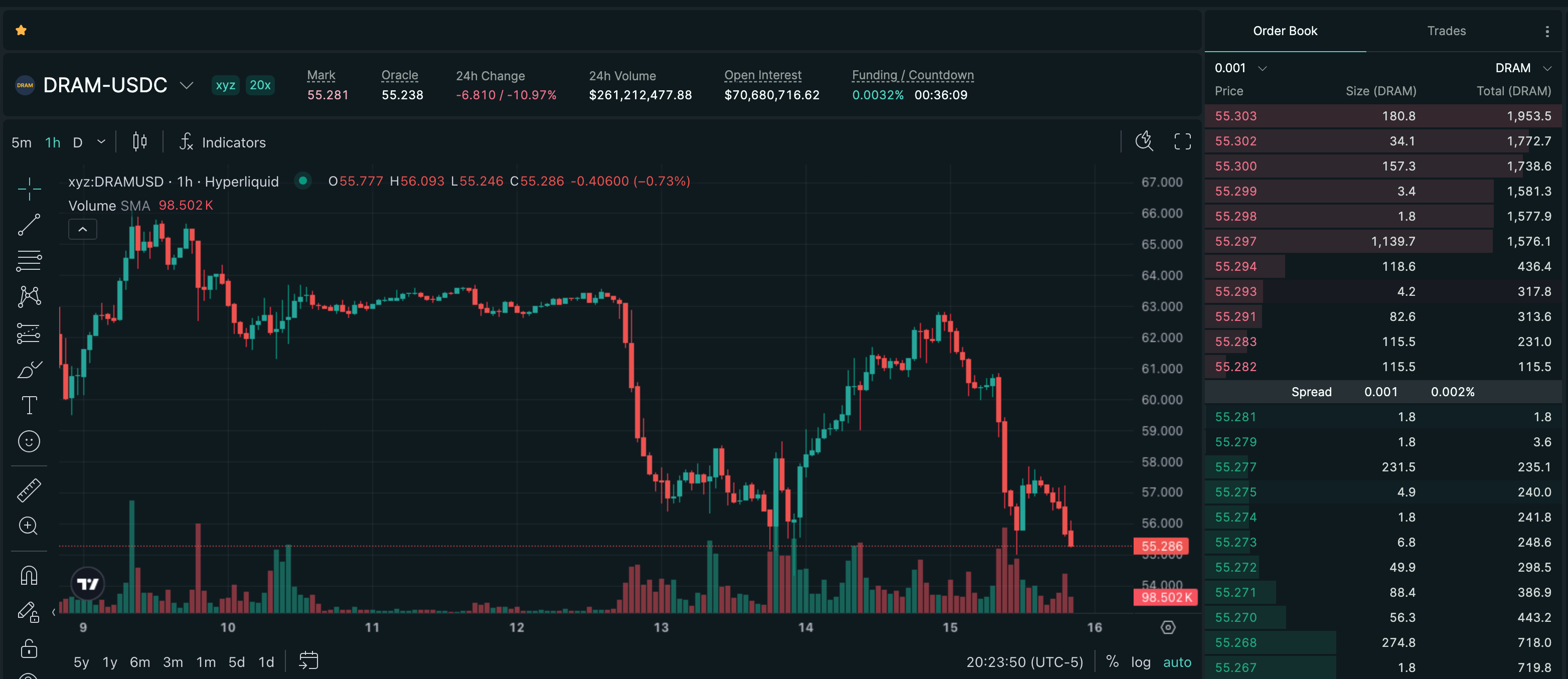
DRAM's two-day bounce evaporated. The Roundhill Memory ETF fell 11.33% to $55.28 and, for the first time since its April launch, closed below its volume-weighted average price since inception — meaning the average buyer is now underwater. This is not a DRAM-specific crack. It is pure beta to a memory group that has shed roughly $1.5 trillion in market value since June 25 and slipped into a bear market, even as contract DRAM prices keep rising and DDR5 margins sit near record highs. What broke is positioning after a parabolic run, not demand.
Mover Brief
The Bounce That Didn't Hold
DRAM came into this week trying to reclaim its footing after a two-day rebound briefly lifted it back toward $62. The recovery didn't survive. The ETF fell 11.33% over the past 21 hours to $55.28, wiping out the bulk of that bounce and closing back below its 50-day moving average.
The more telling number isn't the daily move — it's the milestone underneath it. On July 14 the fund closed below its volume-weighted average price since inception for the first time. Roundhill only launched the product on April 2, and it spent its entire life above water until this week. Cross that line and the average holder is now sitting on a loss — a psychological threshold that tends to invite more selling, not less.
Why the Whole Group Cracked
None of this is DRAM-specific. The fund is a concentrated basket — roughly three-quarters of its weight sits in Micron, Samsung and SK Hynix — so it trades as pure beta to the memory complex. And that complex just entered a bear market. Semiconductor names have shed about $1.5 trillion in market value since June 25, with Micron alone giving back nearly $350 billion over seven trading days.
The proximate trigger was SK Hynix. A Korean brokerage pegged its Q2 profit roughly 8% below consensus on slower-than-expected HBM4 shipments, dragging Micron, SanDisk and Western Digital down about 6% in sympathy. It's the same story that first spread from Wall Street to Seoul at the start of the month, and it hasn't let up.
Demand Didn't Break — Positioning Did
Here's the part the tape is obscuring: the memory cycle itself still looks strong. SK Hynix is reallocating capacity from HBM4 toward conventional DDR5 precisely because general-purpose DRAM has become so profitable — analysts peg DDR5 operating margins near 90%. Contract prices are still climbing, and even Samsung's record earnings couldn't stop the slide, which is the tell.
What corrected was valuation, not fundamentals. After a run that had the group up roughly 60% off the March lows, the crowd's willingness to keep paying up finally snapped. For a concentrated, leverage-friendly product like DRAM, that unwind cuts twice: it captures the full downside of a positioning reset with none of the diversification to cushion it. The demand story is intact — the trade got too crowded.
Sources & Provenance
Citations below are preserved as structured Postgres source rows for this brief.
Citations Preserved
6
Reference links carried forward from the published mover record.
Original Signal
Open source tweetMarket Route
Direct route preserved for readers who want to inspect the tracked Hyperliquid market behind this archive entry.
Already onboarded? Open tracked market- 1GuruFocus: DRAM's First Close Below Inception Average Pricegurufocus.com
- 2Yahoo Finance: Micron, Samsung, SK Hynix drag memory stocks into a bear marketfinance.yahoo.com
- 324/7 Wall St: SK Hynix's weak outlook rattles memory stocks247wallst.com
- 4CNBC: Samsung, SK Hynix shares tumble as chip rout spreadscnbc.com
- 5OC3D: SK Hynix to prioritise DDR5 expansion over HBM4overclock3d.net
- 6Roundhill Investments: DRAM ETF fund pageroundhillinvestments.com
This content is for informational purposes only and does not constitute financial advice. Trading perpetual futures involves substantial risk of loss.
Trade DRAM on Hyperliquid
Use referral code HIPERWIRE for 4% off trading fees on your first $25M in volume.
Live Market Metrics
Monitor real-time open interest and funding for DRAM.