DRAM Grinds Lower as Korea's Leveraged Unwind Meets Memory-Cost Fear
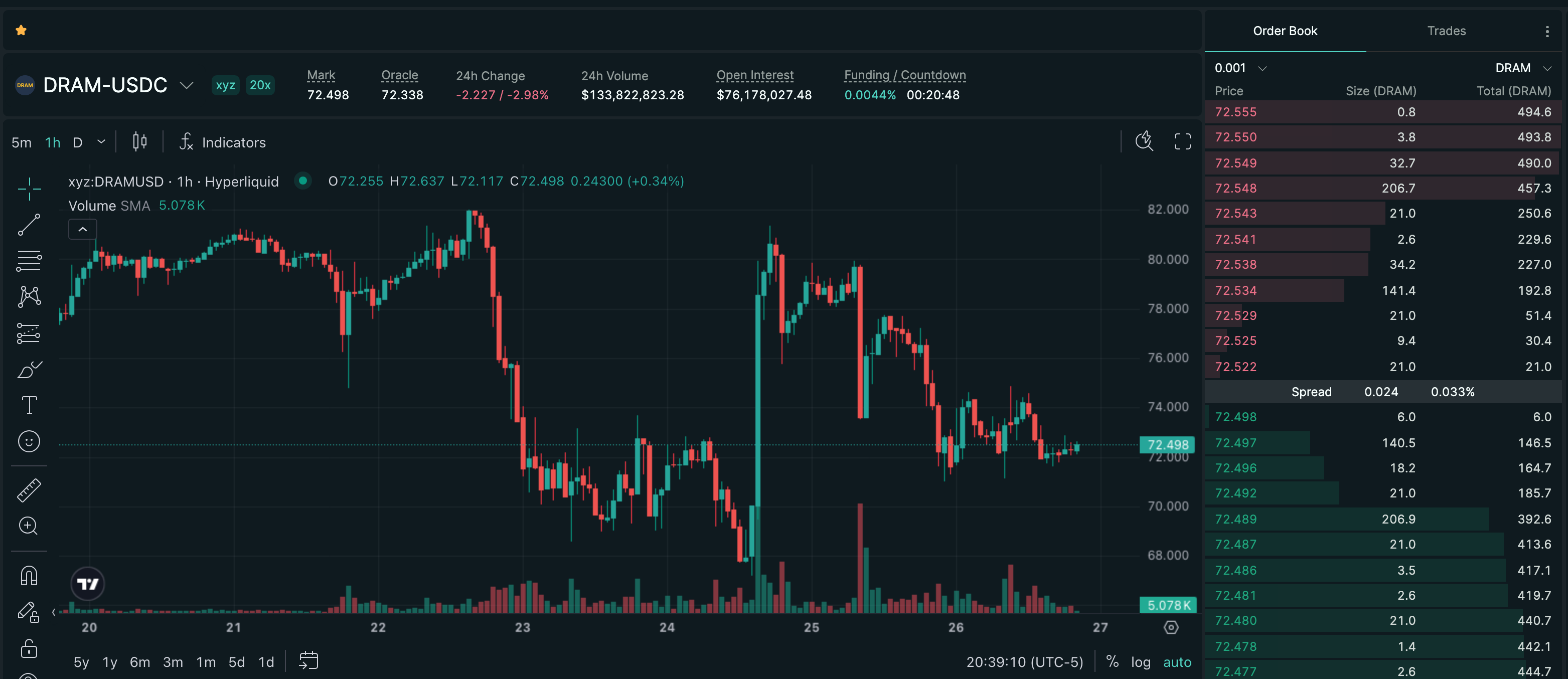
DRAM slipped 3% to $72.51, a quiet print to close a violent week in which the Roundhill Memory ETF swung double digits. The move has little to do with memory demand and almost everything to do with mechanics: nearly half the fund is SK Hynix and Samsung, and Korea's single-stock leveraged ETFs have been force-selling those names by the billions. Layer on a fresh Wall Street worry that rising memory prices will squeeze tech margins, plus a July 10 SK Hynix ADR listing that adds supply, and you get a basket whipsawed by everything except its own fundamentals.
Mover Brief
A Korean Memory Basket Wearing a US Wrapper
Before assigning blame to memory demand, look at what DRAM actually holds. The Roundhill Memory ETF is a concentrated bet on the memory supply chain — HBM, DRAM and NAND makers — but its single largest exposures sit in Seoul: roughly SK Hynix at 25.95%, Samsung Electronics at 20.27%, and Micron at 6.41%. That means about 46% of the fund is two Korean chipmakers.
So when those two names get violently repriced in Korean trading, DRAM inherits the move regardless of what the underlying memory market is doing. Today's 3% slide to $72.51 is actually a calm session by this week's standards — the ETF has printed double-digit intraday swings inside a 52-week range that runs from $26.14 to $81.34. The price action this week has been a story about who is doing the selling, not about end demand for chips.
The Mechanical Driver: Korea's Leveraged-ETF Unwind
The selling pressure traces back to a financial product, not a fundamentals call. South Korea launched single-stock leveraged ETFs on Samsung and SK Hynix in late May, and retail piled in fast — assets ballooned toward roughly $9.1 billion with about 92% retail ownership. Leveraged funds have to buy more as their stocks rise and sell as they fall to keep their 2x ratio, which turns them into forced momentum traders.
When Samsung and SK Hynix had their worst single day since 2008, that machinery went into reverse: leveraged ETFs tracking the pair sold an estimated $6 billion of shares to rebalance, amplifying the drop into the close. The reflexivity got loud enough that Korea's own regulator turned on the products — FSS Governor Lee Chan-jin sharply criticized the ETFs as a windfall for brokerages, pegging trading commissions at $3 billion to $6.4 billion while warning of market distortion. For DRAM holders, the takeaway is uncomfortable but simple: a chunk of your fund's recent volatility is being set by Korean retail leverage, not by the memory cycle.
The Bear Case That Cuts Against the Supercycle
There is a genuine fundamental worry layered on top of the mechanics, and it's an interesting one because it inverts the bull thesis. The bull case for memory is a shortage — Micron and peers have been redirecting output to high-margin data-center customers, leaving a supply crunch for consumer devices and sending electronic-component prices up sharply year over year. Pricing power should be good for memory makers.
The new fear is that this pricing power becomes a tax on everyone downstream. Semiconductor stocks retreated as Apple raised prices to offset surging memory costs and Microsoft lifted Xbox pricing, feeding the idea that expensive memory eventually dents end demand for phones and PCs. That is the tension sitting inside DRAM right now: the same memory shortage that makes the basket's holdings more profitable is also the thing markets are starting to worry will choke the devices those chips go into. The 3% print is the market refusing to fully commit to either read.
What to Watch: July 10
The next dated catalyst is a supply event, not a demand one. SK Hynix plans to list American depositary receipts on Nasdaq on July 10, targeting roughly $29.4 billion in proceeds from about 17.8 million new shares. For DRAM's single largest holding, that is fresh equity supply hitting the market, and an overhang the ETF will feel given its weighting.
The more durable thing to track is whether the Korean leveraged-ETF complex keeps dictating price. As long as ~46% of DRAM is Samsung and SK Hynix, and as long as Seoul's single-stock leverage stays this large and this retail, the ETF will trade as much on Korean rebalancing flows as on the memory cycle it was built to capture. If regulators force those products to shrink, the mechanical volatility should fade — and DRAM's price should start tracking memory fundamentals again instead of someone else's margin call.
Sources & Provenance
Citations below are preserved as structured Postgres source rows for this brief.
Citations Preserved
7
Reference links carried forward from the published mover record.
Original Signal
Open source tweetMarket Route
Direct route preserved for readers who want to inspect the tracked Hyperliquid market behind this archive entry.
Already onboarded? Open tracked market- 1Bloomberg — Leveraged Korea ETFs Sold Estimated $6 Billion of Shares in Routbloomberg.com
- 2KED Global — Korea regulator blasts Samsung, SK Hynix leveraged ETFs as brokerages reap windfallskedglobal.com
- 3Yahoo Finance — Semiconductor stocks retreat over worries about memory costsfinance.yahoo.com
- 4Fortune — 'Memory supply crisis': Wall Street triggers huge selloff over chip shortagesfortune.com
- 5The Motley Fool — Is the Roundhill Memory ETF (DRAM) a Buy Before July 10?fool.com
- 6TradingKey — Korea plans special control measures on Samsung and SK Hynix leveraged ETFstradingkey.com
- 7Roundhill Investments — Memory ETF (DRAM) strategy and holdingsroundhillinvestments.com
This content is for informational purposes only and does not constitute financial advice. Trading perpetual futures involves substantial risk of loss.
Trade DRAM on Hyperliquid
Use referral code HIPERWIRE for 4% off trading fees on your first $25M in volume.
Live Market Metrics
Monitor real-time open interest and funding for DRAM.