DRAM Slides as Korea's $1.3T Chip Buildout Revives Memory Oversupply Fears
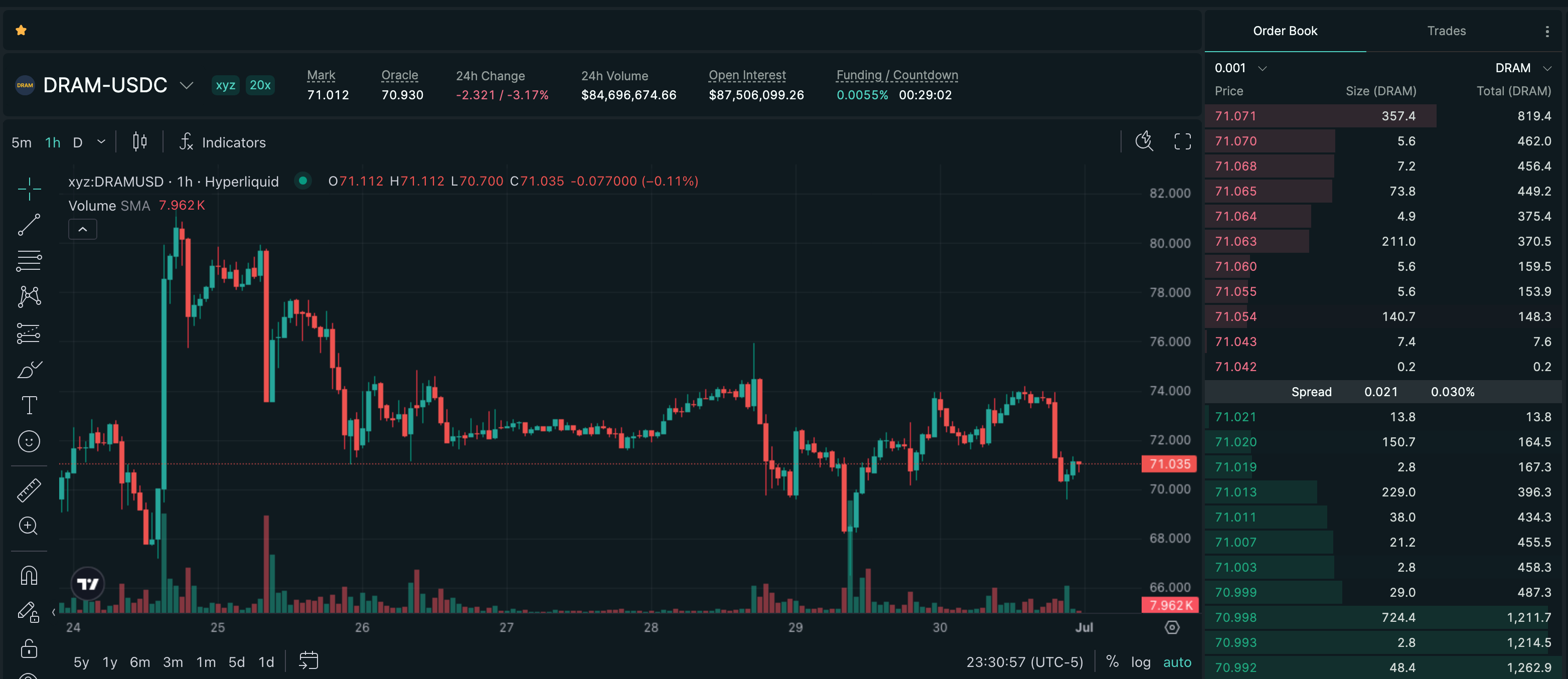
The Hyperliquid DRAM perp is down 3.91% over six hours to $71.06, tracking a selloff in the memory-chip basket it mirrors. The trigger is confirmation that Samsung and SK Hynix will pour as much as $1.3 trillion into new Korean fabs over the next decade — a capacity buildout that reads as future oversupply for a basket whose entire bull case is record DRAM prices. A fresh U.S. antitrust suit accusing the same three memory makers of rigging supply adds a second crack in the thesis. The structural pull is still July 10, when top holding SK Hynix debuts roughly $29 billion of ADRs on Nasdaq.
Mover Brief
The $1.3 Trillion Problem
DRAM doesn't hold a single chip — it holds the companies that make them, and roughly three-quarters of the fund sits in Samsung, SK Hynix and Micron. So when Samsung and SK Hynix confirmed plans to invest as much as $1.3 trillion (2,000 trillion won) over the next decade, the basket moved with them. Of that total, about 800 trillion won (~$520 billion) is earmarked for a national semiconductor project that includes four new fabs — two each from Samsung and SK Hynix — plus expanded HBM and NAND capacity, with the government fast-tracking approvals to pull construction forward by up to a decade.
Here's the tension. Capex this large is a vote of confidence in AI memory demand, but it's also a promise of supply. The entire bull case for a memory basket is that DRAM and HBM prices stay elevated — commodity DRAM has run up roughly 700% over four years on tight supply. A decade of new fabs is precisely the thing that eventually breaks that tightness. The cash market read it that way immediately: Samsung dropped 4% in Seoul and SK Hynix slipped nearly 2%, and the Hyperliquid perp faded 3.91% over six hours to $71.06 alongside them. This is the perp tracking its basket down on a real catalyst — not off-hours noise.
The Lawsuit Aimed at the Thesis
Layered on top is a legal problem that goes at the pricing power directly. On June 25, seventeen plaintiffs sued Samsung, SK Hynix and Micron in U.S. federal court, alleging the three memory makers colluded to keep DRAM artificially scarce. The specific claim is sharp: that they used the industry-wide pivot to high-bandwidth memory as cover to cut DDR3 and DDR4 output, squeezing supply and forcing buyers into 'supracompetitive' prices. The suit seeks treble damages.
Whatever the eventual merits, the framing matters for anyone long the basket. The bull thesis and the antitrust complaint describe the same fact — record memory prices — and disagree only on whether it's a supercycle or a cartel. And it's not the first time the question has been asked: SK Hynix has pleaded guilty to DRAM price-fixing before, paying a $185 million U.S. fine back in 2005. A live case reintroduces the tail risk that today's pricing is partly regulatory-fragile rather than purely structural — exactly the kind of doubt that turns a crowded, in-the-money trade into fast profit-taking.
A Concentrated Basket Into July 10
None of this changes what DRAM structurally is: a very concentrated bet, with about 73% of assets in its top three names — Samsung, SK Hynix and Micron each near a quarter of the fund, with SanDisk rounding out the core. That concentration is why the perp mirrors headline risk on any one of them so cleanly; there's almost no diversification to absorb a single name's bad day. The ETF only launched April 2 and became one of the fastest-growing funds on record, so its price history is thin and most holders are still in the green — which makes it prone to quick unwinds on exactly this kind of news.
The date that still anchors the trade is July 10, when top holding SK Hynix is set to debut roughly $29 billion of ADRs on Nasdaq via 17.79 million new shares — the single largest catalyst on the basket's calendar and a direct U.S.-market read on memory sentiment. Between now and then, this perp trades as a proxy for two competing stories: AI-driven scarcity versus a coming wave of Korean supply. Today the market leaned toward the second.
Sources & Provenance
Citations below are preserved as structured Postgres source rows for this brief.
Citations Preserved
8
Reference links carried forward from the published mover record.
Original Signal
Open source tweetMarket Route
Direct route preserved for readers who want to inspect the tracked Hyperliquid market behind this archive entry.
Already onboarded? Open tracked market- 1CNBC: Samsung and SK Hynix's ~$1.3 trillion semiconductor and AI mega-projectscnbc.com
- 2Tom's Hardware: Korea's ~$520B plan with four new memory fabs and HBM facilitiestomshardware.com
- 3Tom's Hardware: Samsung, SK Hynix, Micron sued over alleged DRAM price-fixingtomshardware.com
- 4Reuters via Yahoo Finance: Memory makers face antitrust class actionfinance.yahoo.com
- 5Yahoo Finance: Why the DRAM ETF is falling on the investment newsfinance.yahoo.com
- 6Yahoo Finance: DRAM ETF holds 73% in just three companiesfinance.yahoo.com
- 7CNBC: SK Hynix plans ~$29 billion Nasdaq ADR listing as soon as July 10cnbc.com
- 8Motley Fool: DRAM ETF concentration and record-fast growthfool.com
This content is for informational purposes only and does not constitute financial advice. Trading perpetual futures involves substantial risk of loss.
Trade DRAM on Hyperliquid
Use referral code HIPERWIRE for 4% off trading fees on your first $25M in volume.
Live Market Metrics
Monitor real-time open interest and funding for DRAM.