EWY Erases Its Rebound as Korea's Chip Selloff Resumes and the Won Hits a 17-Year Low
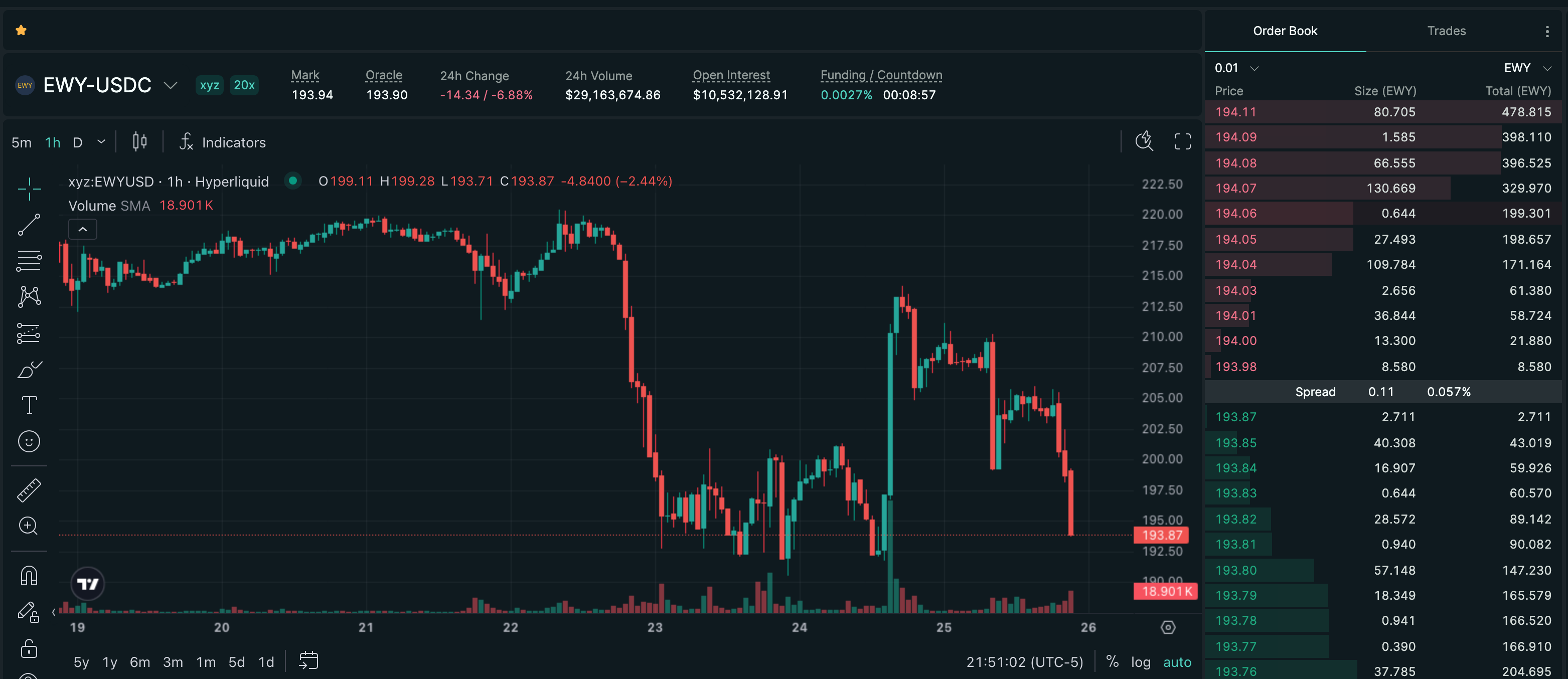
EWY's HIP-3 perp is back to $193.80, down 7.53% over 14 hours and below where it traded before this week's whipsaw. The dead-cat bounce off Tuesday's near-10% Kospi crash has fully unwound: Korean equities rolled over again as Samsung and SK Hynix led another round of foreign selling, and the 90 trillion won Samsung buyback that powered the rebound turned out to be unconfirmed speculation. The bigger driver for a dollar-priced ETF is the currency. The won just closed at its weakest level against the dollar since 2009, so EWY holders eat a translation loss on top of falling shares.
Mover Brief
The Bounce That Couldn't Hold
EWY's HIP-3 perp is trading at $193.80, down 7.53% over the past 14 hours and now below the levels it held before Korean equities started whipsawing this week. Two sessions ago the fund was at $204.90, clawing back part of a near-10% Kospi crash on a single report that Samsung was planning a massive buyback. That move has now fully reversed.
The round trip tracks Seoul. After the Kospi cratered 9.99% into a circuit breaker on June 23 — one of its steepest single-day drops on record — the index spent two sessions grinding higher, only to roll over again as foreign investors resumed selling Samsung and SK Hynix. For a fund where two memory names carry the index, there is no second engine: when Samsung and SK Hynix turn, EWY turns with them.
The Buyback Was a Rumor, Not a Plan
The catalyst that produced the rebound was never a committed plan. The number that ripped through the tape — a 90 trillion won ($58.6 billion) Samsung buyback — came out of market speculation, and Samsung's own statement walked it back: the company said it is only reviewing the possibility of repurchasing treasury shares to fund stock-based compensation, with no timing or scale finalized and an update promised within a month. For scale, 90 trillion won spread over three years would be roughly triple Samsung's 30.7 trillion won of cumulative buybacks across the entire past decade — large enough to explain why the rumor moved the index, and why its retraction let the air back out.
Samsung jumped as much as 7.58% on the report before fading to a 2.42% gain as the rebound lost breadth. Domestic retail bought 8.54 trillion won, but that was overwhelmed by institutions and foreigners dumping a combined ~8.7 trillion won. A bounce built on an unconfirmed press report and carried by local retail is exactly the kind that fails on the next risk-off candle.
The Won Is Doing Half the Damage
Here is the part that matters most if you are trading EWY rather than the Kospi directly: the ETF is priced in dollars, and the won is collapsing. It closed at 1,541.8 per dollar on June 24, the first time it has cleared 1,540 since March 2009 — a 17-year low. A dollar-based holder of Korean equities takes the hit twice: once on the share-price decline, and again when those won-denominated shares are translated back into a stronger dollar.
The mechanism is self-reinforcing. Foreign investors net sold 4.6 trillion won of Korean stock in a single session and 11.7 trillion won across four sessions; each of those exits converts won proceeds into dollars, adding to the currency's slide, which in turn deepens the dollar loss on EWY. That loop is why the perp is printing a 7.53% drop while the underlying index's local-currency move is smaller.
Forced Sellers vs. 'Cheapest in the AI Era'
The pressure is more structural than fundamental. Strategists have framed the foreign exodus as forced selling driven by index mechanics — as Korean chip names rallied, their weight in global benchmarks ballooned, pushing active managers to trim to stay within risk limits. The disappointment that MSCI again kept Korea in its emerging-market index rather than upgrading it to developed status removed a potential offsetting flow. And the concentration is extreme — chip-linked stocks make up roughly 61.7% of the index, so leveraged SK Hynix products fell 25.6% during the crash and dragged everything with them.
The other side is worth stating, because it is why the bounces keep happening. Local analysts argue Samsung and SK Hynix are now the 'cheapest stocks in the AI era,' undervalued versus global peers despite the rally. If that view is right, EWY at $193.80 is a discount on the same AI-memory thesis that drove it to records weeks ago. But until the won stops sliding and foreigners stop selling, the dollar-priced version of that thesis stays under water no matter how cheap the shares look in Seoul.
Sources & Provenance
Citations below are preserved as structured Postgres source rows for this brief.
Citations Preserved
7
Reference links carried forward from the published mover record.
Original Signal
Open source tweetMarket Route
Direct route preserved for readers who want to inspect the tracked Hyperliquid market behind this archive entry.
Already onboarded? Open tracked market- 1Bloomberg — Korean stocks fall from record on tech selloff (June 23)bloomberg.com
- 2The Elec — Samsung says no decision made on 90 trillion won buybackthelec.net
- 3Seoul Economic Daily — Won closes above 1,540 per dollar, first in 17 yearsen.sedaily.com
- 4EBC Financial Group — Kospi recovery fades after Samsung's 7% jumpebc.com
- 5CNBC — Why foreign investors are selling Kospi, Samsung, SK Hynixcnbc.com
- 6Reuters — MSCI keeps South Korea in emerging-market indexreuters.com
- 7The Asia Business Daily — Samsung, SK Hynix still undervalued vs global peersasiae.co.kr
This content is for informational purposes only and does not constitute financial advice. Trading perpetual futures involves substantial risk of loss.
Trade EWY on Hyperliquid
Use referral code HIPERWIRE for 4% off trading fees on your first $25M in volume.
Live Market Metrics
Monitor real-time open interest and funding for EWY.