Donghak Ants Storm Back: EWY Surges 9% as KOSPI Posts Biggest Rebound Since 2008
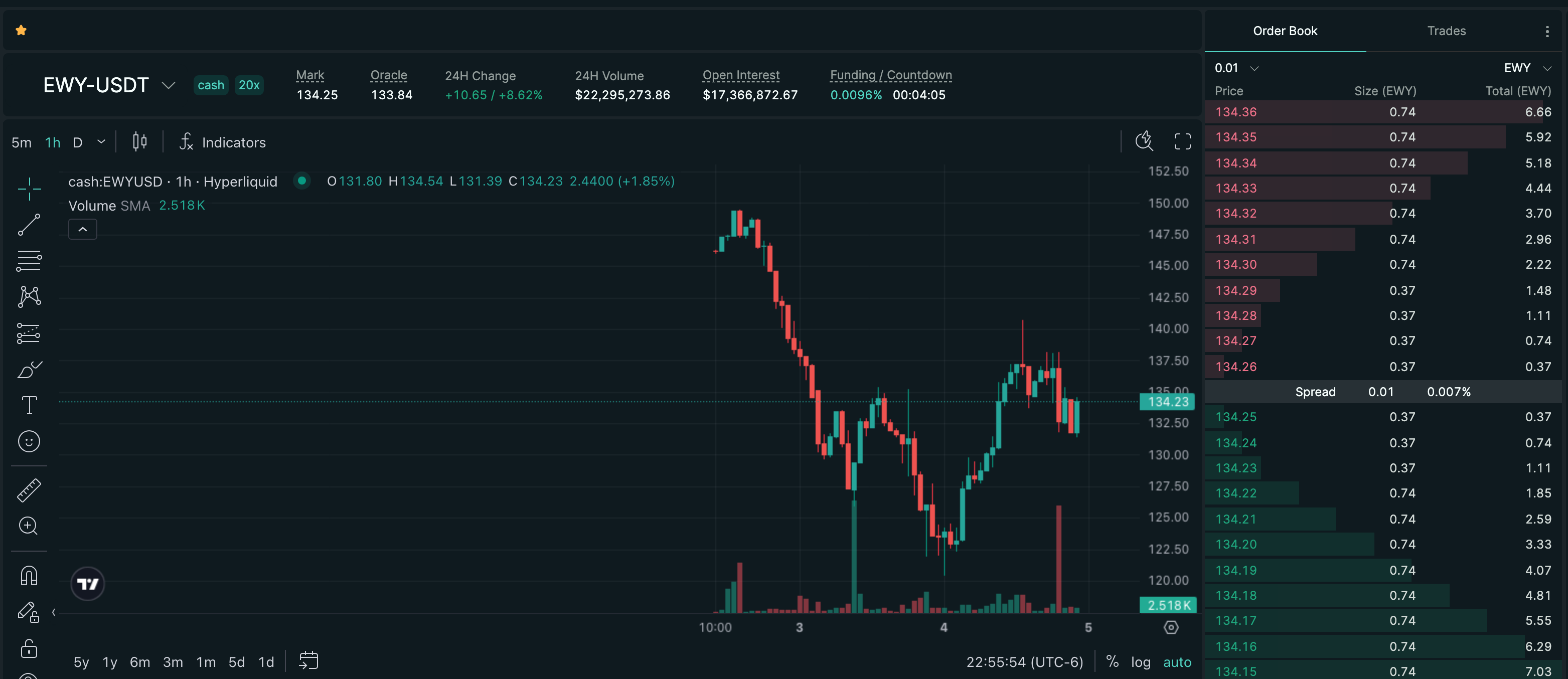
EWY ripped 9.26% over 21 hours on Hyperliquid, tracking what turned out to be the largest single-day point gain in KOSPI history. The KOSPI surged 9.63% on March 5, closing at 5,583.90 — just one day after crashing 12.1% in what the Korean press is calling Black Wednesday. South Korean retail investors — the so-called Donghak Ants — showed up in force to buy the dip while foreign institutions kept dumping.
Mover Brief
What Happened
The March 5 session was nothing short of historic. The KOSPI added 490.36 points, its second-steepest percentage gain since October 2008 when the index rose 11.95% during the global financial crisis. Market bellwether Samsung Electronics surged 11.27% to 191,600 won, while chip giant SK Hynix soared 10.84% to 941,000 won. Hyundai Motor climbed 9.38% and Kia added 6.19%.
This rebound came after a brutal sequence. The KOSPI had plunged 12.1% on March 4, its worst single-day drop in history, triggering Level 1 circuit breakers within minutes of the open. The index gapped down 8% at the bell and kept falling. Foreign investors offloaded billions in shares before trading curbs kicked in. Over two consecutive sessions of selling, foreigners dumped an estimated 12 trillion won.
For EWY — the iShares MSCI South Korea ETF that this Hyperliquid perp tracks — the US-listed fund had already dropped roughly 10% on March 3-4 before snapping back. Despite the violent round-trip, EWY remains down from its recent highs. The broader context matters: South Korea ETFs have returned 175% over the trailing 12 months on the back of a generational semiconductor supercycle, so this correction hit an extremely crowded trade.
Why It Moved
The catalyst for the crash was geopolitical, not fundamental. Over the preceding weekend, coordinated US and Israeli strikes hit Iranian military infrastructure. Iran's IRGC retaliated by declaring the Strait of Hormuz closed, deploying naval mines and anti-ship missiles to block the 21-mile-wide passage. For South Korea, which depends on the Strait for nearly 70% of its crude oil and 30% of its natural gas, this was an existential threat to the energy supply chain.
The selloff was amplified by forced liquidation. A wave of margin calls among leveraged retail investors triggered cascading sell orders, pushing the index well beyond what the geopolitical shock alone would justify. Once those margin positions were unwound on March 4, the selling pressure exhausted itself.
The March 5 rebound was driven almost entirely by domestic retail investors. The Donghak Ants — named after a 19th-century Korean peasant uprising — piled into the dip with record daily buying, echoing their behavior during the COVID-19 crash of 2020. Foreign investors continued to be net sellers even during the bounce, meaning the rally was domestically funded against the weight of institutional outflows. That divergence is important: it means the rebound was conviction-driven by local participants who view these levels as fundamentally cheap, not a coordinated institutional re-risking.
The KOSPI's heavy concentration in semiconductors — Samsung and SK Hynix alone make up roughly half the index — means these two names effectively dictated both the crash and the recovery. Both stocks had been punished disproportionately despite having no direct exposure to Middle Eastern oil flows, which suggests the selloff was more about forced liquidation mechanics than sector-specific risk.
What to Watch
The Strait of Hormuz situation remains the key variable. Any escalation — or de-escalation — in the Iran conflict will move Korean equities violently in either direction. Oil prices have stabilized at elevated levels but haven't spiked as dramatically as the equity selloff implied, which could mean the market overshot on the downside.
Foreign investor flows are the other signal to monitor. The Donghak Ants can provide a floor, but a sustained recovery requires foreign capital to stop bleeding out. In the 2020 COVID crash playbook, retail buying held the line for weeks before institutional flows eventually turned. Whether that pattern repeats depends on how quickly the geopolitical premium fades.
The semiconductor cycle itself remains strong — global AI demand continues to drive chip exports and the Korea Development Institute recently upgraded its 2026 growth forecast to 1.9%. The fundamental bull case for Korean equities hasn't changed; the question is whether geopolitical risk repricing has further to run. Watch for circuit breaker triggers and whether the KOSPI can hold the 5,000 level on any retest.
Sources & Provenance
Citations below are preserved as structured Postgres source rows for this brief.
Citations Preserved
16
Reference links carried forward from the published mover record.
Original Signal
Open source tweetMarket Route
Direct route preserved for readers who want to inspect the tracked Hyperliquid market behind this archive entry.
Already onboarded? Open tracked market- 1Seoul shares rebound nearly 10% after worst-ever drop — UPIupi.com
- 2Korean Stocks Rebound as Chipmakers Gain After Record Selloff — Bloombergbloomberg.com
- 3South Korea's Kospi rebounds to clock its best day since 2008 — CNBCcnbc.com
- 4South Korea's Kospi sinks over 12% as Iran conflict fuels risk-off — CNBCcnbc.com
- 5Black Wednesday in Seoul: KOSPI Plummets 12% as Hormuz Crisis Shakes Global Marketsmarkets.financialcontent.com
- 6Donghak Ants Propel KOSPI to Historic 9.63% Surge — Chosunchosun.com
- 7KOSPI soars on March 5 — Yonhapen.yna.co.kr
- 8Global stock markets tumble as Middle East conflict triggers energy shockeconomymiddleeast.com
- 9Global stock markets reel as Strait of Hormuz blockade triggers energy shockeconomymiddleeast.com
- 10Kospi Index crashes 12% amid escalating Iran conflict — Meykameyka.com
- 11South Korea ETFs on a Generational Run — ETF Databaseetfdb.com
- 12Retail Investors Drive Korean Stock Market with Record Buying — Seoul Economic Dailyen.sedaily.com
- 13South Korea markets — New York Timesnytimes.com
- 14KOSPI Rebounds After Rout — EBC Financial Groupebc.com
- 15EWY — Yahoo Financefinance.yahoo.com
- 16Trade EWY on Hyperliquidapp.hyperliquid.xyz
This article is for informational purposes only and does not constitute financial advice. Trading leveraged perpetual contracts carries substantial risk of loss.
Trade EWY on Hyperliquid
Use referral code HIPERWIRE for 4% off trading fees on your first $25M in volume.
Live Market Metrics
Monitor real-time open interest and funding for EWY.