Natural Gas Breaks Below $3 as Spring Shoulder Season Crushes Heating Demand
Henry Hub natural gas has fallen sharply as the market transitions from winter withdrawal season into spring injections, with above-average temperatures forecast across most of the Lower 48 through mid-April. May NYMEX futures settled at $2.887/MMBtu on March 31, the lowest close since late February, as mild weather eliminates residual heating demand and storage levels sit comfortably above the five-year average. The move is striking because it comes against a backdrop of global energy chaos — the Iran war and Strait of Hormuz closure have sent European and Asian gas prices parabolic, but U.S. domestic supply remains insulated from those disruptions.
Mover Brief
The Catalyst: Shoulder Season Meets Mild Weather
May NYMEX natural gas futures settled at $2.887/MMBtu on March 31 — down 13.8 cents on the session — as the contract rolled into the front-month position with soft fundamentals all around. The immediate driver is straightforward: above-average temperatures are forecast across the eastern half of the U.S. from March 30 through April 13, effectively killing what remained of late-season heating demand.
This is the classic natural gas shoulder season — the dead zone between winter heating and summer cooling where demand craters and production keeps flowing. The EIA's latest weekly storage report showed working gas at 1,829 Bcf as of March 20, sitting 90 Bcf above last year and 14 Bcf above the five-year average. The first net injection of 2026 is expected to add roughly 42 Bcf, which would push the year-over-year surplus to 184 Bcf.
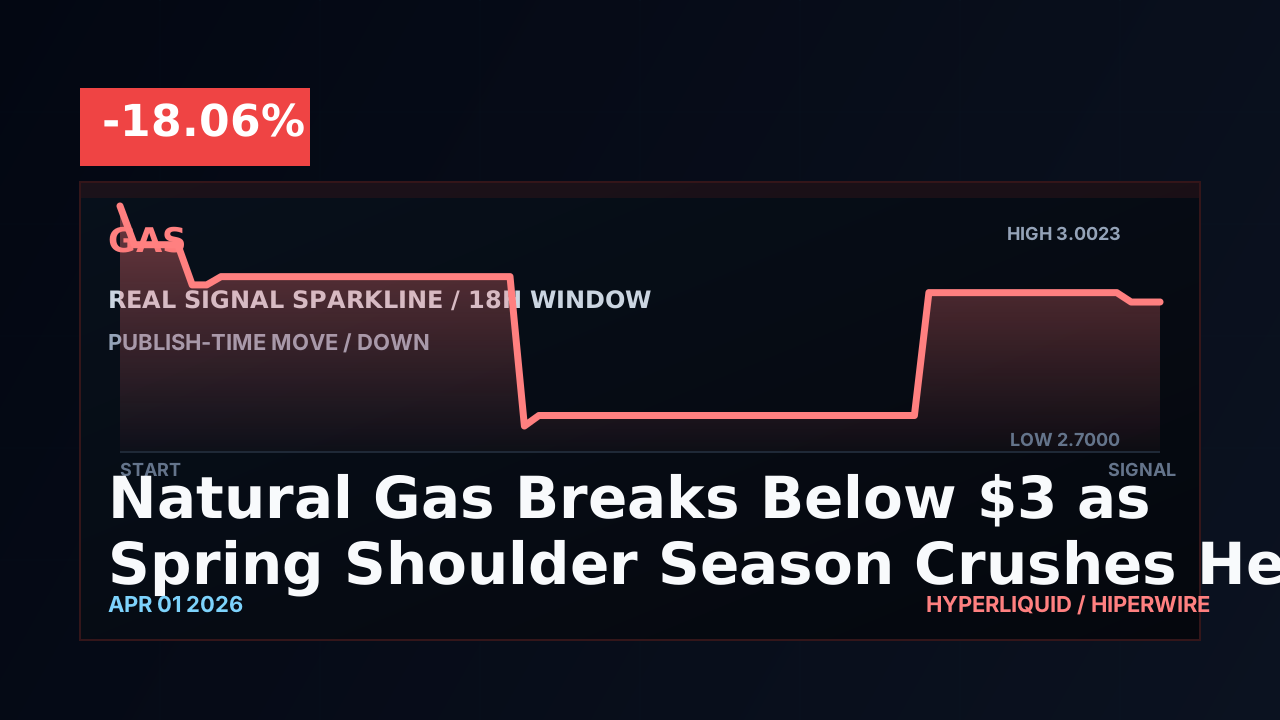
For context, Henry Hub hit $7.72/MMBtu in January during a severe cold snap. It is now trading below $3. That is a 60%+ drawdown in under three months — violent even by natural gas standards.
The Iran War Paradox
Here is the counterintuitive part of this move: the 2026 Strait of Hormuz crisis has caused the largest supply disruption in the history of global energy markets. Iran's closure of the strait on March 4 stranded oil and LNG exports, QatarEnergy declared force majeure, and the March 18 strike on Ras Laffan knocked out 17% of Qatar's LNG production capacity — damage that will take 3-5 years to repair. European TTF benchmarks nearly doubled to over €60/MWh. Asian LNG spot prices surged 140%.
But U.S. Henry Hub barely noticed. American natural gas is overwhelmingly domestically produced and consumed. The Hormuz disruption affects Qatari LNG flowing to Europe and Asia — it does not tighten U.S. domestic supply. The EIA explicitly noted that Henry Hub prices remain relatively insulated from the Strait of Hormuz disruption, and actually *lowered* its 2026 Henry Hub forecast from $4.31 to $3.80/MMBtu.
The geopolitical premium that briefly supported U.S. gas has evaporated. Seasonal fundamentals — mild weather, strong production, comfortable storage — are winning.
What the Curve Is Pricing
The NYMEX futures curve tells you exactly what the market expects: pain now, recovery later. April settled near $3.03, July at $3.43, and December at $4.70. That steep contango reflects the expectation that storage will build through spring and summer, then prices will firm as winter heating demand returns and new LNG export capacity — Plaquemines, Corpus Christi Stage 3, Golden Pass — ramps through the second half of the year.
The risk is asymmetric from here. A hotter-than-normal summer could pull gas demand forward for power generation. Any escalation of the Iran conflict that disrupts U.S. LNG export logistics — unlikely but not impossible — would tighten the domestic market. Conversely, if spring stays mild and production holds at 109+ Bcf/d, prices could test the $2.50 floor before summer demand kicks in.
On the Hyperliquid perp specifically, the 18% drawdown over 18 hours overshot the ~5% move in NYMEX futures. With only $66K in 24-hour volume, the HIP-3 GAS market is thin enough that a few aggressive shorts or liquidations can push price well beyond the underlying benchmark.
Sources & Provenance
Citations below are preserved as structured Postgres source rows for this brief.
Citations Preserved
7
Reference links carried forward from the published mover record.
Original Signal
Open source tweetMarket Route
Direct route preserved for readers who want to inspect the tracked Hyperliquid market behind this archive entry.
Already onboarded? Open tracked market- 1EIA Weekly Natural Gas Storage Reporteia.gov
- 2Natural Gas Intelligence — Spring Weather Reset Sends Cash Natural Gas Lowernaturalgasintel.com
- 3Natural Gas Intelligence — Expected First Injection Would Add to Supply Surplusnaturalgasintel.com
- 4Natural Gas Intelligence — EIA Lowers Henry Hub Forecast Despite Iran Warnaturalgasintel.com
- 5Atlantic Council — How the Iran War Could Trigger a European Energy Crisisatlanticcouncil.org
- 6Wikipedia — 2026 Strait of Hormuz Crisisen.wikipedia.org
- 7EIA Short-Term Energy Outlook — Natural Gaseia.gov
This content is for informational purposes only and does not constitute financial advice. Trading perpetual futures involves substantial risk of loss.
Trade GAS on Hyperliquid
Use referral code HIPERWIRE for 4% off trading fees on your first $25M in volume.
Live Market Metrics
Monitor real-time open interest and funding for GAS.