Arthur Hayes Dumps His Entire HYPE Stack Days After His $100K Bet on It
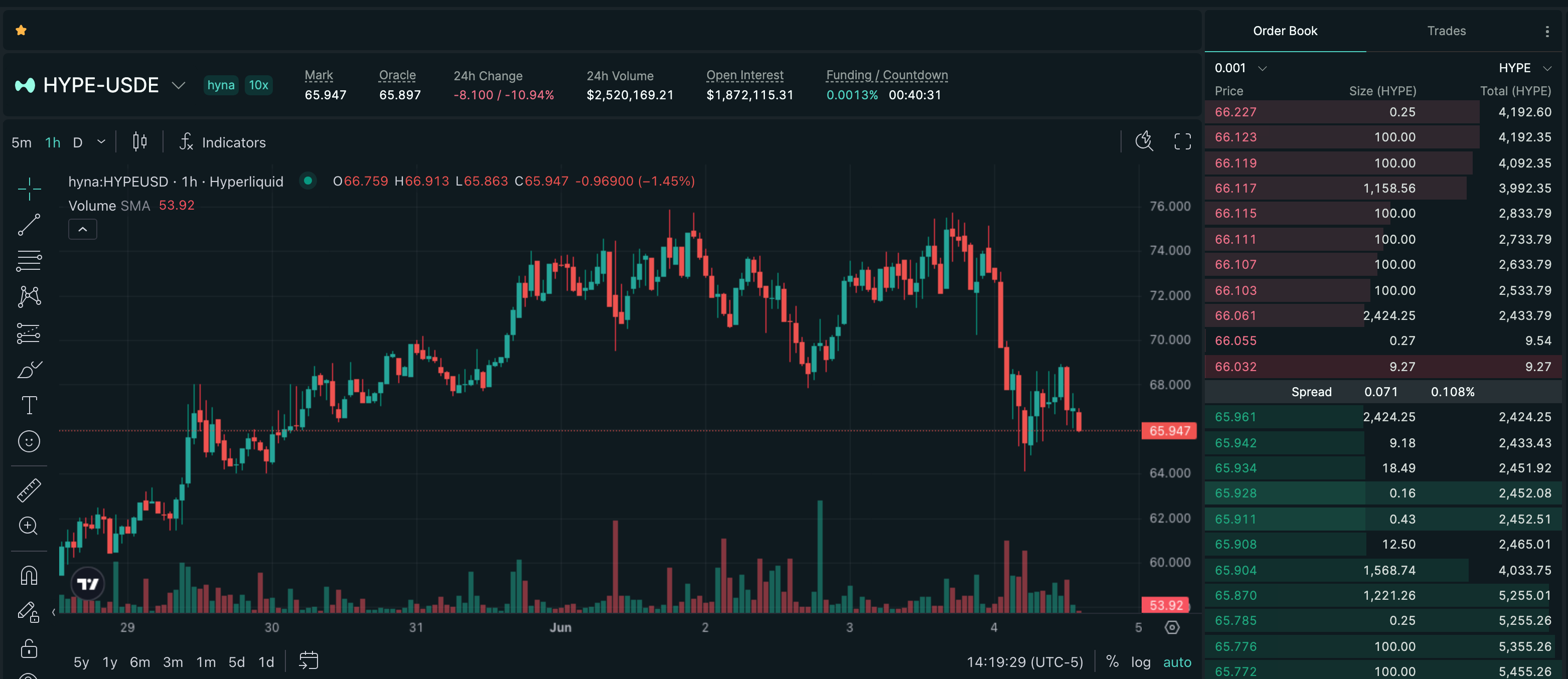
HYPE fell from its $75.51 record to the mid-$60s after Arthur Hayes, one of its loudest backers, sold his full position — roughly 247,000 tokens worth about $18M — and warned of a market top by September. The kicker: he did it the same week he staked a $100,000 charity bet that HYPE would beat every top-10 token this year. His reasons are macro, not Hyperliquid-specific, but the timing landed on top of a 9.92M-token unlock due June 6.
Mover Brief
Hayes Sold the Token He Just Bet $100K On
The move that broke HYPE's record-high run had a name attached to it. On June 4, BitMEX co-founder Arthur Hayes — one of Hyperliquid's most vocal champions — announced he had sold his entire HYPE and NEAR positions. On-chain trackers pegged the HYPE leg at 247,334 tokens worth roughly $18M. "Time to take profit," was the summary.
What made it sting wasn't the size — $18M is not a market-moving sell into ~$40B of weekly perp volume — it was the reversal. Days earlier Hayes had thrown down a $100,000 charity bet against Multicoin's Kyle Samani that HYPE would outperform any current top-10 crypto in dollar terms through year-end, carrying a $150 price target. Selling the position while the bet still stands is the kind of whiplash that moves sentiment more than supply. Arthur Cheong called it "the epitome of a guy that over-trades his position."
His Reasons Aren't About Hyperliquid
Read Hayes' actual rationale and almost none of it is HYPE-specific. He cited rising oil prices tied to the Iran conflict, three large AI IPOs expected before early Q3 that will pull liquidity, and a call that risk markets top out somewhere between now and September. He even floated a thesis that Trump turns anti-AI heading into the midterms. This is a macro de-risking trade, not a verdict on Hyperliquid's fundamentals.
That distinction matters for how you frame the drop. The thing that actually changed at the $75 highs was valuation, not the business. At the top, HYPE traded near 25x projected fee revenue — the richest multiple it's carried in the past year — after a roughly 100% run in a month. When the most prominent bull steps off a position that's stretched against its own fundamentals, the marginal buyer reprices the risk-reward, and that's most of what the 12% does.
The Unlock Sitting Underneath It
The selloff didn't happen in a vacuum. A 9.92 million HYPE unlock — about 1% of supply, roughly $700M — is scheduled for June 6, releasing to core contributors. It's the first of what co-founder Iliensinc has confirmed will be a monthly cadence on the sixth, a deliberately telegraphed schedule so the market absorbs supply rather than gets surprised by it.
The counterweight is real and worth keeping in view: Hyperliquid routes the vast majority of trading fees into HYPE buybacks, which is the structural bid that has absorbed prior supply. So the bear read is "insider unlock into a macro-cautious tape with the lead bull gone," and the bull read is "telegraphed 1% release that recurring buyback revenue is built to eat." At $65.93, the HIP-3 perp is pricing the first interpretation. The June 6 print is the cleanest test of which one holds.
Sources & Provenance
Sources used for this article are linked below. See our methodology for how coverage is produced.
Citations Preserved
6
Reference links carried forward from the published mover record.
Original Signal
Open source tweetMarket Route
No direct market URL was preserved in archive storage.
- 1CoinDesk — HYPE drops 10% as Arthur Hayes exits positioncoindesk.com
- 2BeInCrypto — Hayes dumps entire HYPE and NEAR stack days after $100K betbeincrypto.com
- 3CryptoBriefing — Hayes profit-taking ahead of crowded IPO calendarcryptobriefing.com
- 4Tokenomist — Hyperliquid HYPE unlock eventstokenomist.ai
- 5Netcoins — Hyperliquid's first major HYPE unlock and buyback backdropnetcoins.com
- 6CryptoTimes — Hayes dumps HYPE days after $100K charity betcryptotimes.io
This content is for informational purposes only and does not constitute financial advice. Trading perpetual futures involves substantial risk of loss.