KR200 Drops 12% as Korea's Own Regulator Sets Off a Leveraged-ETF Unwind
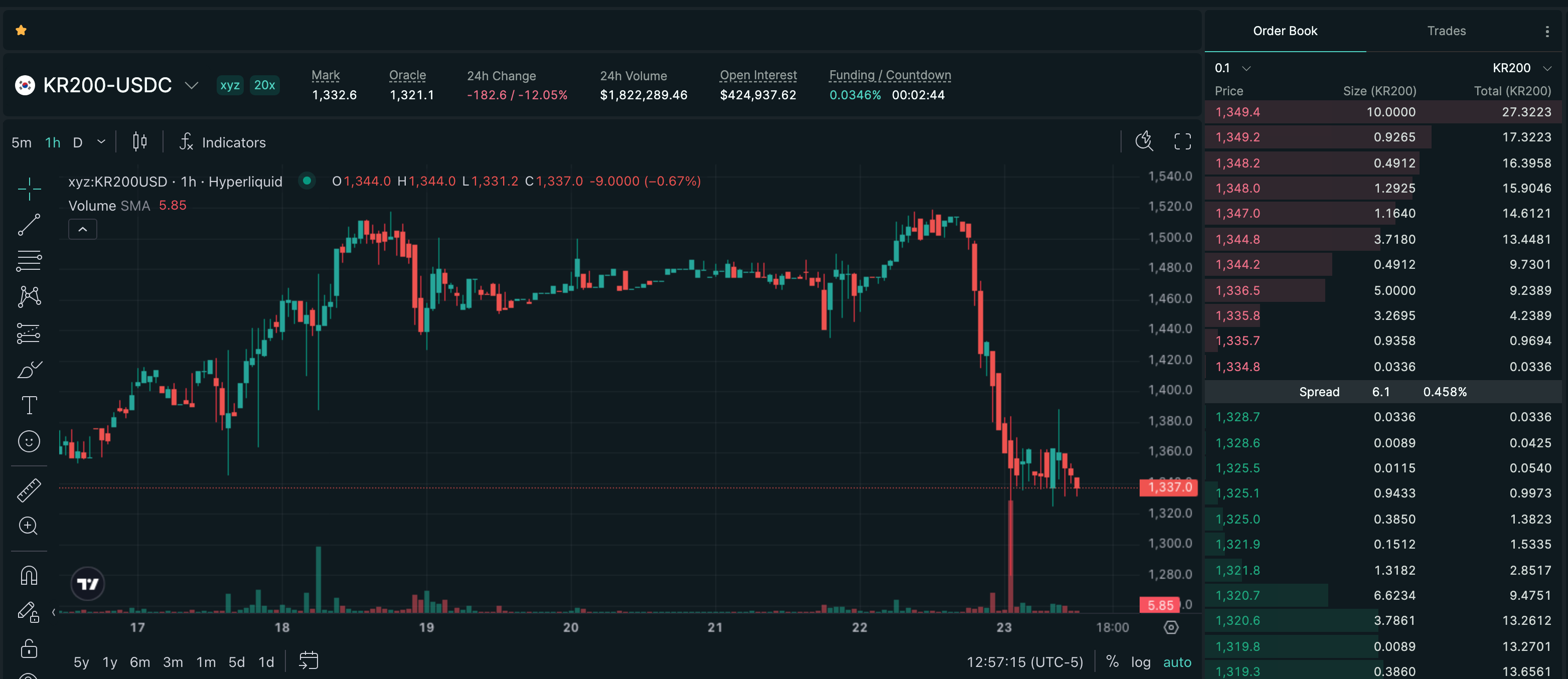
KR200 is down 12.06% over 20 hours, its second double-digit crash this month, but this one didn't start in a US chip-guidance report. It started in Seoul, where Financial Supervisory Service governor Lee Chan-jin went on the record regretting his agency's late-May approval of 16 single-stock leveraged ETFs on Samsung and SK Hynix, products that ballooned to roughly $9.1 billion and are about 92% retail-owned. The admission lit a reflexive unwind: the broad KOSPI fell about 10% and tripped a market-wide circuit breaker, with Samsung and SK Hynix, together nearly half the index, both down more than 12%. On a thin HIP-3 book the perp overshot the cash move.
Mover Brief
The Regulator Lit the Fuse
The catalyst isn't ambiguous. On June 22, Financial Supervisory Service governor Lee Chan-jin said he wished he had done more to block the late-May launch of 16 single-stock leveraged ETFs tracking Samsung Electronics and SK Hynix. His framing was unusually blunt for a sitting regulator: "Half-joking, but I should have just stayed put then, and I have a lot of regrets," he said, calling them high-risk products whose trading hadn't cooled despite repeated warnings.
The numbers behind that regret explain the reaction. Those funds launched in late May with about $3 billion in assets and swelled to roughly 14 trillion won, or $9.1 billion, with about 92% of holders being retail investors. Leveraged ETFs have to buy and sell the underlying as prices move to keep their daily exposure on target, which means once the index turns, the products themselves become forced sellers into the decline. Goldman Sachs estimated that a 5% swing in Korean equities could trigger around $4.7 billion in rebalancing flows from options dealers alone. The governor effectively told a 92%-retail crowd that the thing they're piled into was a mistake, and the mechanical unwind did the rest.
Two Stocks Are Half the Index
KR200 tracks the KOSPI 200, and that index lives or dies on two names. Samsung Electronics fell 12.31% to 310,000 won and SK Hynix dropped 12.47% to 2,555,000 won, and together the pair sits at close to half the index's weight while carrying the bulk of its 2026 gains. When both memory giants fall more than 12% on the same session, there is no diversification left to cushion it.
The tape showed it. The broad KOSPI closed down about 10% — its steepest drop since March — and Korean stocks tripped market-wide circuit breakers after a 20-minute halt failed to stop the bleeding. Foreign investors offloaded more than $2.5 billion of KOSPI shares on volume running 52% above the 20-day average, walking away from the chip trade that had made Seoul one of the best-performing markets on earth. Market watchers tied the rout to forced liquidation of retail margin positions compounded by the leveraged-ETF selling — the exact feedback loop the regulator had just flagged.
A Different Crash Than Two Weeks Ago
What makes this leg interesting is what it isn't. KR200's earlier June crashes were demand scares imported from the US: the 13.5% drop on Broadcom's soft guidance and the early-June "Black Monday" unwind of the AI-memory trade. The index had just recovered most of that on record chip exports, up 15.36% on news that Korea's semiconductor shipments had more than tripled year-on-year. This selloff is domestic and structural. Nothing changed about memory demand on June 23 — only the realization that a hyper-concentrated index had a leveraged retail bid underneath it that the regulator now wants gone.
That distinction matters for how the move behaves here. The KR200 oracle follows the native KOSPI 200 level, but the perp trades on a thin ~$1.82M daily book against an index where two stocks set the tone, so it overshoots the cash move in both directions — printing 12.06% against the broad market's roughly 10%. The global tech tape was already soft, which gave foreigners cover to sell, but the Korean-specific accelerant was a forced unwind, not a fresh fundamental. Reflexive selling like this tends to overshoot and then snap back, the way it did after the early-June crash — though a snap-back assumes the leveraged-ETF overhang clears rather than compounds into the next session.
Sources & Provenance
Citations below are preserved as structured Postgres source rows for this brief.
Citations Preserved
5
Reference links carried forward from the published mover record.
Original Signal
Open source tweetMarket Route
Direct route preserved for readers who want to inspect the tracked Hyperliquid market behind this archive entry.
Already onboarded? Open tracked market- 1Reuters: KOSPI plunges nearly 10% after regulator cautions on leveraged ETFsreuters.com
- 2Yahoo Finance: South Korea leveraged ETF crisis sparks global chip sellofffinance.yahoo.com
- 3Bloomberg: Korean Stocks Tumble 10% as Soaring Volatility Rattles Investorsbloomberg.com
- 4TradingKey: Korean Stocks Trigger Circuit Breakers Twice in a Single Daytradingkey.com
- 5New York Times: Global tech and AI selloff hits Asia and US marketsnytimes.com
This content is for informational purposes only and does not constitute financial advice. Trading perpetual futures involves substantial risk of loss.
Trade KR200 on Hyperliquid
Use referral code HIPERWIRE for 4% off trading fees on your first $25M in volume.
Live Market Metrics
Monitor real-time open interest and funding for KR200.