Marvell's June 22 Index Bid Has Detached From Every Analyst Target
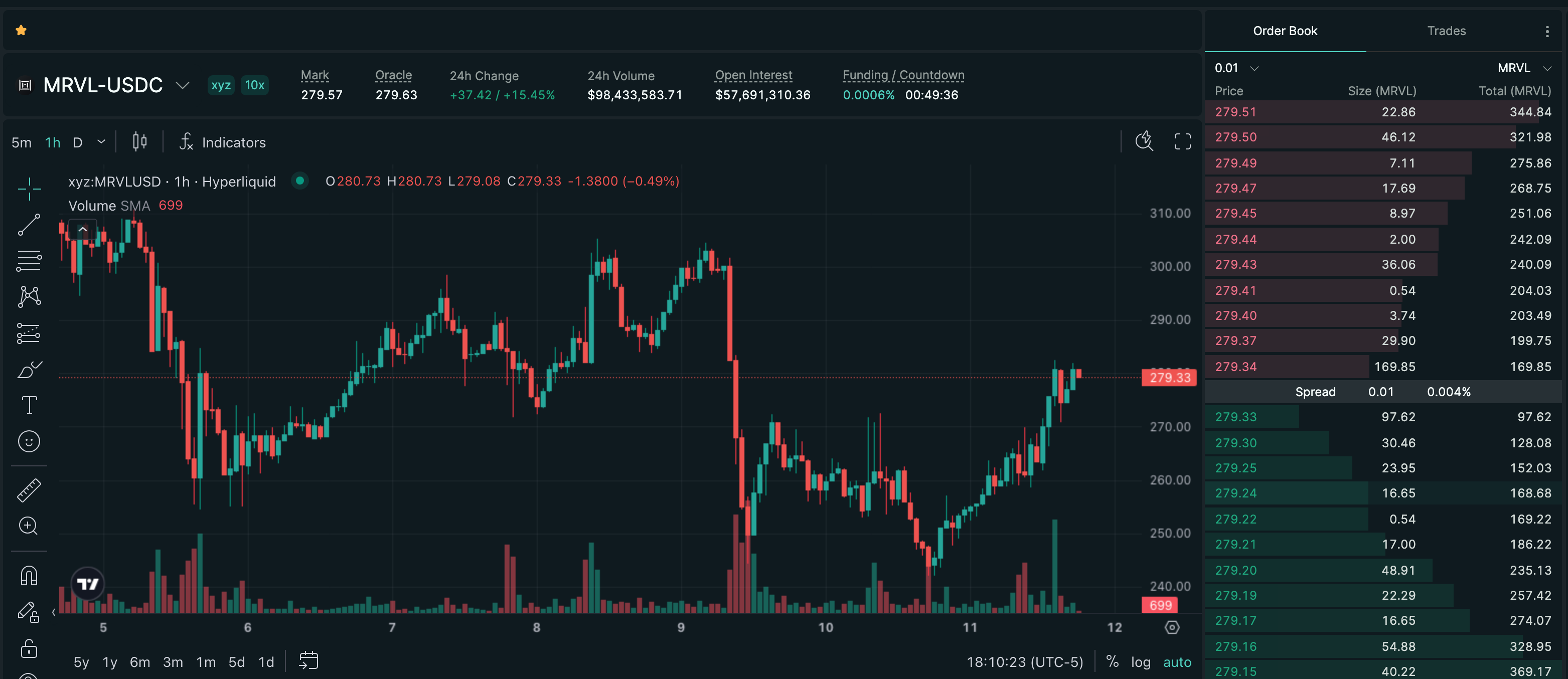
Marvell is up 15.45% over 24 hours to $279.50, the latest leg of a 57% run in a month built on one mechanical force: index funds that must buy the stock when it enters the S&P 500 before the open on June 22. The catalyst is real but price-insensitive, and shares now trade roughly 30% above the freshest Wall Street targets even after analysts raised them. That gap is the whole story heading into the rebalance, and it is the reason the setup inverts the moment forced buying clears.
Mover Brief
The Bid Has One Source
There is no fresh company news behind today's 15.45% move. The engine is mechanical: on June 5, S&P Dow Jones Indices confirmed Marvell will join the S&P 500 before the open on June 22, replacing Pool Corp alongside Flex. Every fund that tracks the index now has to own MRVL at the rebalance, and they have to own it at whatever the price is on that date.
That is a buyer who does not check valuation, does not wait for a dip, and does not stop because the chart looks extended. It is the cleanest kind of flow to trade because it is calendar-driven and forced — but it is also the kind that has a known expiration. The bid you are pressing into on June 11 is borrowing demand from June 22, not creating new fundamental support.
Price Has Outrun the Analysts Who Cover It
The setup got loud on June 2, when Nvidia CEO Jensen Huang called Marvell a potential "next trillion-dollar company" at Computex and the stock jumped more than 20% in a session. Stacked on the index news, that has produced a 57% gain in a month and roughly 340% over twelve.
The tell is what the sell side did in response. Citi lifted its target to $215 from $118 and Stifel to $210 from $140 — and even after those upgrades, MRVL at $279.50 trades about 30% above both. When the freshest, most bullish targets sit a third below spot, the price is no longer being set by a view on the business. It is being set by flow.
What Flips After June 22
The history here is unkind to late buyers. Across 1,926 S&P 500 additions since 1957, the median new member beat the index by 3% in the 25 trading days before joining, then trailed it by 8% over the following year, with nearly 60% underperforming. The run-up into inclusion is the trade; the inclusion itself is frequently where it ends.
The asymmetry is structural. Right now a price-insensitive buyer is absorbing every dip into the rebalance. Once that flow clears on the 22nd, there is no mechanical bid left to defend a move that has detached from fundamentals — and the only remaining marginal buyer is someone who has to underwrite paying 30% above the Street's raised targets. That is the line to respect: the catalyst that is pushing this higher is the same one that disappears on a known date.
Sources & Provenance
Citations below are preserved as structured Postgres source rows for this brief.
Citations Preserved
5
Reference links carried forward from the published mover record.
Original Signal
Open source tweetMarket Route
Direct route preserved for readers who want to inspect the tracked Hyperliquid market behind this archive entry.
Already onboarded? Open tracked market- 1S&P Dow Jones Indices — Marvell and Flex to join S&P 500 (June 5)press.spglobal.com
- 2CNBC — Marvell, Flex to join S&P 500, replacing Pool and Campbell'scnbc.com
- 324/7 Wall St — Will the June 22 S&P 500 listing be a sell-the-news event?247wallst.com
- 4Reuters — Marvell shares jump after winning S&P 500 spotreuters.com
- 5Motley Fool — After 340% in 12 months, is Marvell still a buy?fool.com
This content is for informational purposes only and does not constitute financial advice. Trading perpetual futures involves substantial risk of loss.
Trade MRVL on Hyperliquid
Use referral code HIPERWIRE for 4% off trading fees on your first $25M in volume.
Live Market Metrics
Monitor real-time open interest and funding for MRVL.