NATGAS War Premium Deflates as Hormuz Reopening Takes Shape
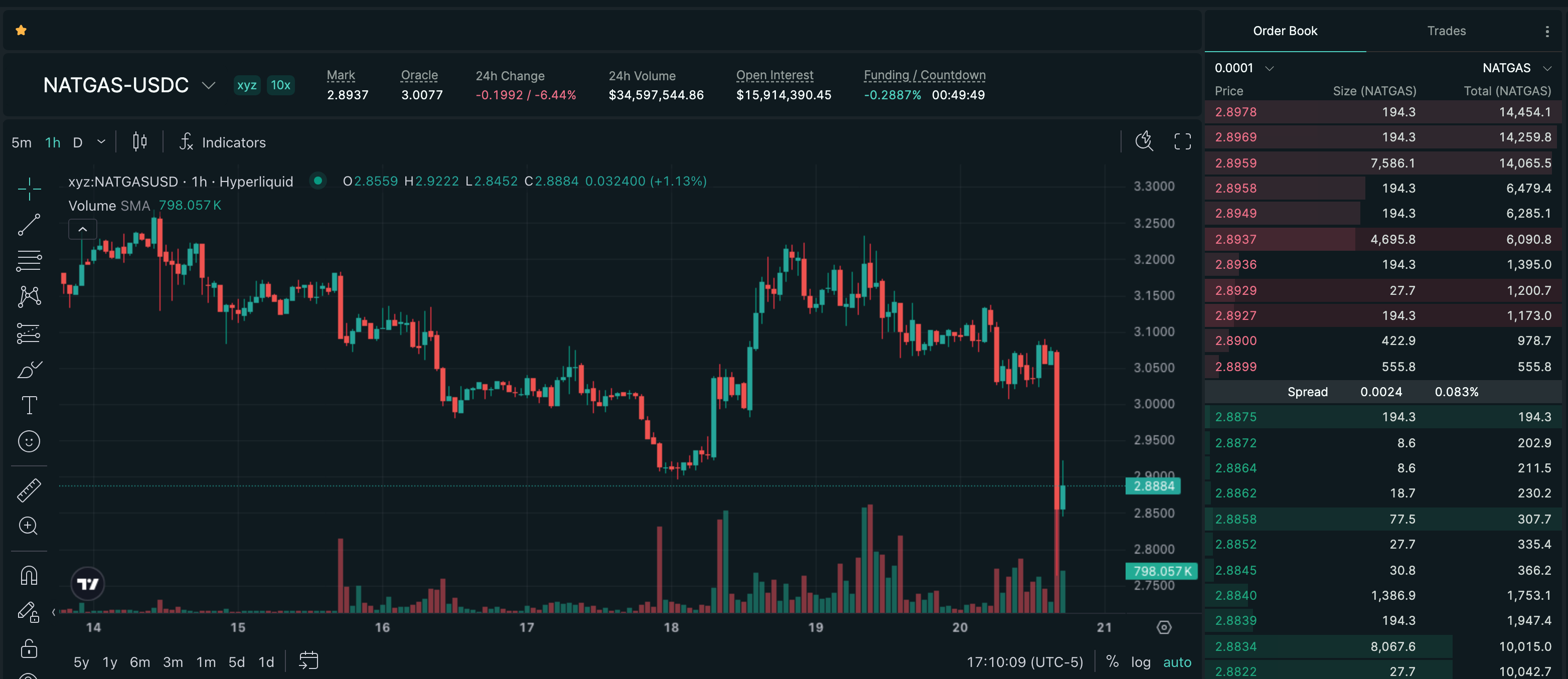
Henry Hub natural gas dropped 7.4% in 12 hours on the Hyperliquid perp as a cascade of de-escalation signals deflated the war premium that had propped up prices since the Iran conflict began in late February. Netanyahu pledged Israeli support for reopening the Strait of Hormuz, a six-nation European and Japanese coalition signaled readiness to secure tanker passage, and Treasury Secretary Bessent floated releasing 140 million barrels of sanctioned Iranian crude. April NYMEX natural gas settled at $3.095 per MMBtu on March 20, down 11.5% for the week.
Mover Brief
The De-Escalation Trade
The geopolitical premium that has been holding Henry Hub aloft since the Iran conflict began on February 28 is cracking. On March 19, Israeli Prime Minister Netanyahu said Israel is actively helping the U.S. reopen the Strait of Hormuz, the critical chokepoint that has been effectively closed to LNG tanker traffic since late February. Hours later, Japan, the UK, France, Germany, Italy, and the Netherlands signaled readiness to contribute to a multinational effort to secure the strait.
The one-two punch reversed the energy complex broadly. Brent crude fell from an intraday high above $119 to settle at $108.65. April NYMEX natural gas settled at $3.095, down 11.5% for the week. On the Hyperliquid perp, the move was sharper — down 7.4% in 12 hours to $2.888 per MMBtu.
Adding to the de-escalation narrative, Treasury Secretary Bessent floated the possibility of unsanctioning roughly 140 million barrels of Iranian crude currently held on tankers, framing it as a tool to suppress energy prices over the next 10–14 days. The signal is clear: Washington is more focused on managing the price impact than escalating the energy disruption.
Ras Laffan Is Still Offline — The Market Doesn't Care
The irony of this selloff is that the underlying supply disruption has actually gotten worse, not better. On March 18, Iranian missiles hit Ras Laffan Industrial City again, causing what QatarEnergy CEO Saad al-Kaabi called "extensive further damage" that took out 17% of Qatar's LNG export capacity. Bloomberg reported that full repairs could take up to five years. Qatar expelled Iran's military attaches in response.
But the market is looking through the damage to the exit. Citi's base case has the conflict de-escalating within four to six weeks. If Hormuz reopens — even partially — to tanker traffic, the roughly 20% of global LNG supply that has been disrupted can begin to be rerouted from non-Gulf sources and alternative facilities. The war premium was never about Ras Laffan alone; it was about the Hormuz chokepoint. If the chokepoint opens, the premium deflates regardless of the facility's status.
Domestic Fundamentals Add Weight
The EIA weekly storage report released March 20 showed a 35 Bcf injection for the week ending March 13 — below the consensus estimate of 39 Bcf. In isolation, that's modestly bullish. But it didn't matter. The de-escalation wave overwhelmed what would normally be a supportive print.
The broader domestic picture leans bearish into spring. U.S. dry gas production is running at 118 Bcf/d, up from 116 Bcf/d last year. Heating demand is fading as temperatures moderate across the eastern U.S. And working gas in storage sits near the five-year average — comfortable by any measure heading into injection season.
Without the war premium, Henry Hub fundamentals point lower into spring shoulder season. The question is whether the diplomatic signals hold or whether another escalation — another missile, another facility hit — resets the geopolitical bid entirely.
Sources & Provenance
Citations below are preserved as structured Postgres source rows for this brief.
Citations Preserved
7
Reference links carried forward from the published mover record.
Original Signal
Open source tweetMarket Route
Direct route preserved for readers who want to inspect the tracked Hyperliquid market behind this archive entry.
Already onboarded? Open tracked market- 1CNBC — Oil prices fall as Netanyahu says Israel helping to open Strait of Hormuzcnbc.com
- 2The Hill — Japan, Europeans signal readiness to help secure Strait of Hormuzthehill.com
- 3CNBC — U.S. considers releasing sanctioned Iranian crudecnbc.com
- 4Al Jazeera — Qatar says Iran attack caused significant damage at Ras Laffanaljazeera.com
- 5EIA — Weekly Natural Gas Storage Reporteia.gov
- 6Washington Post — Iran hits Gulf energy sites as U.S. mulls sanctions rollbackwashingtonpost.com
- 7EIA — Short-Term Energy Outlook: Natural Gaseia.gov
This content is for informational purposes only and does not constitute financial advice. Trading perpetual futures involves substantial risk of loss.
Trade NATGAS on Hyperliquid
Use referral code HIPERWIRE for 4% off trading fees on your first $25M in volume.
Live Market Metrics
Monitor real-time open interest and funding for NATGAS.