Nebius Is Quoting $40-50M a Megawatt — and NBIS Re-Rates to $272
Nebius reported Q2 revenue of $582.3 million on August 12, up 454% year over year, and the stock went up 34% that day. Three sessions later it is still bid, and the reason has shifted from the revenue beat to what management said on the call: short-term GPU capacity is now clearing $40-50 million per megawatt, with deal payback down to one year and ten months. That is a scarcity price, and it re-rates the whole neocloud complex. It also lands on a float that was roughly a quarter short, with Michael Burry adding to his position at $247.00 the day before.
Mover Brief
Why This Is a Pricing Story, Not a Revenue Story
The headline out of Nebius Group's second quarter was revenue of $582.3 million, up 454% year over year, with adjusted EBITDA of $236.2 million against a $21 million loss in the same quarter of 2025. Adjusted loss per share came in at $0.12 versus roughly $0.69 expected. The AI cloud segment is now about 98% of the group, and the company closed four deals averaging over $1 billion in total contract value each — Reflection, Cohere, an unnamed US frontier lab, and a US quant trading firm.
That print moved the stock 34.1% on August 12. It is not what has kept it going.
The number that actually matters came out on the earnings call. Mid-term contracts of one to three years are pricing at $20-25 million per megawatt with prepayments covering half the associated capex. Short-term capacity of up to six months is being negotiated in the $40-50 million per megawatt range, "and sometimes above". A capacity auction cleared 15% above the highest price Nebius had ever charged for Blackwell-generation compute. Payback on Q2 deals compressed to one year and ten months, down from the two to three years the company was quoting before.
That is what a supply-constrained market looks like when the seller stops discounting. And it is not a Nebius-specific data point: CoreWeave raised prices roughly 25% across all SKUs in July, legacy GPU rental rates are up more than 30% from the January-March period, and CoreWeave gained 19.3% on the same session Nebius gained 34%. Two independent operators printing the same pricing curve on the same day is a much stronger signal than either one alone.
The Capex Machine Behind It
The other side of that pricing power is a balance sheet running at a scale that makes people uncomfortable. Nebius spent $5.66 billion on capex in Q2 alone — roughly 9.7 times quarterly revenue — against $510.6 million a year earlier. GAAP net loss was $190.4 million, or $0.68 per share.
What funds it: annualized run-rate revenue hit $3.0 billion at the end of June, up 598% year over year and 56% sequentially from $1.9 billion in Q1. Committed backlog is above $40 billion, more than ten years of revenue at the current run rate, and it is collateral — Nebius has already closed a $775 million asset-backed facility at mid-single-digit rates. About 70% of Q2 deals came with upfront prepayments covering 50-60% of the associated capex, and management expects more than $9 billion in customer prepayments during 2026. Cash sits at $8.04 billion, up from $3.68 billion at the end of 2025.
Full-year 2026 guidance was reaffirmed rather than raised: $3.0-3.4 billion in group revenue, $7-9 billion exit ARR, adjusted EBITDA margin near 40%, and $20-25 billion of capex. The one number that did move was power. Nebius raised its contracted power target to 5 gigawatts by the end of 2026, expects 800 megawatts to 1 gigawatt of connected power at year end, and plans to deploy more than a gigawatt of new capacity in 2027.
If the $40-50 million per megawatt spot price holds, that contracted-power number is the revenue model. If it does not, it is a liability schedule.
Burry Doubled Down at $247
Positioning is doing real work in this move. Short interest sat near 60.2 million shares in late July, somewhere between a quarter and 30% of the float — the kind of setup where a fundamental surprise does not just get bought, it gets bought by people who have no choice.
Michael Burry is the visible half of that trade. He disclosed a short at $211.77 on August 6, then added to it at $247.00 on August 13, saying "Nebius is what the top of a boom looks like." It is worth separating the soundbite from the argument, because the argument is specific and not stupid: Nebius extended its server depreciation schedule from four years to five while its own deal structures assume roughly 50% annual price decay on the underlying compute. Stretching the accounting life of an asset whose rental price you expect to halve every year is exactly the kind of gap that closes violently if utilization ever slips.
The sell side went the other way and went hard. Baird lifted its target from $250.00 to $340.00 on August 13, Northland's Nehal Chokshi took his from $248.00 to $410.00 the same day, and Bank of America's Tal Liani moved to $310.00 from $280.00. That spread — a $410.00 street high against a named short adding size at $247.00 — is most of why the tape is this violent in both directions.
Vineland Is Where the Thesis Gets Tested
The bull case rests on Nebius converting contracted power into connected power on schedule. The clearest test of that is happening right now in New Jersey.
The Vineland site is roughly 300 megawatts, with capacity contracted by Microsoft, and Nebius went around the grid interconnection queue by installing on-site gas engines and Bloom Energy fuel cells. The city has since issued two stop-construction orders — one on August 6 halting LNG tank work and a second on August 10 halting fuel-cell installation, on the grounds that the required approvals and permits were never obtained. The site also falls under New Jersey's Environmental Justice Law, which is not a fast permitting regime. The developer says the pause is temporary and the timeline is intact.
One site is not the thesis. But behind-the-meter power is the entire reason Nebius can promise a gigawatt of new capacity in 2027, and municipal permitting is precisely the sort of thing that does not care about your backlog.
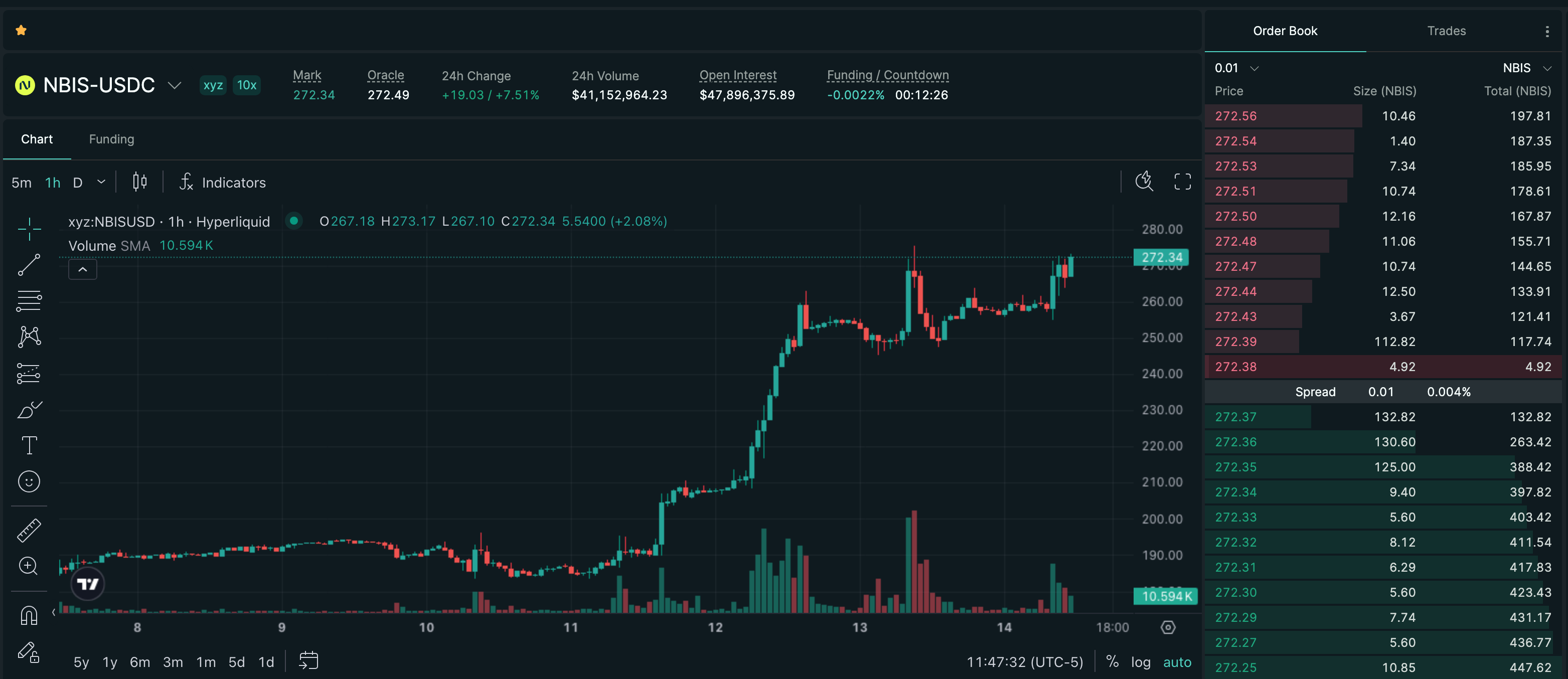
On the price side, NBIS is around $272 against a 52-week range of $62.01 to $299.86, so the June high is the obvious line for anyone trading the continuation. The Hyperliquid perp, which references one Class A ordinary share and offers up to 10x leverage, has turned over $41.15 million in the last 24 hours — thin enough that the leveraged book is a follower of the Nasdaq tape here, not a driver of it.
Sources & Provenance
Sources used for this article are linked below. See our methodology for how coverage is produced.
Citations Preserved
8
Reference links carried forward from the published mover record.
Original Signal
Open source tweetMarket Route
Direct route preserved for readers who want to inspect the tracked Hyperliquid market behind this archive entry.
Already onboarded? Open tracked market- 1Nebius Group — Q2 2026 financial results and shareholder letternebius.com
- 2Nebius Q2 2026 earnings call transcript — per-megawatt pricing, payback, power targetsinvesting.com
- 3Yahoo Finance — Nebius Q2 2026 beat on AI cloud demandfinance.yahoo.com
- 4CNBC — CoreWeave and Nebius post-earnings neocloud rallycnbc.com
- 5Hunterbrook — Vineland stop-construction orders at the Nebius sitehntrbrk.com
- 6WHYY — City of Vineland issues stop-work orders to data centerwhyy.org
- 7Seeking Alpha — Burry adds to Nebius short, 'what the top of a boom looks like'seekingalpha.com
- 8StockAnalysis — NBIS price, market cap and 52-week rangestockanalysis.com
This content is for informational purposes only and does not constitute financial advice. Trading perpetual futures involves substantial risk of loss.
Trade NBIS on Hyperliquid
Use referral code HIPERWIRE for 4% off trading fees on your first $25M in volume.
Live Market Metrics
Monitor real-time open interest and funding for NBIS.