Oil's War Premium Collapses After Trump Floats Strait of Hormuz Takeover
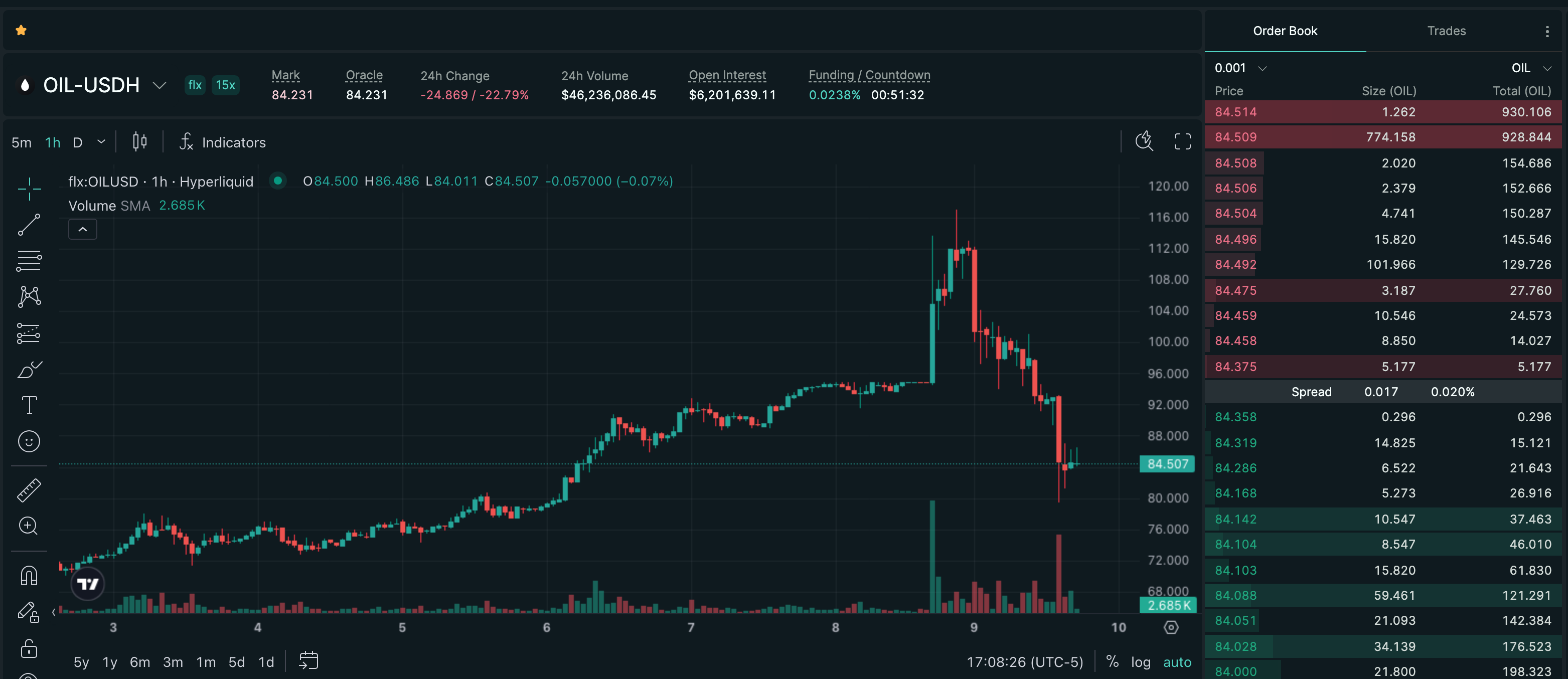
WTI crude reversed nearly a quarter of its value in under a day after President Trump told CBS News the U.S. is considering seizing control of the Strait of Hormuz — the chokepoint through which 20% of global oil flows. The statement triggered an immediate unwind of the conflict premium that had driven prices from the mid-$60s to an intraday high of $119.48, as traders repriced the probability that Iranian blockade threats would persist. G7 discussions about a coordinated release of 300 to 400 million barrels of strategic reserves added further weight.
Mover Brief
The Reversal
WTI crude hit $119.48 intraday on Monday — its highest level since the 2022 Russia-Ukraine spike — before cratering to as low as $81.25, a 32% intraday collapse that erased the entire war premium built up since U.S.-Israeli strikes on Iran began on February 28.
The catalyst was a single sentence. Trump told CBS News he was "thinking about taking it over" in reference to the Strait of Hormuz, which Iran had effectively shut down by threatening to attack any tanker transiting the waterway. Traders read the statement as a signal that the U.S. Navy would forcibly reopen the strait, eliminating the supply disruption that justified triple-digit crude. Long positions liquidated rapidly.
Brent crude followed the same path, pulling back from a session high of $119.50 to $88.43 — a 4.6% decline on the day after having been up as much as 30% overnight.
The Supply Picture
The spike that preceded this reversal was driven by real physical disruption. Iran's threats against tanker traffic through the Strait of Hormuz created a de facto blockade of the 20% of global oil supply that transits the waterway daily. Gulf Arab nations cut production preemptively — Kuwait announced precautionary cuts to refinery output, and Iraqi production from its three main southern oilfields fell 70% to 1.3 million barrels per day.
On the other side of the ledger, OPEC+ agreed on March 1 to add 206,000 barrels per day in April — a modest increase that did nothing to offset the scale of the disruption. The real supply question now is whether the U.S. can actually reopen Hormuz, or whether Trump's statement was rhetoric without an operational timeline.
The G7 Reserve Overhang
Adding to the bearish pressure, G7 finance ministers held a conference call on Monday to discuss a coordinated release of strategic petroleum reserves. The proposal under discussion: releasing 300 to 400 million barrels — roughly 25% to 30% of the reserves held by IEA member countries.
French President Macron confirmed publicly that "the use of strategic reserves is an envisaged option", though the G7 has not formally approved the release. Analysts estimate a credible coordinated release of 60 to 100 million barrels could reduce Brent by $10 to $20 per barrel.
The market is now pricing two competing scenarios: a world where the Hormuz blockade persists and oil grinds back toward $120, or one where U.S. military action and reserve releases flood enough supply to break the crisis. The 20-hour, 24% wipeout on the Hyperliquid OIL perp reflects traders aggressively betting on the latter.
What to Watch
The key variable is operational, not rhetorical. Trump's Hormuz comments moved price because the market was positioned for sustained disruption — but the practical challenges of securing the strait are significant. Iran retains the ability to threaten tanker traffic with mines, drones, and fast-attack craft even under U.S. naval escort.
The G7 energy ministers are scheduled to meet Tuesday morning to discuss the reserve release formally. A concrete announcement with volumes and timelines would put further downside pressure on crude. Conversely, if the meeting produces only vague language, the war premium could rebuild quickly — Iraqi and Kuwaiti production shutdowns are ongoing physical realities, not speculative risks.
For now, WTI is trading in no-man's-land between $80 and $90 — too high for pre-war fundamentals, too low if the strait stays closed.
Sources & Provenance
Citations below are preserved as structured Postgres source rows for this brief.
Citations Preserved
7
Reference links carried forward from the published mover record.
Original Signal
Open source tweetMarket Route
Direct route preserved for readers who want to inspect the tracked Hyperliquid market behind this archive entry.
Already onboarded? Open tracked market- 1CNBC: Oil prices decline after Trump's Strait of Hormuz commentscnbc.com
- 2CNBC: G7 energy ministers to discuss release of oil reservescnbc.com
- 3CNBC: Oil prices soar as analysts raise alarm over Iran warcnbc.com
- 4Fortune: Macron confirms strategic reserves under considerationfortune.com
- 5Yahoo Finance: Oil crosses $110 as Hormuz closure forces shut-insfinance.yahoo.com
- 6CryptoTicker: Oil price crash by more than 30%cryptoticker.io
- 7European Business Magazine: G7 considers emergency oil reserve releaseeuropeanbusinessmagazine.com
This content is for informational purposes only and does not constitute financial advice. Trading perpetual futures involves substantial risk of loss.
Trade OIL on Hyperliquid
Use referral code HIPERWIRE for 4% off trading fees on your first $25M in volume.
Live Market Metrics
Monitor real-time open interest and funding for OIL.