Oil War Premium Collapses After Trump Floats Hormuz Takeover and Sanctions Relief
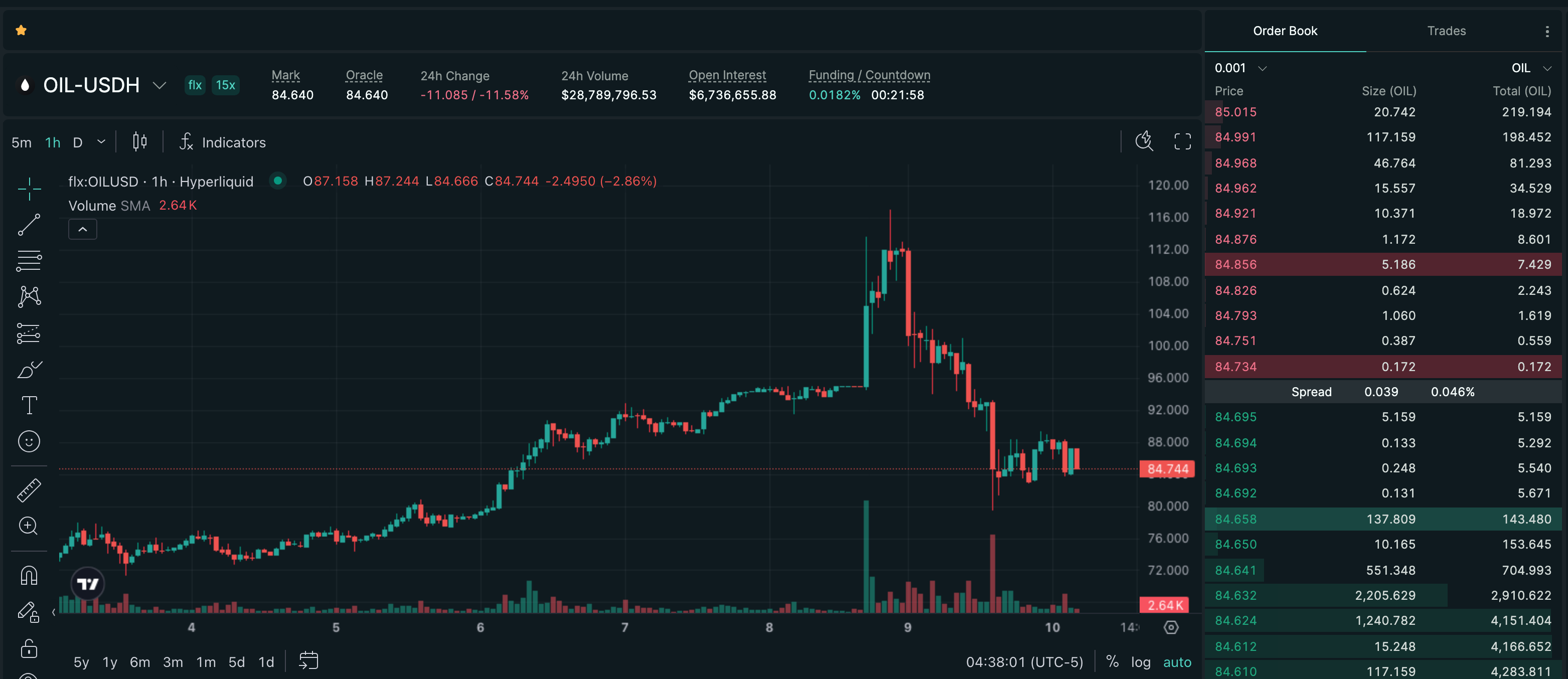
WTI crude has given back nearly all of its Iran-war spike after two rapid-fire policy signals from the White House. President Trump told CBS he is considering a U.S. takeover of the Strait of Hormuz, and on Monday announced temporary sanctions waivers on Russian and Venezuelan oil to boost global supply. Traders liquidated the conflict premium within hours, sending crude from triple digits back to the mid-$80s.
Mover Brief
The Catalyst: Two Trump Announcements in 24 Hours
The selloff started Sunday night when Trump told CBS News the U.S. "could do a lot" about the Strait of Hormuz and was "thinking about taking it over" to restore shipping traffic. Markets read this as a signal that Washington would force the chokepoint open rather than let Iran hold global oil flows hostage indefinitely.
The second shoe dropped Monday afternoon. Trump told reporters he would waive sanctions on oil-producing nations "until this straightens out," directly targeting the supply side of the crisis. Treasury Secretary Scott Bessent followed up with a 30-day waiver on sanctions covering Russian oil sales to India, and the Treasury separately authorized transactions involving Venezuela's PDVSA. The message was blunt: Washington will flood the market with barrels before it lets crude stay above $100.
Traders didn't need to be told twice. WTI crashed from a session high near $119.48 to as low as $81.25 — a 32% single-day collapse — before stabilizing in the mid-$80s on Tuesday.
How Big Was the Supply Disruption
The selloff looks dramatic, but context matters: crude had no business being at $119 on fundamentals alone. The entire spike was driven by the effective closure of the Strait of Hormuz after the U.S.-Israel strikes on Iran beginning February 28.
The strait normally handles roughly 13.4 million barrels per day of crude — about 30% of global seaborne supply. After Iran's IRGC warned vessels away, tanker traffic dropped 70% within days and then went effectively to zero. Insurance withdrawal, not a physical blockade, is what killed commercial shipping.
This was the largest oil supply disruption in history, roughly double the record set during the 1956 Suez Crisis. Iraq alone cut output by 60% from 4.3 million bpd to under 1.8 million bpd because it had nowhere to export. Kuwait and the UAE followed with their own cuts.
OPEC+ holds roughly 3.5 million barrels per day of spare capacity, but much of it sits behind the closed strait and can't reach global markets until shipping resumes.
Why the Premium Evaporated So Fast
Two things happened simultaneously. First, Trump's Hormuz comments gave the market a timeline. If the U.S. military forces the strait open — whether by escorting tankers, establishing a corridor, or some other intervention — the supply disruption has an expiration date. Traders priced that in immediately.
Second, the sanctions waivers attacked the problem from the other direction. Russian barrels flowing to India and Venezuelan crude re-entering the market won't replace 13 million bpd of Hormuz transit, but they compress the worst-case scenario. The market went from pricing "20% of global supply is gone indefinitely" to "the White House is moving aggressively to restore flows and find alternatives."
The speed of the unwind also reflects positioning. WTI had its biggest weekly gain in the history of the futures contract dating back to 1983 the week prior. That kind of crowded long positioning unwinds violently when the thesis cracks.
What Holds From Here
Crude at $84.70 isn't cheap by pre-war standards — WTI was trading near $63 before the strikes began on February 28. The market is still pricing in a meaningful residual risk premium for the possibility that the Strait stays closed longer than the White House hopes.
The key variable now is execution. Trump's rhetoric on Hormuz has been aggressive, but physically reopening the strait against Iranian opposition is a different problem than announcing it on television. If shipping resumes within days, crude likely falls back toward the $70s. If the strait stays closed through March, the $80s become a floor as strategic reserves draw down and alternative supply routes get strained.
Asia faces the most acute exposure. India sources 85% of its LPG through the strait, and both India and China are dominant buyers of Hormuz-transiting crude. The Russia sanctions waiver gives India a pressure valve, but it doesn't solve the structural problem.
For now, the trade is between two scenarios: managed de-escalation that grinds crude back toward $70, or a protracted standoff that keeps it range-bound in the $80s–$90s with periodic spikes on headline risk.
Sources & Provenance
Citations below are preserved as structured Postgres source rows for this brief.
Citations Preserved
7
Reference links carried forward from the published mover record.
Original Signal
Open source tweetMarket Route
Direct route preserved for readers who want to inspect the tracked Hyperliquid market behind this archive entry.
Already onboarded? Open tracked market- 1CNBC — Oil prices decline after Trump says U.S. considering Strait of Hormuz takeovercnbc.com
- 2Al Jazeera — Trump says some sanctions to be lifted on oil producers amid Iran waraljazeera.com
- 3CNBC — The U.S.-Iran war is the biggest oil supply disruption in historycnbc.com
- 4Kpler — Strait of Hormuz crisis reshapes global oil marketskpler.com
- 5Fortune — Nightmare scenario looms as global markets face biggest oil disruptionfortune.com
- 6CryptoTicker — Oil price crash: WTI drops 32% in single sessioncryptoticker.io
- 7CNN — The big problem with Trump's plans to open the Strait of Hormuzcnn.com
This content is for informational purposes only and does not constitute financial advice. Trading perpetual futures involves substantial risk of loss.
Trade OIL on Hyperliquid
Use referral code HIPERWIRE for 4% off trading fees on your first $25M in volume.
Live Market Metrics
Monitor real-time open interest and funding for OIL.