Uber Commits to 50,000-Vehicle Rivian Robotaxi Fleet
Uber and Rivian announced a partnership on March 19 to deploy up to 50,000 fully autonomous Rivian-powered robotaxis, with Uber reportedly committing up to $1.25 billion in investment. The deal is the first major commercial validation of Rivian's in-house autonomy stack and custom RAP1 chip, unveiled at the company's December 2025 AI Day, and adds Rivian to Uber's rapidly expanding multi-supplier robotaxi portfolio alongside NVIDIA, Zoox, and Lucid/Nuro.
Mover Brief
The Deal
Uber and Rivian announced a partnership on March 19 to deploy up to 50,000 fully autonomous Rivian-powered vehicles on Uber's ride-hail network. Uber will reportedly invest up to $1.25 billion in the collaboration, covering vehicle procurement, fleet deployment, and integration of Rivian's autonomy stack into Uber's platform.
The partnership leverages Rivian's Rivian Autonomy Processor (RAP1), the custom 5nm chip unveiled at the company's December 2025 AI Day, and its end-to-end autonomy software stack designed for Level 4 operation. The 50,000-vehicle commitment puts this deal in the same tier as Waymo's 50,000-unit supply agreement with Hyundai — one of the largest robotaxi fleet commitments announced to date.
Deployment timelines haven't been fully disclosed, but the deal likely maps to Rivian's next-generation platform, purpose-built around the RAP1 chip and designed with cost efficiencies the current R1 architecture lacks. The R2 begins customer deliveries in mid-April, and Rivian's Georgia facility — set to come online for additional capacity — could eventually serve fleet production alongside consumer vehicles.
Rivian's Autonomy Stack Gets a Customer
Before today, Rivian's autonomy ambitions were a roadmap. The RAP1 chip, the AI-trained driving models, the Autonomy+ subscription priced at $2,500 upfront or $49.99 per month — all technically impressive, but without a commercial deployment partner beyond Rivian's own consumer fleet.
Rivian has been building toward this since its Autonomy & AI Day in December 2025, where CEO RJ Scaringe outlined a path from hands-free highway driving to full Level 4 autonomy. The RAP1 is a ground-up design fabricated on a 5nm process — Rivian's bet that vertical integration in silicon gives it a cost and performance edge similar to what Tesla achieved with its FSD computer. The chip is paired with an AI stack trained on Rivian's own driving data, and vehicles will ship with LiDAR starting with the R2 platform.
The Volkswagen joint venture — $5.8 billion committed, with $2 billion expected in 2026 — already validated the software and electrical architecture side. The Uber deal validates the autonomy side. Together, they reframe Rivian from a low-volume EV maker burning $2.5 billion a year in free cash flow into a technology platform with two major commercial licensing relationships.
From R2 Selloff to Platform Play
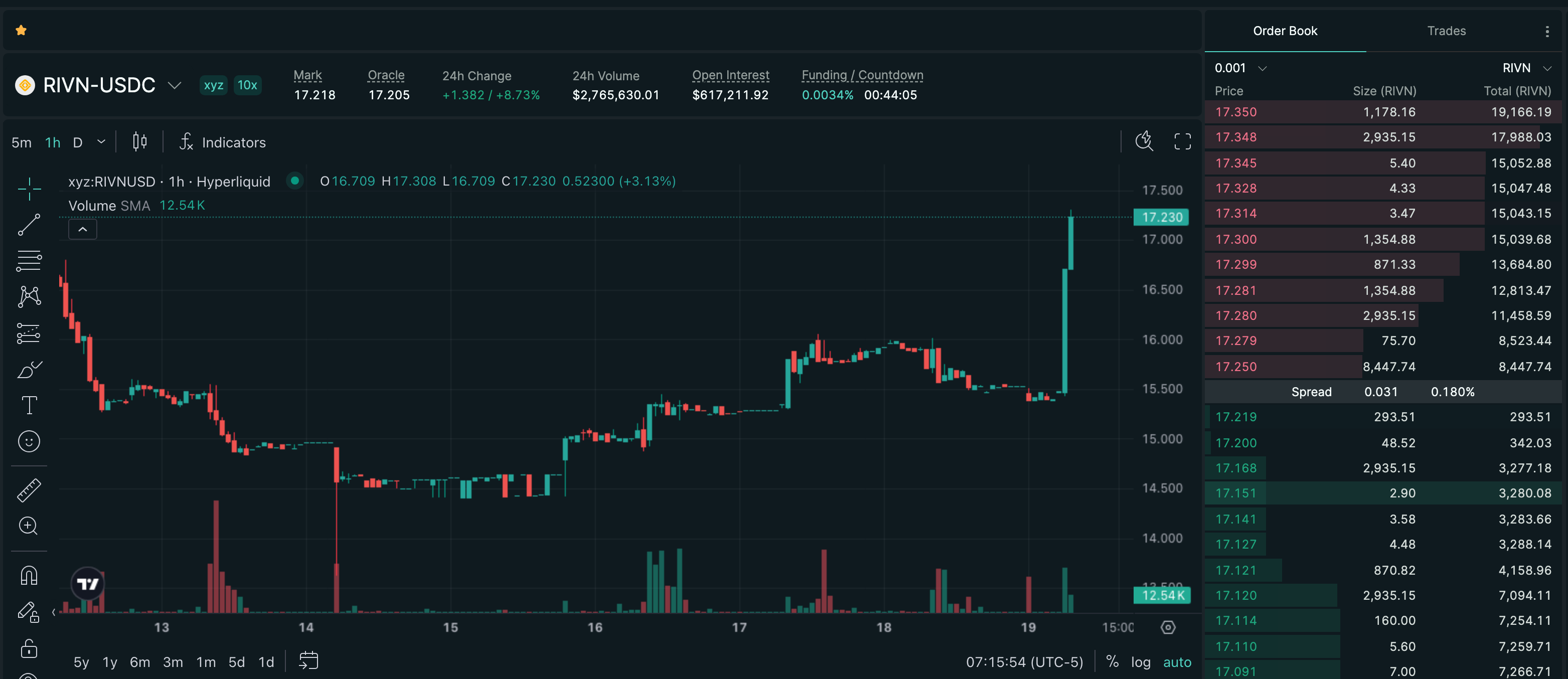
RIVN was already gathering analyst momentum before today. TD Cowen upgraded to Buy with a $20 target on March 10, citing R2 demand potential of 212,000 to 335,000 units annually. Bay Area Ideas on Seeking Alpha upgraded to Buy on March 17, pointing to vertical integration, custom silicon, and a forward P/S ratio of 2.7x. But the stock had been stuck around $15.50 after the post-SXSW selloff — the R2 pricing reveal on March 12 sent it down 8.6% when the $45,000 base trim was pushed to late 2027.
The Uber deal reframes the narrative away from consumer pricing disappointment and toward Rivian as an autonomous platform company. At $17.24, RIVN is still more than 80% below its IPO price and trades at roughly 3x current-year sales with $8.6 billion in current assets. Uber's expanding robotaxi ecosystem — NVIDIA for L4 software across 28 cities, Zoox for purpose-built vehicles, Lucid/Nuro for 20,000 units — now includes Rivian at the top of the volume stack.
The risk is familiar: execution. Rivian still needs to ship the R2 on time, hit its 62,000 to 67,000 delivery guidance for 2026, and prove that the RAP1 chip and autonomy stack work outside a controlled demo environment. Most robotaxi fleet commitments are aspirational until vehicles actually deploy. But as a catalyst for a stock that was drifting lower on R2 sticker shock, a $1.25 billion vote of confidence from the largest ride-hail platform in the world is hard to ignore.
Sources & Provenance
Citations below are preserved as structured Postgres source rows for this brief.
Citations Preserved
7
Reference links carried forward from the published mover record.
Original Signal
Open source tweetMarket Route
Direct route preserved for readers who want to inspect the tracked Hyperliquid market behind this archive entry.
Already onboarded? Open tracked market- 1Rivian Newsroom — Uber partnership announcementrivian.com
- 2Rivian Autonomy — RAP1 chip and Level 4 roadmaprivian.com
- 3Benzinga — TD Cowen upgrades RIVN to Buy, $20 price targetbenzinga.com
- 4Seeking Alpha — Bay Area Ideas upgrades RIVN to Buyseekingalpha.com
- 5InsideEVs — R2 production targets and delivery timelineinsideevs.com
- 6BusinessWire — NVIDIA and Uber L4 robotaxi expansionbusinesswire.com
- 7Electric Vehicles — Rivian targets $2.5B software revenue on VW dealeletric-vehicles.com
This content is for informational purposes only and does not constitute financial advice. Trading perpetual futures involves substantial risk of loss.
Trade RIVN on Hyperliquid
Use referral code HIPERWIRE for 4% off trading fees on your first $25M in volume.
Live Market Metrics
Monitor real-time open interest and funding for RIVN.