SanDisk Cracks $1,548 Support as Samsung's Blowout Q2 Triggers a Memory Sell-the-News
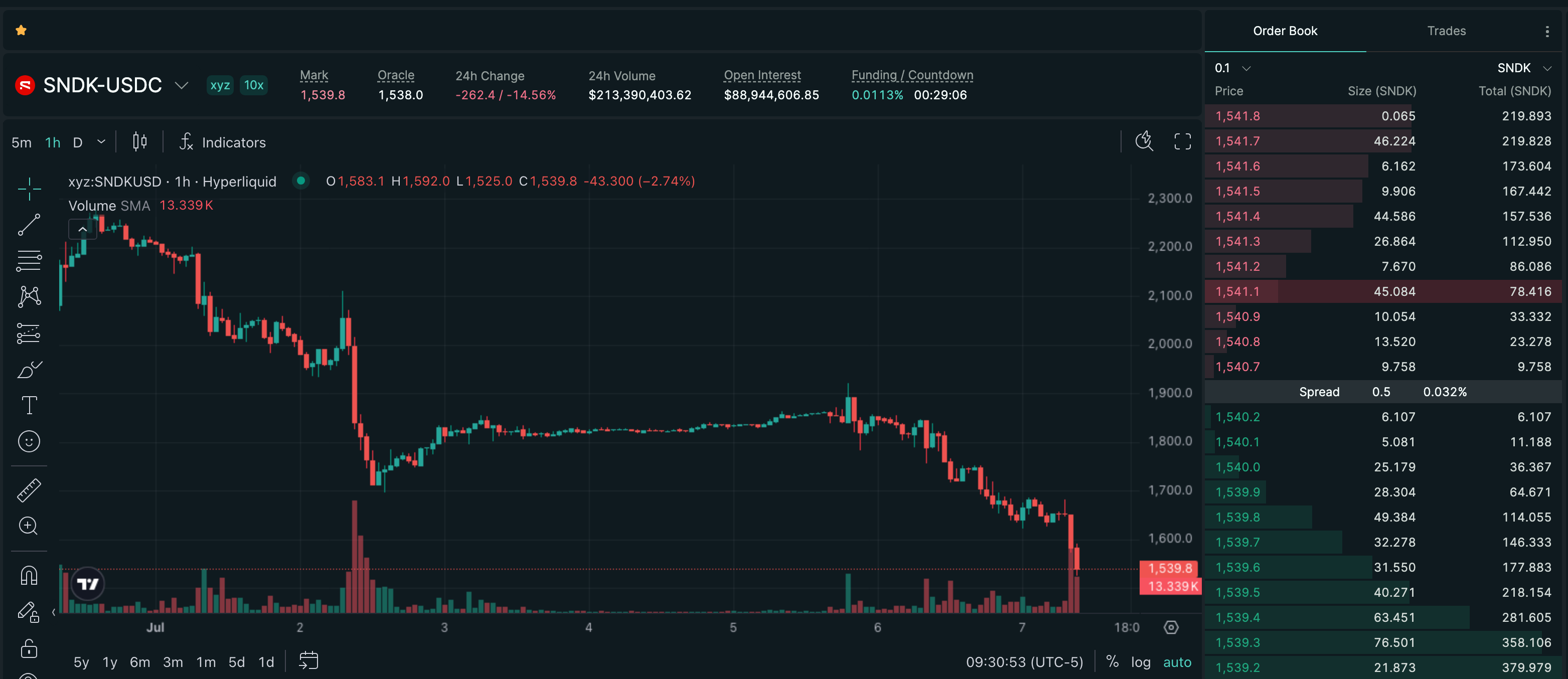
SanDisk has fallen 16.30% over 24 hours to $1,539, breaking a technical floor near $1,548 as the memory-sector selloff pushes into a fourth session. The trigger was a sell-the-news reaction to Samsung's blowout Q2, where operating profit jumped 19-fold year over year yet still failed to stop memory stocks from selling off on supply-glut fears. SanDisk carries more of that glut risk than most peers because roughly 60% of its NAND output is priced on the spot market and only a third of fiscal 2027 revenue is locked under contract.
Mover Brief
Sell the News on Samsung
The proximate trigger was a textbook sell-the-news. Samsung posted preliminary Q2 operating profit of about 89.4 trillion won (~$58.44 billion), a 19-fold jump year over year, with revenue up roughly 129% to 171 trillion won — a clean beat on consensus. And yet Samsung fell more than 6% in Seoul, and U.S. memory names bled out overnight alongside it: Micron, Western Digital, SanDisk and the Roundhill Memory ETF all shed roughly 4–5%. When numbers that good can't hold a bid, it tells you the AI-memory boom was already priced in after a monster run. This is the same rotation that opened the month, when the Philadelphia Semiconductor Index dropped over 6% on July 1 and Fed Chair Kevin Warsh flagged stretched asset valuations.
Why SanDisk Bleeds More Than Peers
SanDisk isn't just riding sector beta down. Roughly 60% of its NAND output is exposed to spot pricing, with only about a third of fiscal 2027 revenue secured under contract — so any hint of a supply glut from Samsung and SK Hynix capacity additions flows straight to earnings, and faster than it does for more-contracted peers. Layer on a P/E north of 60 after a ~635% year-to-date run — and better than 6,000% since the February 2026 Western Digital spin-off — and you have a name primed for a valuation reset the moment sentiment turns. The sell-side is openly split on whether it's already too rich: Goldman just lifted its target to $2,200 from $1,200, Bernstein sits at $3,000, Citi and BofA at $2,500, yet the 16-analyst average of about $2,041 barely clears where the stock trades.
The Level That Just Broke
Earlier in the run SanDisk had been bouncing off support near $1,548; at $1,539 that floor has now given way. RSI down around 34 puts the tape in oversold territory, but the broader memory selloff has refused to find a bottom across four sessions, and neither a fresh Kioxia NAND partnership nor a Morgan Stanley price-target raise has stemmed the bleed. The real tell from here is spot NAND pricing itself. If it holds firm, this drawdown reads as positioning and profit-taking after a red-hot run; if it actually softens, the bear case built on SanDisk's spot exposure stops being theoretical.
Sources & Provenance
Citations below are preserved as structured Postgres source rows for this brief.
Citations Preserved
6
Reference links carried forward from the published mover record.
Original Signal
Open source tweetMarket Route
Direct route preserved for readers who want to inspect the tracked Hyperliquid market behind this archive entry.
Already onboarded? Open tracked market- 1Invezz — SanDisk stock drops as Samsung-led chip selloff hits memory sectorinvezz.com
- 2Stocktwits — MU, SNDK, DRAM dip overnight on Samsung's post-earnings selloffstocktwits.com
- 3TradingKey — Why Did SanDisk (SNDK) Stock Crash? AI Chip Selloff, Valuationtradingkey.com
- 4The Motley Fool — Why Sandisk Stock Is Plummeting Todayfool.com
- 5FX Leaders — SanDisk (SNDK) Risks Breakdown If Support Goes as Asian Chip Selloff Weighsfxleaders.com
- 6Yahoo Finance — Sandisk Stock Plunged 14% in a Day. Is the AI Memory Boom Cracking?finance.yahoo.com
This content is for informational purposes only and does not constitute financial advice. Trading perpetual futures involves substantial risk of loss.
Trade SNDK on Hyperliquid
Use referral code HIPERWIRE for 4% off trading fees on your first $25M in volume.
Live Market Metrics
Monitor real-time open interest and funding for SNDK.