SanDisk Falls to $1,359 as SK Hynix's HBM Contract Warning Rerates Memory
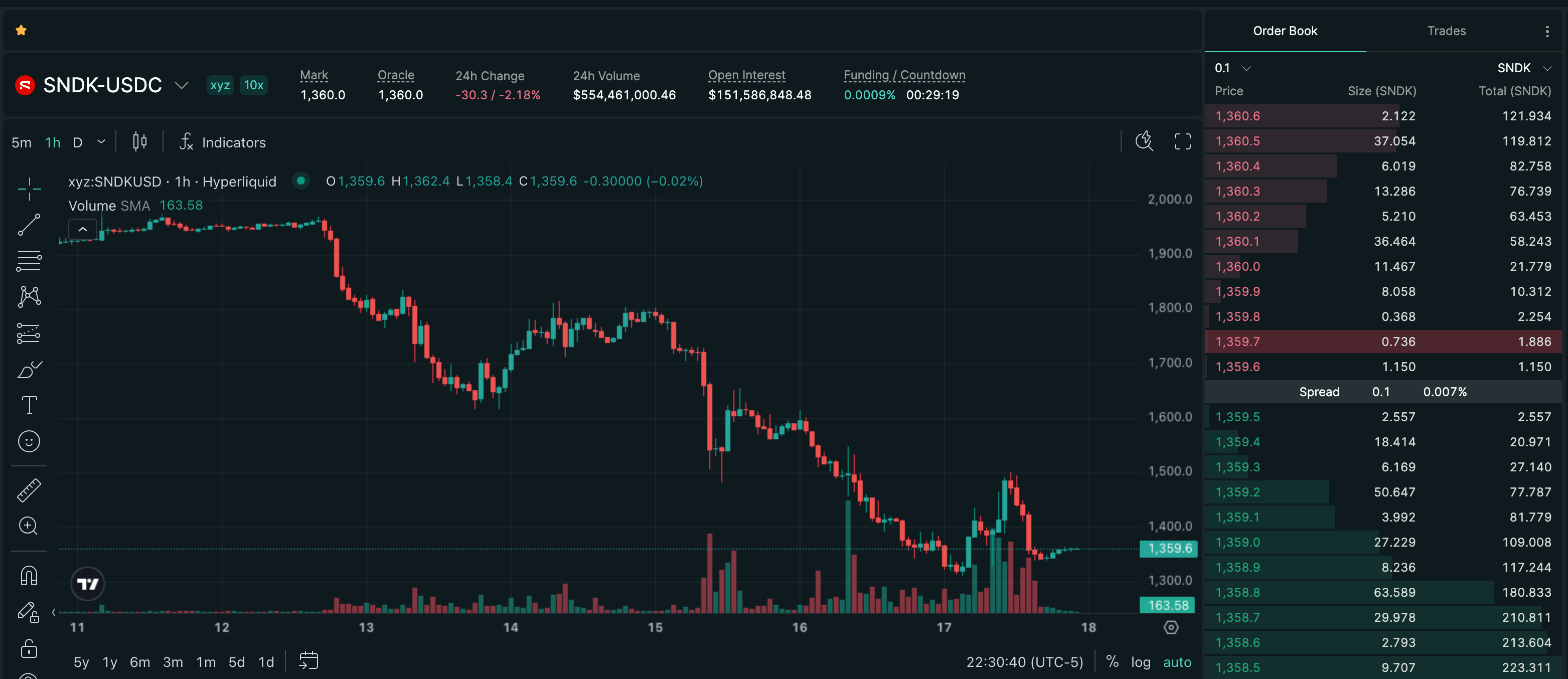
SanDisk is down 7.72% to $1,359, the third straight session of a memory-sector selloff that began July 13 when SK Hynix fell 15.4% in Seoul. The trigger wasn't broken demand but an analyst note showing that fixed-price HBM contracts cap the industry's ability to capture the DRAM and NAND price spike, reframing the whole memory trade as more priced-in than the tape assumed. Nothing has broken at SanDisk specifically; analyst price targets have actually risen even as the stock fell more than 40% off its June peak. This is a crowded momentum name unwinding after an 857% first half, with no fundamental floor until the August 5 fiscal Q4 print.
Mover Brief
The De-Rate Started in Seoul
SNDK's 7.72% slide to $1,359 isn't a SanDisk story. It's the third straight session of a memory-wide re-rate that began July 13, when SK Hynix fell 15.4% in a single Seoul session — its worst on record.
The catalyst was a Korea Investment & Securities note that flagged fixed-price HBM contracts as a ceiling on earnings. Q2 operating profit was projected roughly 8% below consensus — not because the business deteriorated, but because those locked contracts stop SK Hynix from capturing the DRAM and NAND price spike happening around it (blended DRAM ASP growth was cut from ~50% quarter-over-quarter to 28.9%). KIS kept its Buy rating and said outright the revision wasn't about fundamentals. That is the tell for the entire complex.
The same session, Micron, SanDisk, and Western Digital each dropped about 6% as the market extended the logic: if the memory leader can't monetize the AI-storage boom the way everyone assumed, the read-through hits every name levered to the same cycle.
Falling Price, Rising Targets
Here is the disconnect that defines this move. Across every SanDisk analyst note in the past three weeks, not one price target moved down — several moved up, some by more than 100%, even as the stock came apart.
There is no SanDisk-specific bad news: no guidance cut, no lost contract, no downgrade to the actual business. What's unwinding is the position, not the company. SNDK ran roughly 857% in the first half of 2026 to a June 22 peak of $2,354; at $1,359 it's now more than 40% off that high and down over 20% on the month.
When a name goes vertical on momentum and then trips, the air pocket has nothing to do with fundamentals — it's crowded longs hitting the same exit at the same time. Daily swings above 10% and WallStreetBets-fueled volume tell you this is a flows tape, not a fundamentals tape.
The Oversupply Clock Nobody Wanted to Hear
Underneath the positioning sits a real worry the bulls had been shrugging off. NAND flash average selling prices are falling faster than analysts modeled, with inventory elevated in enterprise storage and consumer electronics and manufacturing running near full utilization — the exact pattern that historically precedes an oversupply cycle and aggressive price compression. That's the bear case for gross margins, and a fixed-price-contract warning from SK Hynix is what made it legible.
Layered on top on July 17: a Nikkei 225 drop of more than 4% — its worst week since April 2025 — and fresh Chinese AI competition after Moonshot unveiled its Kimi K3 open-weight model, both feeding a broad risk-off across anything AI-levered. None of it is SanDisk-specific, but all of it lands hardest on the most crowded, most expensive name in the group.
No Floor Until the Print
The uncomfortable part for longs is that a sentiment-driven de-rate has no obvious floor. There's no earnings miss to mark against, which cuts both ways: nothing anchors the downside until SanDisk delivers its fiscal Q4 print on August 5.
A true fundamentals break would need weak guidance on ASPs or demand. Absent that, this is a valuation and positioning reset that resolves only when the marginal seller is finished. Two things matter into the print: whether SanDisk's NAND pricing commentary confirms or refutes the oversupply thesis, and whether its margins are actually tracking the ASP decline the group is now pricing in. Until then, the tape is trading the memory cycle, not SanDisk.
Sources & Provenance
Citations below are preserved as structured Postgres source rows for this brief.
Citations Preserved
6
Reference links carried forward from the published mover record.
Original Signal
Open source tweetMarket Route
Direct route preserved for readers who want to inspect the tracked Hyperliquid market behind this archive entry.
Already onboarded? Open tracked market- 1The Motley Fool — SK Hynix tumbles 15% in South Korea, leading semiconductor drop (Jul 13)fool.com
- 2TechTimes — SK Hynix posts worst Seoul session on record as HBM contracts limit earnings upsidetechtimes.com
- 324/7 Wall St. — Micron, SanDisk, Western Digital fall 6% as SK Hynix's weak outlook rattles memory stocks247wallst.com
- 4TipRanks — AI chip sell-off enters third straight session: NVDA, AMD, Intel, Micron, SNDK (7/17/26)tipranks.com
- 5INDmoney — Why is SanDisk stock falling? NAND memory selloff analysisindmoney.com
- 6Benzinga — What's going on with SanDisk stockbenzinga.com
This content is for informational purposes only and does not constitute financial advice. Trading perpetual futures involves substantial risk of loss.
Trade SNDK on Hyperliquid
Use referral code HIPERWIRE for 4% off trading fees on your first $25M in volume.
Live Market Metrics
Monitor real-time open interest and funding for SNDK.