SPCX Firms Into the Nasdaq-100 Add While the S&P 500 Stays Locked Out
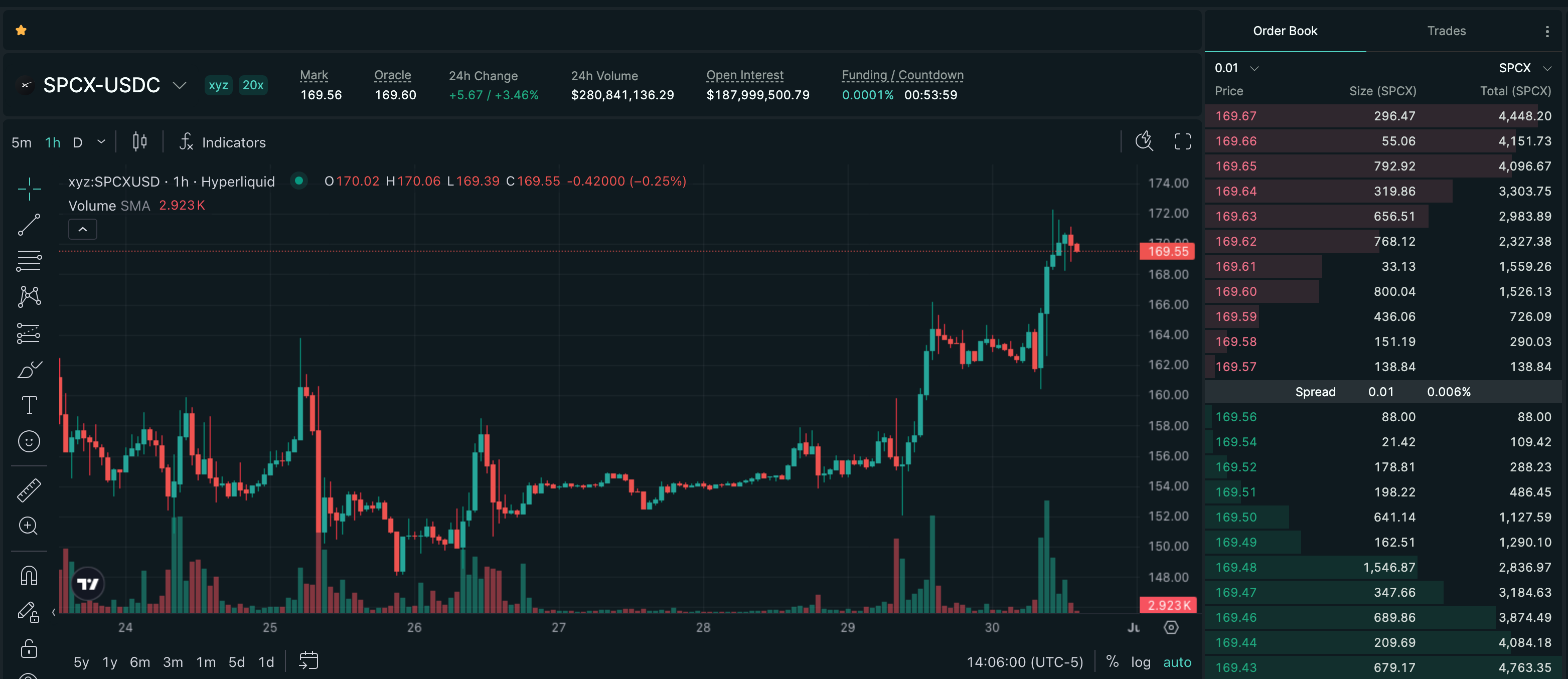
SpaceX's freshly public Class A shares are up 4.96% over six hours to $169.40, and the bid is mechanical more than fundamental. The Nasdaq-100 adds SPCX effective July 7, forcing QQQ trackers to buy a name with a float of only a few percent of shares outstanding, while the S&P 500's seasoning rules keep SPY and VOO on the sidelines until 2027. A separate report of Charter mobile talks adds a second tailwind, but the dominant story this week is index mechanics meeting a thin book.
Mover Brief
The Index Split
SPCX is up 4.96% over six hours to $169.40, and the cleanest read on the bid is mechanical, not fundamental. SpaceX cleared the Nasdaq-100's rewritten eligibility rules and joins the index effective July 7, with QQQ and other Nasdaq-100 trackers forced to buy after the July 6 close. The contrast that makes this interesting: the S&P 500 declined to follow suit and held firm on its twelve-month IPO-seasoning requirement, demonstrated GAAP profitability, and minimum float thresholds, so SPY, VOO, and IVV can't touch the name until mid-2027 at the earliest. One major index is a forced buyer within days; the other is sidelined for a year. That asymmetry concentrates the entire passive bid into the Nasdaq-100 channel, which is what the tape has been front-running.
Why the Float Makes It Bite
At a roughly $1.75T valuation, SPCX trades on a float of only about 3-5% of shares outstanding — a thin book relative to the size of buyer about to step in. J.P. Morgan pegs the Nasdaq-100 passive add near $4.3B hitting after the July 6 close, and SpotGamma's broader estimate puts combined Nasdaq-100 and Russell 1000 mechanical demand at $22-27B across the summer. Against a float that small, forced index demand can consume a meaningful slice of available liquidity, which is the mechanism behind the rebound off the $147.11 post-IPO low set June 23. The MSCI standard-index add was already absorbed June 29; the Nasdaq-100 tranche is the next scheduled forced bid, and the market is pricing it in early rather than waiting for the print.
The Other Bid: Charter and Starlink Mobile
The index story isn't the only thing supporting sentiment. Late June brought Bloomberg's report that SpaceX and Charter Communications discussed a U.S. consumer mobile partnership, with Charter potentially routing Starlink phone traffic through its terrestrial network the way it already backs Spectrum Mobile. It's still unconfirmed talks, not a signed deal, but it feeds the thesis that Starlink is moving from a $10-a-month T-Mobile add-on toward a direct-to-consumer carrier squaring off against Verizon, AT&T, and T-Mobile. The volatility cuts both ways: this is a name that printed $225.64 on June 16 and $147.11 a week later. The forced bid into July 7 is real — but so is the air pocket if the passive flows clear and the Charter talks go quiet without an announcement.
Sources & Provenance
Sources used for this article are linked below. See our methodology for how coverage is produced.
Citations Preserved
6
Reference links carried forward from the published mover record.
Original Signal
Open source tweetMarket Route
Direct route preserved for readers who want to inspect the tracked Hyperliquid market behind this archive entry.
Already onboarded? Open tracked market- 1CNBC: The S&P 500's call on SpaceX index inclusioncnbc.com
- 2Quartz: S&P 500 rejects fast-track entry rules for SpaceX IPOqz.com
- 3SpotGamma: How index rule changes force funds to buy SpaceXspotgamma.com
- 4Bloomberg: SpaceX, Charter discussed mobile phone partnership in USbloomberg.com
- 5Fortune: SpaceX, Charter discussed mobile phone partnershipfortune.com
- 6CNBC: SpaceX IPO takeaways and Day 1 closecnbc.com
This content is for informational purposes only and does not constitute financial advice. Trading perpetual futures involves substantial risk of loss.
Trade SPCX on Hyperliquid
Use referral code HIPERWIRE for 4% off trading fees on your first $25M in volume.
Live Market Metrics
Monitor real-time open interest and funding for SPCX.