Hyperliquid USA500 Perp Dislocates 13x the Actual S&P 500 Move as Hormuz Crisis Deepens
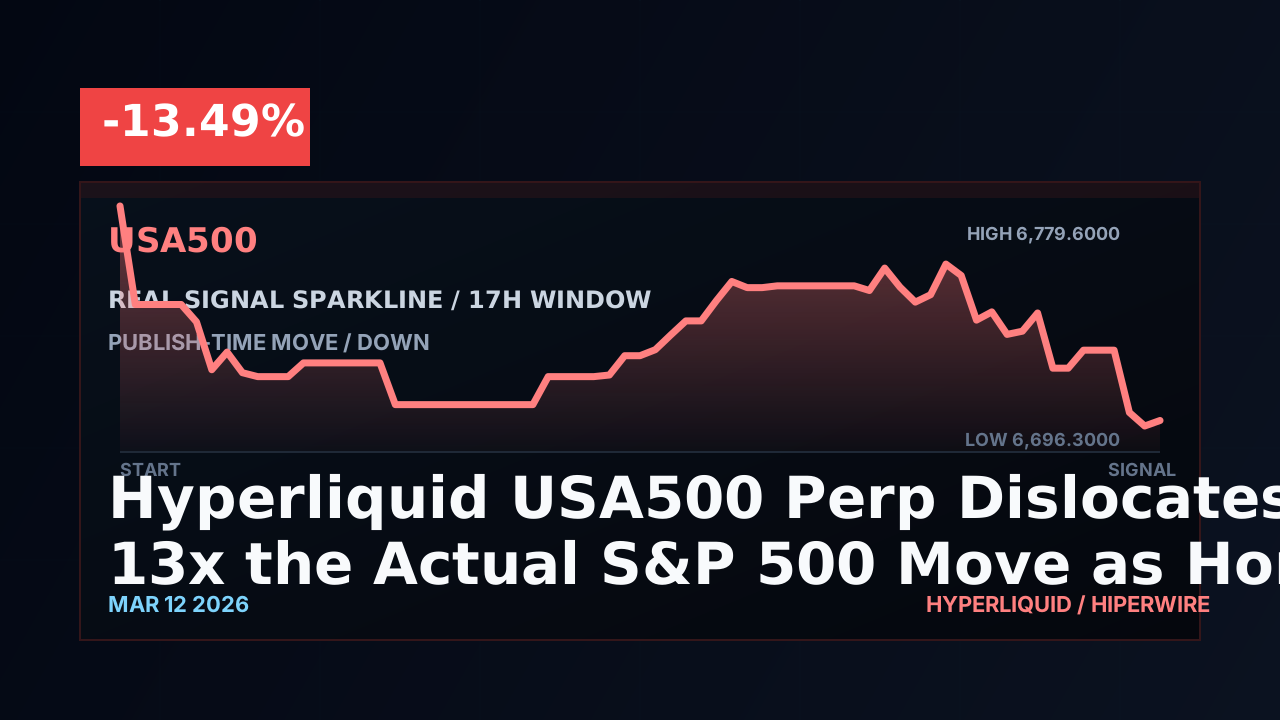
The S&P 500 index fell roughly 1% on March 12 after Iran's new Supreme Leader Mojtaba Khamenei declared the Strait of Hormuz must remain closed, sending Brent crude back toward $100. But on Hyperliquid, the USA500 HIP-3 perp dropped 13.49% to $5,865 — more than thirteen times the underlying move — exposing the thin-book dynamics that define these markets under stress.
Mover Brief
The Macro Catalyst
The real-world trigger is straightforward. Iran's newly appointed Supreme Leader Mojtaba Khamenei declared Thursday that the Strait of Hormuz blockade should continue as a "tool to pressure the enemy" — his first public statement since taking power on March 9 after the killing of Ali Khamenei in joint US-Israeli strikes on February 28.
The market response was immediate. Brent crude jumped 8.5% to $99.76, briefly breaking above $100 intraday. WTI traded around $95. Three more foreign ships were struck in the Persian Gulf overnight, and tanker traffic through the strait — which handles roughly 20% of global daily oil supply — has effectively dropped to zero.
US equity futures fell across the board. The S&P 500 lost 0.99%, the Dow shed 1.17%, and the Nasdaq 100 dropped 1.19%. The Russell 2000 took the hardest hit at -1.93%. The index is now at its lowest close since November, with all 2026 gains erased.
Why the Perp Moved 13x the Index
The actual S&P 500 dropped about 1%. The Hyperliquid USA500 perp dropped 13.49%. That is not a rounding error — it is a structural feature of HIP-3 markets.
USA500 is a community-deployed perpetual on Hyperliquid's HIP-3 infrastructure, meaning it carries thin order books and low sustained liquidity compared to the index it tracks. On a day when the underlying moves 1%, a few aggressive market sells or a cascade of long liquidations can push the perp multiple standard deviations below fair value. The current price of $5,865 represents a discount of roughly 12% to the actual S&P 500 level near 6,650-6,710.
This is not the first time HIP-3 perps have dislocated violently from their underlyings. The mechanism is well-documented: thin books absorb directional flow poorly, stop-losses and liquidation engines compound the move, and the perp overshoots until arbitrageurs or new limit orders fill the gap. For traders, the dislocation itself can be the trade — but only if you understand that the perp and the index are not the same instrument under stress.
The Broader Pressure Stack
The Hormuz crisis is not the only weight on risk assets. Morgan Stanley capped redemptions on its $7.6 billion North Haven Private Income Fund at 5% of shares, honoring only 45.8% of withdrawal requests and returning $169 million. Cliffwater's $33 billion Corporate Lending Fund hit its 7% cap after receiving requests totaling 14% of shares. The trigger: a combination of credit deterioration fears and concern that AI is eroding software-sector profit margins — the same sector that makes up a large chunk of private credit loan books.
Morgan Stanley shares fell 4% on the day. Goldman dropped 3%. The private credit gating adds a financial-sector stress narrative on top of the geopolitical oil shock — a combination that historically correlates with elevated volatility and broader de-risking.
JPMorgan analysts have warned that a sustained Iran conflict pushing oil beyond $100 could trigger a 10% correction in the S&P 500 from recent highs. With the index already down meaningfully from its January peak, that target is coming into view.
What to Watch
The Hyperliquid USA500 perp at $5,865 is pricing in a scenario significantly worse than what the actual index reflects. Either the perp converges back toward the S&P 500's real level in the 6,650-6,710 range as liquidity normalizes, or the underlying index itself has further to fall and the perp is leading — a less likely but not impossible read given the geopolitical backdrop.
For the macro picture, the key variable is the Strait of Hormuz. Energy Secretary Chris Wright acknowledged the US Navy is not ready to escort tankers through the strait, with all military assets focused on degrading Iran's offensive capabilities. Until shipping resumes or a credible de-escalation signal emerges, oil stays bid and equities stay under pressure.
The private credit redemption wave is the slower-burning risk. If more funds gate in coming weeks, the forced selling and sentiment contagion could amplify whatever the geopolitical situation delivers.
Sources & Provenance
Citations below are preserved as structured Postgres source rows for this brief.
Citations Preserved
7
Reference links carried forward from the published mover record.
Original Signal
Open source tweetMarket Route
Direct route preserved for readers who want to inspect the tracked Hyperliquid market behind this archive entry.
Already onboarded? Open tracked market- 1CNBC: Iran's new supreme leader vows Strait of Hormuz must remain closedcnbc.com
- 2NBC News: Live updates on Iran war, oil, ship attacks, Hormuznbcnews.com
- 324/7 Wall St: S&P 500 slips on oil again, March 12 2026247wallst.com
- 4Seoul Economic Daily: Morgan Stanley, Cliffwater cap private credit fund redemptionsen.sedaily.com
- 5InvestingCube: JPMorgan's 10% S&P 500 correction warningnews.investingcube.com
- 6CNBC: Oil tankers in Strait of Hormuz warned by Irancnbc.com
- 7gCaptain: First 36 hours — Strait of Hormuz becomes a war zonegcaptain.com
This content is for informational purposes only and does not constitute financial advice. Trading perpetual futures involves substantial risk of loss.
Trade USA500 on Hyperliquid
Use referral code HIPERWIRE for 4% off trading fees on your first $25M in volume.
Live Market Metrics
Monitor real-time open interest and funding for USA500.