Oil War Premium Collapses After Trump Signals Iran Ceasefire
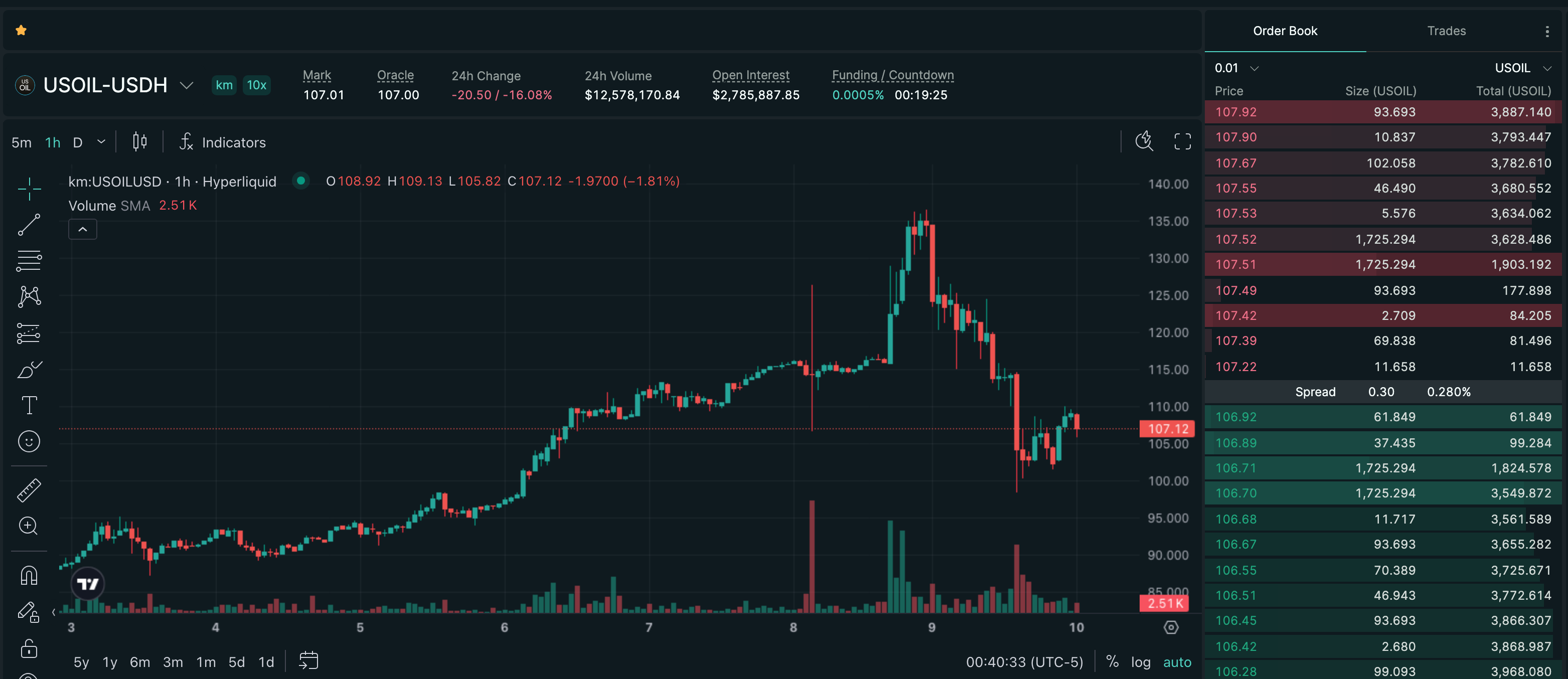
WTI crude swung from a session high near $119 to the mid-$80s on March 9 after Trump told CBS the Iran war ends very soon and announced sanctions waivers plus Navy escorts for Strait of Hormuz tankers. The USOIL perp, which tracks the USO ETF, shed 16% in 24 hours as weeks of supply-disruption pricing unwound in a single session.
Mover Brief
The Reversal
The US-Israel joint strikes on Iran that began February 28 sent crude oil on its sharpest run since the 2022 Russia-Ukraine shock. Iran's threats against tankers in the Strait of Hormuz — the chokepoint for roughly 20% of global oil supply — effectively shut down transit, pushing WTI from the mid-$60s to an intraday high of $119.48 on March 9. That was the first time crude traded above $100 since mid-2022.
Then it reversed. Within hours, WTI dropped as much as 32% from its peak, touching $81.25 before stabilizing in the mid-$80s. The USOIL perp, which tracks the USO ETF's exposure to near-month WTI futures, followed the move down — shedding 16% in 24 hours to $107.
What Broke the Premium
The trigger was a Trump press conference around 3:15 PM ET on March 9. He told CBS the war is "very complete, pretty much" and will end "very soon." He followed up by announcing oil sanctions waivers and pledging US Navy escorts for tankers through the Strait of Hormuz.
The market moved immediately. Traders who had been pricing in a prolonged Hormuz closure liquidated long positions, and the conflict premium — weeks of accumulated supply-disruption risk — came out in a single session. Stocks reversed hard in the other direction: S&P 500 gained 0.83%, Nasdaq rallied 1.38%.
There's a credibility question. Trump separately said the war would not end this week, and the Navy told shipping leaders it doesn't currently have the fleet availability for Hormuz escorts. The market chose to trade the headline anyway.
The G7 Backstop and What's Next
Running in parallel, G7 finance ministers held an emergency call to discuss coordinated strategic petroleum reserve releases. The numbers floated — 300 to 400 million barrels, roughly a quarter to a third of the IEA system's public reserves — were large enough to weigh on prices even as a rumor. The G7 ultimately held off on pulling the trigger, but the signal mattered: if Trump's ceasefire timeline doesn't hold and prices spike again, the SPR backstop is loaded and waiting.
The obvious risk is that "very soon" doesn't materialize. Iran's ability to threaten Hormuz shipping hasn't been eliminated, and tanker traffic hasn't resumed at pre-war levels. If the ceasefire stalls, the war premium comes right back. On the other side, if both the ceasefire and the reserve release converge, oil could retrace further toward pre-war levels in the $60s. For now, the market is trading Trump's word — and betting he delivers.
Sources & Provenance
Citations below are preserved as structured Postgres source rows for this brief.
Citations Preserved
6
Reference links carried forward from the published mover record.
Original Signal
Open source tweetMarket Route
Direct route preserved for readers who want to inspect the tracked Hyperliquid market behind this archive entry.
Already onboarded? Open tracked market- 1CNBC — Trump says Iran war will end 'very soon,' predicts lower oil pricescnbc.com
- 2Al Jazeera — Oil soars past $100 a barrel amid US-Israel war on Iranaljazeera.com
- 3Fortune — Stocks stage massive upside reversal as oil plunges on Trump Iran commentsfortune.com
- 4Bloomberg — G-7 to discuss joint emergency oil reserves releasebloomberg.com
- 5CNN — Oil prices surge above $100: biggest oil disruption in historycnn.com
- 6CNBC — Why Trump's Navy tanker escort plan may not workcnbc.com
This content is for informational purposes only and does not constitute financial advice. Trading perpetual futures involves substantial risk of loss.
Trade USOIL on Hyperliquid
Use referral code HIPERWIRE for 4% off trading fees on your first $25M in volume.
Live Market Metrics
Monitor real-time open interest and funding for USOIL.