Oil Gives Back 8% After Bessent Confirms Iranian Tankers Transiting Hormuz
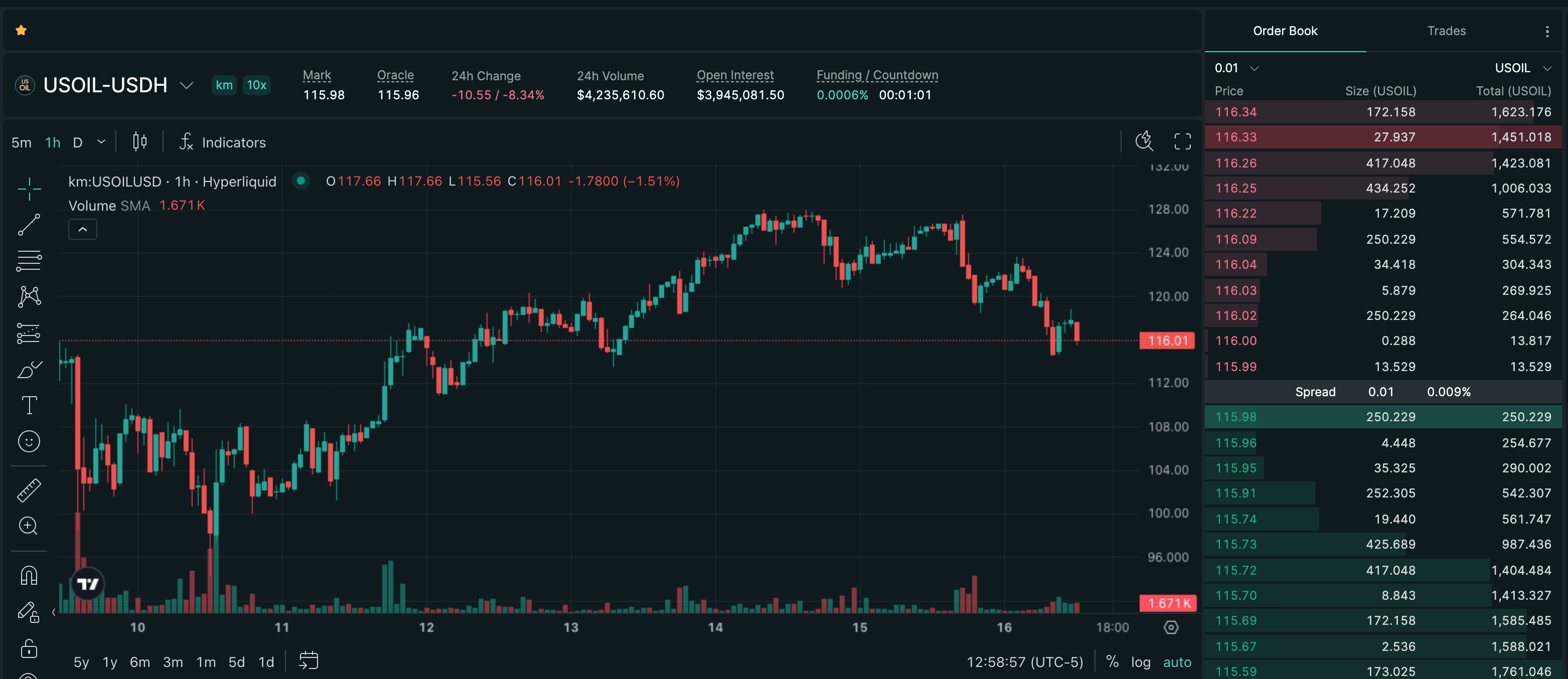
Treasury Secretary Scott Bessent told CNBC on March 16 that the US is allowing Iranian oil tankers to pass through the Strait of Hormuz, the first official confirmation that some crude supply is flowing despite the ongoing blockade. The USOIL perp dropped 8.46% in 23 hours as the market began unwinding a portion of the estimated $40-per-barrel geopolitical premium that has accumulated since the US-Israel strikes on Iran began February 28.
Mover Brief
The Bessent Signal
The trigger was straightforward. Treasury Secretary Scott Bessent told CNBC on Monday that the US is letting Iranian oil tankers pass through the Strait of Hormuz. "The Iranian ships have been getting out already, and we've let that happen to supply the rest of the world," he said. Tankers supplying India have already transited, and Bessent indicated some Chinese-flagged vessels are also moving through.
WTI fell 3.16% to $95.59 per barrel on the news. Brent dropped to $102.16. The USOIL perp, which tracks the USO ETF's exposure to near-month WTI futures, amplified the move — shedding 8.46% in 23 hours as leveraged positioning unwound.
Bessent went further, saying oil should fall "much lower" than $80 per barrel once the war ends. That's a remarkable statement given Brent was above $100 at the time, and it signals the administration views the current war premium as temporary and excessive. The market took it as permission to start selling.
Supply Relief vs. Supply Reality
The Bessent disclosure adds to a growing list of factors chipping away at the war premium. The IEA unanimously approved a 400-million-barrel release from strategic reserves — the largest coordinated drawdown in the agency's history, more than double the 182 million barrels released after Russia's Ukraine invasion. Last week's EIA data showed US crude inventories rose 3.8 million barrels, nearly four times the expected 1.1 million barrel build.
But the gap between price relief and physical supply recovery is wide. Oil shipments through Hormuz have fallen to less than 10% of pre-war levels. The 400-million-barrel reserve release covers roughly 20 days of typical Hormuz traffic — energy strategist Naif Aldandeni called it "a small bandage on a large wound." Analysts estimate crude still carries roughly $40 per barrel of geopolitical risk premium above fundamentals.
The price is correcting, but it's not normalizing. Iran letting its own tankers through is not the same as the strait reopening to commercial traffic.
Coalition of None
Trump's plan to build an international coalition to escort commercial shipping through Hormuz has drawn no commitments. He called on China, Japan, France, and the UK by name — Japan and Australia both said Monday they have no plans to send ships. Trump warned NATO the alliance would face a "very bad" future if the response remains negative, but so far the appeal is unanswered.
The timeline is also extending. The US Energy Secretary signaled the Iran conflict could last several more weeks, and administration officials said Navy escorts won't deploy until Iran's military capacity is further degraded. Wolf Street's analysis of the March 9 spike-and-crash called the volatility "sheer manic speculation," noting the US imports only 2% of its petroleum through Hormuz — the lowest share in 40 years.
That disconnect between US domestic fundamentals and global crude pricing is what makes this trade so volatile. The US doesn't need Hormuz oil, but the benchmark it trades on reflects a world that does.
Sources & Provenance
Citations below are preserved as structured Postgres source rows for this brief.
Citations Preserved
7
Reference links carried forward from the published mover record.
Original Signal
Open source tweetMarket Route
Direct route preserved for readers who want to inspect the tracked Hyperliquid market behind this archive entry.
Already onboarded? Open tracked market- 1CNBC — Bessent confirms US allowing Iranian tankers through Hormuzcnbc.com
- 2Al Jazeera — Trump seeks coalition to reopen Strait of Hormuzaljazeera.com
- 3Al Jazeera — Strategic oil release cannot fix Hormuz disruptionaljazeera.com
- 4Reuters — US crude stocks rise 3.8M barrels, EIA reportreuters.com
- 5Fortune — Oil price report, March 16, 2026fortune.com
- 6Wolf Street — WTI spike-and-crash speculation analysiswolfstreet.com
- 7CNBC — Oil prices fall as Trump pressures allies on Hormuzcnbc.com
This content is for informational purposes only and does not constitute financial advice. Trading perpetual futures involves substantial risk of loss.
Trade USOIL on Hyperliquid
Use referral code HIPERWIRE for 4% off trading fees on your first $25M in volume.
Live Market Metrics
Monitor real-time open interest and funding for USOIL.