USOIL Surges as Strait of Hormuz Closure Chokes Global Oil Supply
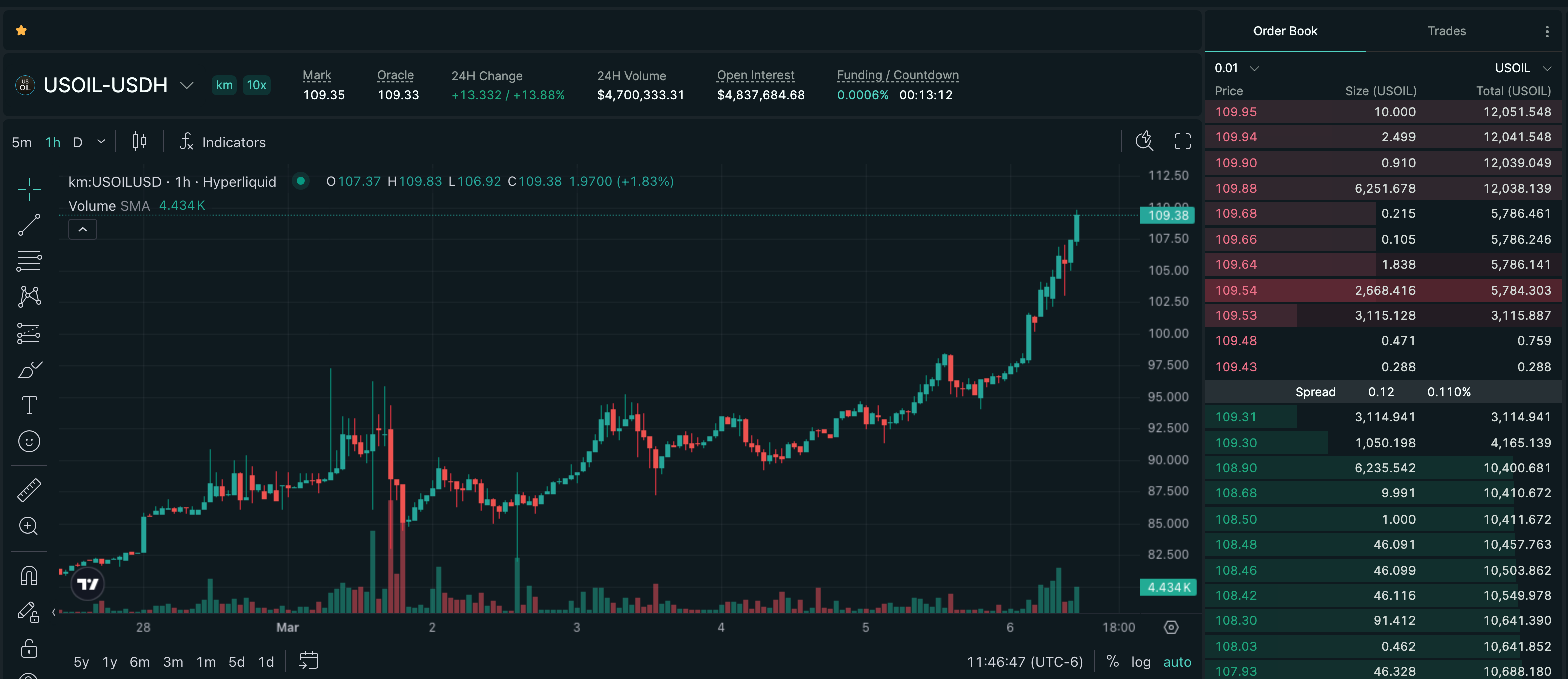
USOIL ripped 15.25% in just 17 hours on Hyperliquid, pushing past $109 as the U.S.-Iran war enters its most dangerous phase yet. The catalyst is straightforward and severe: the Strait of Hormuz is effectively closed to commercial shipping, roughly 200 tankers are stranded in the Persian Gulf, and President Trump just demanded unconditional surrender from Iran, killing any hope of a quick resolution.
Mover Brief
What Happened
The USOIL perpetual on Hyperliquid — which tracks U.S.-listed instruments tied to WTI crude futures, not spot crude directly — surged past $109 on the back of a week that has delivered the single largest oil rally since WTI futures began trading in 1983. The HIP-3 perp notched $4.7 million in 24-hour volume as traders piled into the only oil exposure available around the clock.
On traditional markets, WTI crude topped $90 per barrel on Friday, with Brent hitting $92. The weekly gain is on pace to surpass the 31.7% spike from March 2020, making this the most violent oil move in over four decades. The broader risk landscape is ugly: the Dow dropped over 900 points, the VIX spiked to 26, and Bitcoin slid toward $70,000 as risk assets got sold across the board.
Hyperliquid has been a direct beneficiary of the chaos. When traditional markets closed over the weekend following the initial strikes, crypto perp platforms were the only game in town. Oil perps on Hyperliquid generated $17 million in volume that first Sunday alone, with gold perps clocking $148 million. As Coinbase's Kenny Chan put it, traders "went straight to the source on Hyperliquid" rather than routing through Bitcoin as a proxy.
Why It Moved
The primary catalyst is the effective closure of the Strait of Hormuz — the chokepoint through which roughly 20% of the world's daily crude oil and natural gas typically flows. After the U.S. and Israel launched "Operation Epic Fury" on February 28, killing Supreme Leader Ali Khamenei, Iran's IRGC declared the strait closed on March 2 and began threatening any commercial vessel that attempted passage.
The blockade didn't require a traditional naval presence. As analyst Helima Croft explained, all Iran needed was several drone strikes near the strait to make insurers and shipping companies deem passage unviable. Tanker transits collapsed from 24 per day to just four — three of which were Iran-flagged. Around 200 internationally trading tankers are now stranded in the Gulf, including 60 VLCCs.
The supply damage extends beyond shipping. Iraq has shut in over 2 million barrels per day of production at three major fields that can't export. Kuwait is cutting output after exhausting storage. QatarEnergy halted its world-leading LNG export facility following an Iranian drone attack on infrastructure. This isn't just a shipping disruption — it's a rolling production crisis across the entire Gulf.
Then, on Friday, Trump posted that there would be no deal without "UNCONDITIONAL SURRENDER" from Iran. That extinguished whatever remained of ceasefire hopes. Prediction markets now give just a 12% chance of a ceasefire within one week and 28% by March 31. The market is pricing in a prolonged conflict.
What to Watch
The Strait of Hormuz is everything. If tanker traffic resumes — whether through U.S. Navy escorts, a ceasefire, or insurance markets adjusting — the war premium unwinds fast. Qatar's energy minister warned prices could hit $150 per barrel within weeks if the blockade holds. Goldman Sachs has raised its Q2 Brent forecast by $10 to $76 and flagged that five weeks of disruption could push prices past $100 on traditional benchmarks.
Key variables: Iran's ability to sustain the Hormuz closure under military pressure, whether Iraqi and Kuwaiti production stays offline, and any signal from the White House on diplomatic off-ramps. The Trump administration has signaled it will deploy U.S. naval escorts and political risk insurance through the DFC to reopen shipping lanes, but execution remains uncertain.
For the USOIL perp specifically, watch for premium or discount divergence from the underlying oracle reference as volatility stays elevated. The perp tracks near-month WTI futures instruments, not spot — contango or backwardation shifts in the futures curve will affect pricing independently of headline spot moves.
Sources & Provenance
Citations below are preserved as structured Postgres source rows for this brief.
Citations Preserved
10
Reference links carried forward from the published mover record.
Original Signal
Open source tweetMarket Route
Direct route preserved for readers who want to inspect the tracked Hyperliquid market behind this archive entry.
Already onboarded? Open tracked market- 1Trade USOIL on Hyperliquidapp.hyperliquid.xyz
- 2U.S. crude oil tops $90 per barrel after Trump demands unconditional surrender from Iran — CNBCcnbc.com
- 3Oil hits biggest weekly rally on record — Benzingabenzinga.com
- 4The Iran war has effectively closed the Strait of Hormuz — NPRnpr.org
- 5Passage denied: Hormuz shutdown keeps oil prices climbing — Euronewseuronews.com
- 6Shutdown of Hormuz Strait raises fears of soaring oil prices — Al Jazeeraaljazeera.com
- 7Around 200 tankers stranded as Strait of Hormuz closure freezes Gulf traffic — Lloyd's Listlloydslist.com
- 8Hyperliquid captures macro trade after Trump's Iran gambit — DL Newsdlnews.com
- 9Trump demands unconditional surrender, sending oil surging — CoinDeskcoindesk.com
- 10Oil surges and stock futures sink as war in Iran threatens crude supply — CNNcnn.com
This article is for informational purposes only and does not constitute financial or trading advice.
Trade USOIL on Hyperliquid
Use referral code HIPERWIRE for 4% off trading fees on your first $25M in volume.
Live Market Metrics
Monitor real-time open interest and funding for USOIL.