USOIL Reverses From Iran War Highs as G7 Floats Record Reserve Release
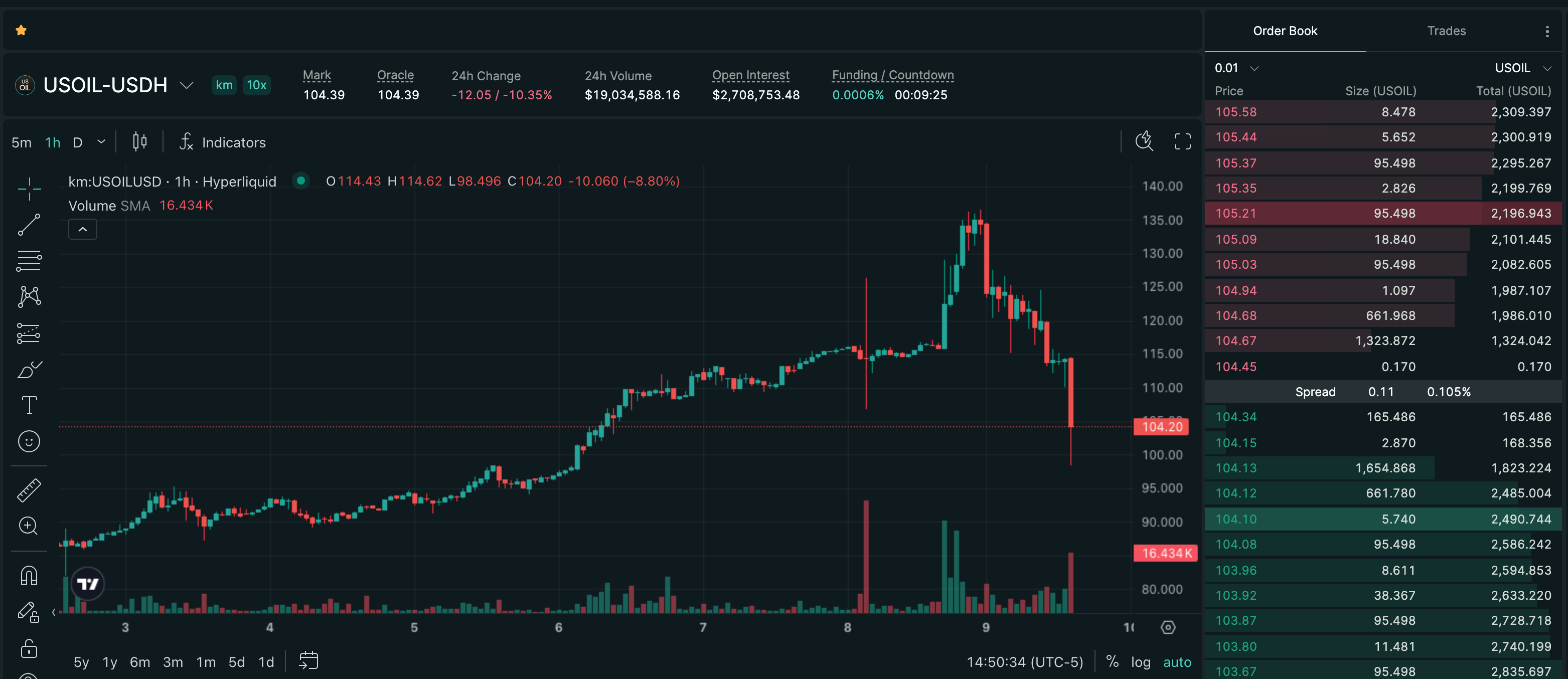
Crude gave back its entire Strait of Hormuz war premium on March 9 after G7 finance ministers announced an emergency meeting to discuss releasing 300 to 400 million barrels from strategic petroleum reserves. WTI reversed from session highs near $118 to trade below $96, erasing over a week of conflict-driven gains in a single session. The proposed release would be the largest coordinated intervention in oil markets since the 2022 Russia-Ukraine response.
Mover Brief
The G7 Trigger
The reversal started with a Financial Times report that G7 finance ministers would hold an emergency meeting to discuss a joint release of strategic petroleum reserves, coordinated by the International Energy Agency. The proposed volume — 300 to 400 million barrels — would exceed the 240 million barrels released during the 2022 Ukraine crisis by roughly 60%.
The headline hit while WTI was trading near session highs above $118. Within hours, WTI fell from $115.29 to $95.81 and Brent dropped from $116.23 to $99.63. On Hyperliquid, the USOIL perp tracked the move in real time, falling over 22% from its war-premium highs.
IEA head Fatih Birol had set the stage days earlier, stating publicly that "there is plenty of oil, we have no oil shortage" — framing the spike as a geopolitical premium rather than a fundamental supply deficit. The G7 announcement gave the market permission to sell.
Ten Days From Strikes to Blockade
The war premium that just unwound took ten days to build. On February 28, the U.S. and Israel launched joint military strikes on Iranian infrastructure. Iran retaliated and its Revolutionary Guard effectively shut down the Strait of Hormuz, the maritime chokepoint responsible for roughly 20% of the world's daily oil and LNG flow.
The blockade was devastating. Tanker traffic through the strait dropped by over 90%, with more than 150 vessels anchoring outside the passage. Insurance premiums hit six-year highs, making transit economically unviable for most operators. The result was a de facto closure even without a formal naval blockade.
The downstream effects compounded fast. UAE and Kuwait cut oil production as export routes disappeared. Iraq followed suit. On March 8, Israel escalated further with air raids targeting four Iranian oil storage facilities and a products transfer center in Tehran and Alborz province. By Sunday evening, WTI had posted a 35.6% weekly gain — its largest in history — and Brent briefly touched $119.50.
Can 400 Million Barrels Actually Cool This?
The math is straightforward but not encouraging for bulls betting the SPR release is a bluff. The Strait of Hormuz normally carries roughly 21 million barrels per day. At that rate, 400 million barrels covers about 19 days of lost Hormuz flow — meaningful enough to prevent a worst-case scenario but not enough to replace the strait for any sustained period.
There are real constraints, though. The 2022 release of 240 million barrels took months to fully deploy. Physical logistics — pipeline capacity, port throughput, tanker availability — mean you cannot flood the market overnight. Three IEA members including the U.S. expressed initial support, but the G7 ultimately delayed a formal decision, leaving the market in limbo between headline relief and physical reality.
Iran's IRGC has warned that oil could reach $200 if the U.S. and Israel "continue this game." Analysts at Kpler noted that any confirmed ceasefire or maritime safe corridor would instantly collapse the remaining premium, with technical models suggesting a 15% correction to fill the $90 liquidity void. The market is caught between two binary outcomes: a prolonged blockade that sends crude well above $120, or a diplomatic resolution that sends it right back to pre-war levels near $70.
Sources & Provenance
Citations below are preserved as structured Postgres source rows for this brief.
Citations Preserved
7
Reference links carried forward from the published mover record.
Original Signal
Open source tweetMarket Route
Direct route preserved for readers who want to inspect the tracked Hyperliquid market behind this archive entry.
Already onboarded? Open tracked market- 1Al Jazeera — Oil soars past $100 as US-Israel war on Iran ragesaljazeera.com
- 2OilPrice.com — G7 Considers Releasing Up to 400 Million Barrelsoilprice.com
- 3CoinDesk — Oil pulls back from 25% spike as G7 discusses emergency reserve releasecoindesk.com
- 4EIA — Strait of Hormuz remains critical oil chokepointeia.gov
- 5Wikipedia — 2026 Strait of Hormuz crisisen.wikipedia.org
- 6Bloomberg — UAE and Kuwait Cut Oil Output After Hormuz Blockagebloomberg.com
- 7Kpler — Strait of Hormuz crisis reshapes global oil marketskpler.com
This content is for informational purposes only and does not constitute financial advice. Trading perpetual futures involves substantial risk of loss.
Trade USOIL on Hyperliquid
Use referral code HIPERWIRE for 4% off trading fees on your first $25M in volume.
Live Market Metrics
Monitor real-time open interest and funding for USOIL.