Brent Breaks $106 After Iran Turns Away China's Own Ships at Hormuz
Iran's Revolutionary Guard turned back three Chinese-linked vessels attempting to transit the Strait of Hormuz on Friday, proving the blockade is absolute — not even Beijing gets through. The IRGC formally declared the strait closed to all vessels bound for U.S. and Israeli allies, while Trump's latest deadline extension to April 6 failed to calm a market now pricing the closure as indefinite.
Mover Brief
China Gets Blocked at Its Own Ally's Chokepoint
Three Chinese-linked vessels — the COSCO-owned CSCL Indian Ocean, CSCL Arctic Ocean, and Hong Kong-owned bulk carrier Lotus Rising — made abrupt U-turns near Hormuz at roughly 3:20 and 3:50 a.m. UTC on Friday. The IRGC issued a formal statement afterward: "The Strait of Hormuz is closed."
This was COSCO's first attempt to push ships through since resuming Middle East-bound cargo bookings — a test of whether Beijing's relationship with Tehran would translate into privileged transit. It didn't. COSCO handles roughly 10% of global seaborne freight, and the company now has at least six crude tankers stuck inside the Persian Gulf with nowhere to go. According to CSIS analysis, 55 Chinese-flagged ships are trapped inside the Gulf, while more sit idle in the Gulf of Oman outside.
The implications are hard to overstate. China imports approximately 40% of its oil and 30% of its LNG through Hormuz. If Beijing — Iran's largest trade partner — can't get ships through, nobody can. Vessel traffic through the strait has fallen over 90% since March 1, from 153 daily transits to roughly 13.
Trump's April 6 Deadline Changes Nothing
Trump extended his ultimatum to Iran by 10 days to April 6, pausing strikes on Iranian energy infrastructure while citing talks that he claims are going "very well." Iran's foreign ministry has said the opposite — Tehran rejected the U.S. ceasefire proposal and countered with its own demands, while threatening to retaliate against regional desalination infrastructure if Washington follows through on bombing threats.
The market's verdict was clear: Brent settled at $112.57, up 4.22%, its highest close since July 2022. WTI closed at $99.64, up 5.46%. The S&P 500 dropped 1.6%. This is the pattern: each deadline extension buys a brief dip, then crude resumes climbing as the market concludes the disruption isn't ending soon. Macquarie strategists now project $200 oil if the war continues through June.
The Supply Math
The numbers are stacking up badly. Iran's Hormuz blockade has removed the transit route for roughly 17.8 million barrels per day of pre-conflict oil flows. Meanwhile, the Ukrainian drone campaign against Russian oil infrastructure has knocked out an additional 2 million bpd of Russian export capacity — the two largest oil export corridors in the world are now compromised simultaneously.
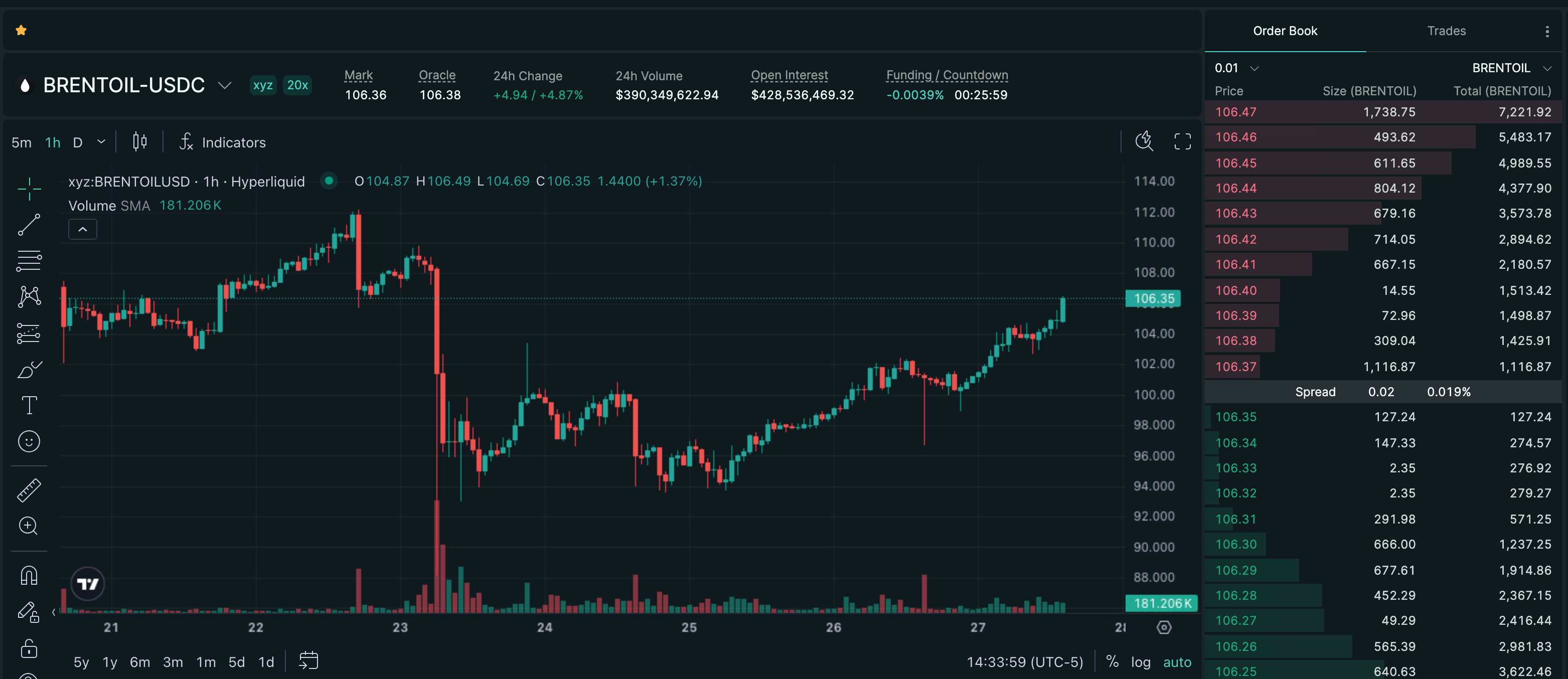
Iran has begun operating Hormuz as a de facto toll booth, allowing limited passage for vessels willing to pay fees settled in Chinese yuan, submit manifests, and pass "geopolitical vetting." But even that arrangement appears unreliable after Friday's COSCO incident. The $14-18 per barrel risk premium that analysts estimated at the start of the conflict now looks conservative — Brent has moved from $70 pre-war to $106+ on Hyperliquid, with the options market beginning to price scenarios above $150.
What Breaks the Impasse
The April 6 deadline is the next binary event, but the market has stopped treating these deadlines as credible inflection points. Trump has extended twice already. Iran has no incentive to reopen the strait while it serves as leverage, and Israel has vowed to "intensify and expand" strikes on Iranian targets.
The realistic scenarios are narrowing. Either a genuine ceasefire framework emerges — which requires Iran to accept terms it has publicly rejected — or the conflict escalates further, potentially to U.S. strikes on Iranian energy infrastructure like the South Pars gas field. A middle path where Hormuz partially reopens under a yuan-denominated toll regime would still leave barrels off the market and keep the risk premium elevated. For crude longs, the thesis remains intact until ships start moving through the strait again. They aren't.
Sources & Provenance
Citations below are preserved as structured Postgres source rows for this brief.
Citations Preserved
6
Reference links carried forward from the published mover record.
Original Signal
Open source tweetMarket Route
Direct route preserved for readers who want to inspect the tracked Hyperliquid market behind this archive entry.
Already onboarded? Open tracked market- 1Newsweek: Chinese Ships Fail to Exit Strait of Hormuznewsweek.com
- 2CSIS: No One, Not Even Beijing, Is Getting Through the Strait of Hormuzcsis.org
- 3Fortune: Trump Extends Iran Deadline to April 6fortune.com
- 4BNN Bloomberg: Oil Prices Rise as Trump Delay Fails to Raise Hopebnnbloomberg.ca
- 5Reuters: Options Market Signals Rising Risk of $150 Oilreuters.com
- 6Fortune: Iran's Hormuz Toll Paid in Yuanfortune.com
This content is for informational purposes only and does not constitute financial advice. Trading perpetual futures involves substantial risk of loss.
Trade BRENTOIL on Hyperliquid
Use referral code HIPERWIRE for 4% off trading fees on your first $25M in volume.
Live Market Metrics
Monitor real-time open interest and funding for BRENTOIL.