WTI Pushes Past $97 as US Navy Begins Mine-Clearing in Hormuz
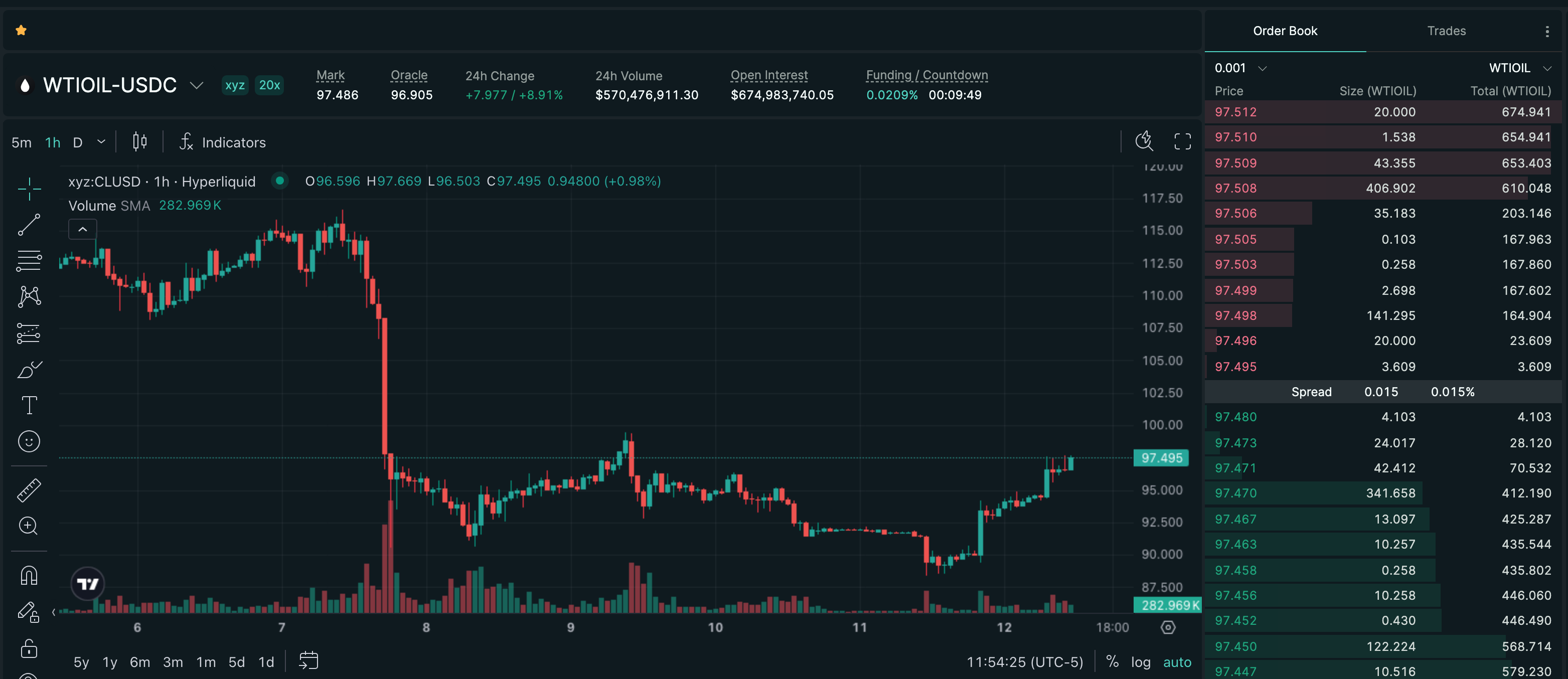
WTI crude extended above $97 after US Navy destroyers entered the Strait of Hormuz for the first time since the Iran war began, launching mine-clearing operations that Tehran called a ceasefire violation. The move comes hours after Islamabad peace talks collapsed over the nuclear issue and Trump declared a full naval blockade of the strait. With 230 loaded tankers still stuck in the Persian Gulf and JPMorgan warning of $120 crude, the risk premium that evaporated during ceasefire hopes is rebuilding fast.
Mover Brief
The Mine-Clearing Escalation
Two Arleigh Burke-class destroyers — the USS Frank E. Peterson and USS Michael Murphy — transited the Strait of Hormuz on April 11, marking the first American warship passage through the strait since Iran mined the waterway in late February. CENTCOM confirmed both ships completed the full transit and began establishing conditions for mine-clearing operations, with underwater drones set to join the effort in the coming days.
Iran told a different story. State television reported that the IRGC issued a 30-minute warning to one of the approaching destroyers, threatening attack if it crossed the strait, and claimed the vessel turned back. US officials flatly denied this, telling multiple outlets that both ships made it through. The USS Michael Murphy broke protocol by switching on its automatic identification system during the transit — a deliberate signal that the US was not trying to hide its presence.
Adm. Brad Cooper framed the mission in commercial terms: "Today, we began the process of establishing a new passage and we will share this safe pathway with the maritime industry soon to encourage the free flow of commerce." A third aircraft carrier, plus thousands of Marines and paratroopers, are expected to arrive later this month.
Diplomacy Dead, Blockade Live
The Navy transit happened while Vice President JD Vance and Iranian Parliament Speaker Ghalibaf sat roughly 2,000 miles away in Islamabad for the first direct US-Iran talks since 1979. Most points were reportedly agreed on, but the nuclear issue killed the deal. Trump later confirmed that "the only point that really mattered, NUCLEAR, was not" resolved.
Hours after Vance announced the breakdown, Trump declared a full naval blockade via social media: "Effective immediately, the United States Navy will begin the process of BLOCKADING any and all Ships trying to enter, or leave, the Strait of Hormuz." The framing was explicit — this is about dismantling Iran's toll system that charged over $1 million per ship for passage through the strait during the war. "We're not going to let Iran make money on selling oil to people that they like. It's going to be all or none."
What's Priced In
WTI's path this week tells the story of a market that keeps getting ahead of itself. Crude dropped from $117 to under $89 as traders front-ran a peace deal through the ceasefire period, then whipsawed back above $97 when that deal evaporated and the US started clearing mines instead.
The physical picture is ugly. Roughly 230 loaded oil tankers remain stuck in the Persian Gulf, and commercial traffic through the strait has slowed to a trickle despite the brief ceasefire window. One-fifth of the world's oil normally flows through this chokepoint. JPMorgan has warned that crude could hit $120 if disruptions extend into mid-year, citing rapid inventory drawdowns, rising freight costs, and insurance premiums that have made commercial shipping through the strait uneconomical even when technically possible.
The bear case is thinner but real. EIA data from April 8 showed a surprise 3.1 million barrel build in US crude inventories to near a three-year high, and US shale production continues to offset some of the Gulf supply loss. But domestic inventory builds don't solve a one-fifth-of-global-supply chokepoint problem — especially when the country announcing the blockade is the same one sitting on those inventories. Energy analyst Bob McNally of Rapidan Energy compared the US military approach to "whack-a-mole", noting Iran's layered defenses across anti-ship missiles, fast-attack boats, drones, submarines, and artillery. He predicted the US could degrade Iran's hold to a "manageable level" — but not before the additional carrier group arrives later this month.
Sources & Provenance
Citations below are preserved as structured Postgres source rows for this brief.
Citations Preserved
6
Reference links carried forward from the published mover record.
Original Signal
Open source tweetMarket Route
Direct route preserved for readers who want to inspect the tracked Hyperliquid market behind this archive entry.
Already onboarded? Open tracked market- 1CBS News — US Naval Destroyers Cross Strait of Hormuzcbsnews.com
- 2Fortune — Navy Tests Hormuz Blockade, Expert Says Iran Hold Could Be Degradedfortune.com
- 3Fortune — Iran Threatens US Warships After Hormuz Transitfortune.com
- 4Al Jazeera — Trump Announces Hormuz Blockade After Peace Talks Endaljazeera.com
- 5APAC News Network — JPMorgan Warns Oil Could Hit $120apacnewsnetwork.com
- 6Reuters — US Crude Stocks Rise 3.1M Barrels, EIA Saysreuters.com
This content is for informational purposes only and does not constitute financial advice. Trading perpetual futures involves substantial risk of loss.
Trade CL on Hyperliquid
Use referral code HIPERWIRE for 4% off trading fees on your first $25M in volume.
Live Market Metrics
Monitor real-time open interest and funding for CL.