WTI Slips Below $96 After Treasury Frees 140 Million Barrels of Iranian Oil at Sea
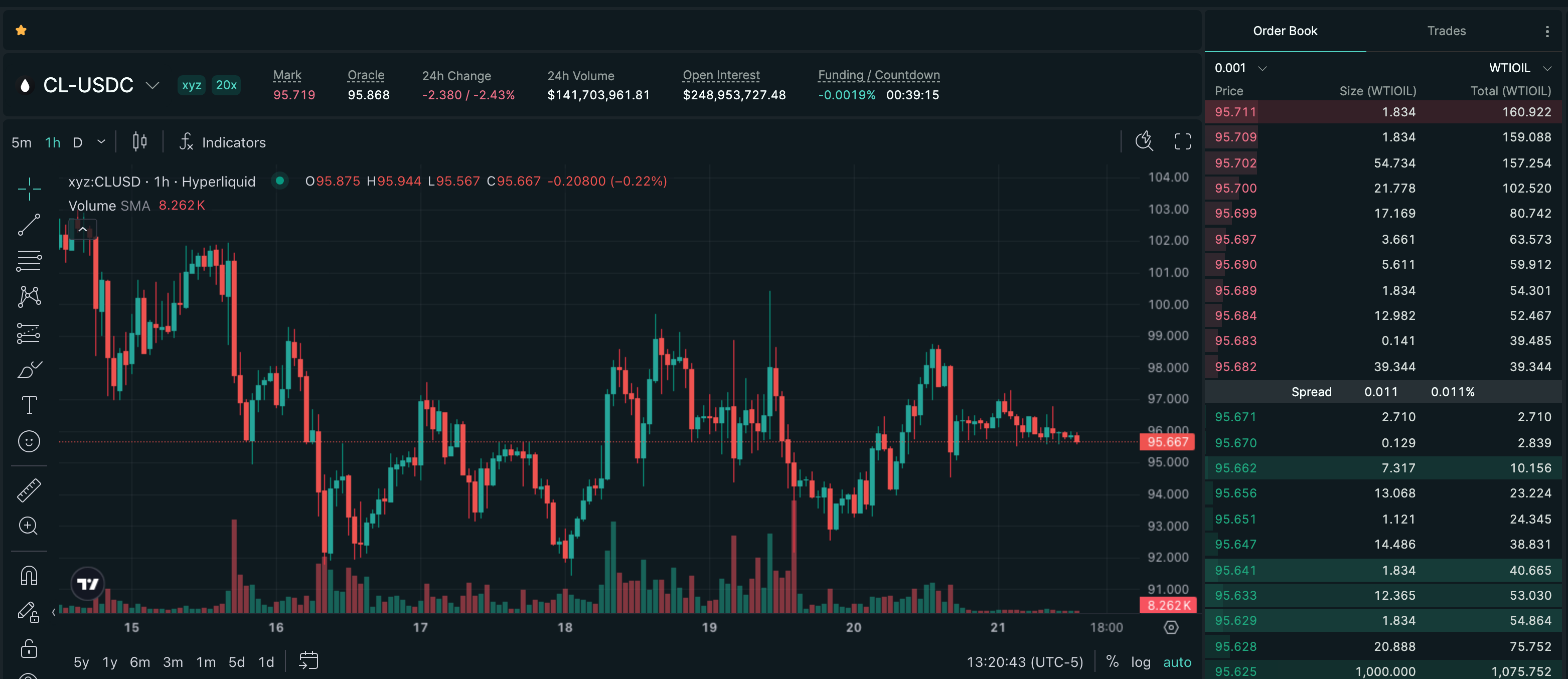
WTI crude fell to $95.92 after the US Treasury issued General License U on March 20, authorizing the sale of approximately 140 million barrels of Iranian oil already loaded on tankers. The 30-day sanctions waiver, valid through April 19, marks the third time in two weeks the administration has temporarily released adversary crude onto global markets in an attempt to cap prices that have nearly doubled since the Hormuz crisis began.
Mover Brief
The Catalyst: Treasury Weaponizes Iran's Own Barrels
The Office of Foreign Assets Control published General License U on Friday, authorizing the delivery and sale of Iranian crude oil and petroleum products loaded onto vessels as of 12:01 a.m. ET on March 20. The window runs through April 19. All buyers are eligible except entities in North Korea, Cuba, and Russian-occupied Ukraine.
Treasury Secretary Scott Bessent framed it bluntly: "In essence, we will be using the Iranian barrels against Tehran to keep the price down" while maintaining that Iran cannot access most of the proceeds. The roughly 140 million barrels sitting on tankers represent about 1.5 days of global consumption — not enough to solve a structural supply crisis, but enough to cool speculative front-month positioning.
This is the third time in just over two weeks the Treasury has temporarily waived sanctions on oil from US adversaries. The pattern is clear: Washington is improvising supply-side interventions one tranche at a time because it has no mechanism to reopen Hormuz. Intraday, the announcement pushed WTI as low as $92.47 — a 3.22% drop — before prices partially recovered.
The 'Winding Down' Signal That Nobody Believes
Hours after the sanctions waiver, Trump posted on Truth Social that the US is "getting very close to meeting our objectives" and considering winding down military efforts in the Middle East. The oil market initially treated this as additional reason to sell risk premium.
The problem: the Pentagon is simultaneously deploying up to 2,500 more Marines to the region, the second such deployment in a week. Iran's response was equally dismissive — a senior Iranian official told CNN the comments were "Trump's psychological operations to control the markets."
The disconnect between rhetoric and troop movements matters for positioning. Traders who sold WTI on the "winding down" headline are betting the words matter more than the ships. Three weeks into a conflict with no ceasefire framework and Iran striking Gulf energy infrastructure daily, that is a directional bet on politics, not supply fundamentals.
Why WTI Keeps Underperforming Brent
WTI at $95.92 while Brent trades above $107 tells the real story. The WTI-Brent spread has blown out past $12 — its widest level in 11 years — because the Hormuz crisis is primarily a problem for waterborne crude flows, not US domestic production.
American supply fundamentals remain intact. The EIA reported US crude inventories rose 6.2 million barrels for the week ending March 13, well above expectations. The API had earlier reported a 6.56 million barrel build. US crude is flowing into the export market as Asian and European refiners scramble for non-Gulf barrels, but domestic storage is filling.
The divergence creates a two-speed oil market. Brent prices the physical reality of 7-10 million bpd offline in the Gulf. WTI prices the fact that the largest oil producer in the world is not supply-constrained and is actively adding inventory. For perp traders, this spread is the key variable — any Hormuz reopening compresses it violently, while continued closure keeps WTI range-bound even as Brent pushes higher.
What This Unwinding Means
WTI has now pulled back roughly 20% from its $119 intraday high on March 9 despite the underlying supply crisis being worse, not better. Iraq declared force majeure on all foreign-operated oilfields. Kuwait's largest refinery is burning for a second straight day. The strait remains closed.
What changed is the market's assessment of the policy response. Treasury is now releasing sanctioned barrels. Trump is signaling an off-ramp, however implausible. Goldman has modeled a scenario where Brent returns to the $70s by Q4 if Hormuz gradually reopens from April. Each of these data points individually is thin — 140 million barrels is noise against a 100 million bpd global market, and diplomatic rhetoric is not a ceasefire — but collectively they give short-sellers enough cover to lean on the war premium.
The risk is asymmetric. If Hormuz actually reopens, WTI has $20+ of downside as the spread normalizes. If the conflict deepens and Treasury runs out of sanctioned barrels to release, the $119 high is back in play. At $95.92, the market is pricing a cautious de-escalation that has not yet begun.
Sources & Provenance
Citations below are preserved as structured Postgres source rows for this brief.
Citations Preserved
6
Reference links carried forward from the published mover record.
Original Signal
Open source tweetMarket Route
Direct route preserved for readers who want to inspect the tracked Hyperliquid market behind this archive entry.
Already onboarded? Open tracked market- 1OFAC General License U — Iranian oil sanctions waiverofac.treasury.gov
- 2CBS News — Trump administration temporarily lifts sanctions on Iranian oil at seacbsnews.com
- 3NPR — Trump mulls winding down Iran war as more Marines head to Mideastnpr.org
- 4Reuters — Oil prices drop as US crude inventories show increasereuters.com
- 5Reuters — WTI-Brent spread hits widest in 11 yearsreuters.com
- 6CNN — Day 21 of Middle East conflict, Trump considers winding downcnn.com
This content is for informational purposes only and does not constitute financial advice. Trading perpetual futures involves substantial risk of loss.
Trade CL on Hyperliquid
Use referral code HIPERWIRE for 4% off trading fees on your first $25M in volume.
Live Market Metrics
Monitor real-time open interest and funding for CL.