WTI Flips Brent for the First Time in a Decade as Hormuz Rewires Crude Flows
WTI crude is trading at a roughly $3.70 premium to Brent, inverting a spread that has favored the international benchmark for over a decade. The flip reflects a market repricing physical accessibility over seaborne volume — U.S. barrels can load and ship without touching the Strait of Hormuz, and traders are paying up for that certainty. Front-month backwardation hit a record $16.70 per barrel on Thursday as the scramble for deliverable crude intensified.
Mover Brief
The Flip
For the first time since the U.S. shale logistics bottleneck of 2011-2013, WTI is trading at a sustained premium to Brent — roughly $3.72 per barrel as of Thursday's settle. The normal spread runs $3-$6 in Brent's favor, reflecting its role as the global seaborne benchmark. That logic broke this week.
The reason is straightforward: the Strait of Hormuz is functionally closed, and roughly 20% of the world's seaborne oil no longer moves. WTI — physically settled at Cushing, Oklahoma, exportable through Gulf Coast terminals — doesn't need the Strait. Brent does. Traders are paying a "security premium" for barrels that can actually be loaded, shipped, and delivered. Murban crude rose nearly 10% alongside WTI for the same reason: it's accessible.
Art Hogan put it plainly — "WTI is currently the primary vehicle for traders betting on the duration of U.S. involvement" in the Iran conflict. As long as that conflict runs, the spread stays inverted.
Record Backwardation
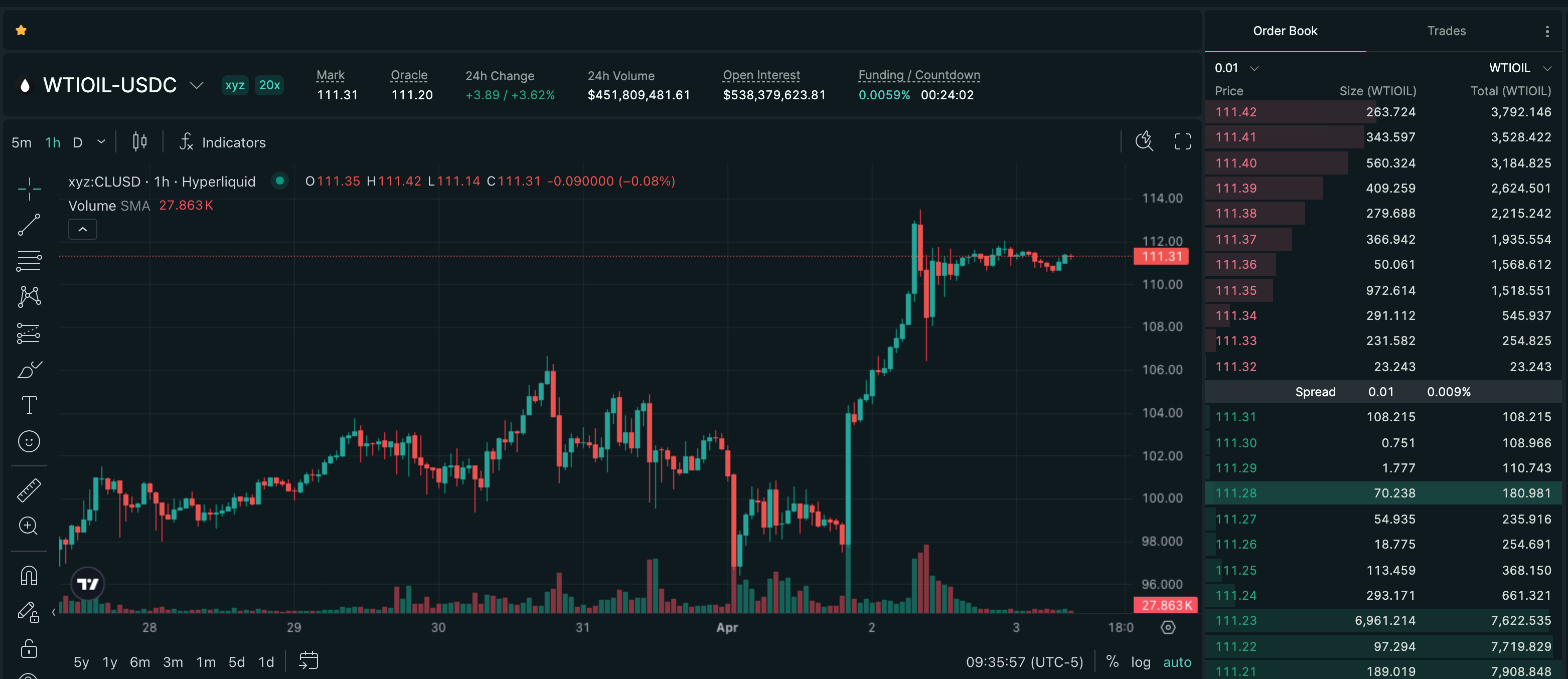
The futures curve is screaming near-term scarcity. May-June WTI backwardation hit $16.70 per barrel on Thursday — the largest front-month spread ever recorded in crude oil. May contracts touched a session high of $113.97 before settling at $111.42, the highest level since June 2022.
Phil Flynn flagged the move as "record backwardation in WTI," driven in part by position unwinding ahead of the Good Friday holiday. But the structural signal is clear: the market is paying a historic premium for immediate delivery, not just speculating on geopolitics. J.P. Morgan estimates the Hormuz closure represents an effective loss of 14 million barrels per day — a deficit so large that only inventory draws and demand destruction can rebalance it.
Energy agencies estimate the war has temporarily cut global supply by around 8 million barrels per day in March, the largest monthly disruption on record. The curve is pricing in the possibility that April is worse.
What Saturday's OPEC+ Meeting Changes
OPEC+ convenes on April 5 with a 206,000 barrel-per-day production hike already agreed in principle for April. In normal conditions, that would be a bearish headline. Right now it's a rounding error — the Hormuz disruption is removing roughly 40 to 70 times that volume from the market daily.
The meeting matters for signaling, not barrels. If the group accelerates the unwind of its 1.65 million b/d voluntary cut package, it would signal that producers view the current disruption as structural rather than transient. If they hold steady, the message is that they're waiting for a diplomatic resolution before committing additional supply.
Either way, the constraint isn't willingness to pump — it's the physical ability to move barrels through a closed strait. Gulf state exports are effectively zero while Hormuz stays shut, and pipeline bypass proposals remain theoretical. U.S. SPR releases and sanctioned-oil exemptions are expected to lose their buffering effect if the closure extends through mid-April.
What to Watch
The WTI-Brent inversion is the market's real-time verdict on how long Hormuz stays closed. If that spread compresses back toward parity, it means traders see a diplomatic off-ramp or a physical workaround. If it widens, the structural repricing has further to run.
Key levels: WTI held above $110 through Thursday's session after Trump's address killed any near-term ceasefire expectations. The UN Security Council vote on Hormuz force authorization was pushed past the Easter weekend — the earliest diplomatic catalyst is now next week. Meanwhile, U.S. crude inventories rose by more than 5 million barrels in the latest EIA report, a reminder that the supply picture outside the Gulf is less dire than the headline price suggests.
The contango signal flagged by traders on X — near-term supply scramble alongside a longer-dated expectation of resolution — captures the tension. The front of the curve is pricing a crisis. The back is pricing an end to it.
Sources & Provenance
Citations below are preserved as structured Postgres source rows for this brief.
Citations Preserved
7
Reference links carried forward from the published mover record.
Original Signal
Open source tweetMarket Route
Direct route preserved for readers who want to inspect the tracked Hyperliquid market behind this archive entry.
Already onboarded? Open tracked market- 1Rigzone — Why WTI Has Surpassed Brentrigzone.com
- 2OilPrice.com — WTI Prices Soar Past Brentoilprice.com
- 3CNBC — Trump's Iran War Speech Paints Grim Picture for Oilcnbc.com
- 4NPR — How Long the Strait of Hormuz Stays Closednpr.org
- 5EIA — Strait of Hormuz Critical Oil Chokepointeia.gov
- 6Rigzone — U.S. Crude Stocks Rise 5MM+ Barrelsrigzone.com
- 7Reuters — U.S. Crude Jumps Over 11% After Trump Vows Iran Actionreuters.com
This content is for informational purposes only and does not constitute financial advice. Trading perpetual futures involves substantial risk of loss.
Trade CL on Hyperliquid
Use referral code HIPERWIRE for 4% off trading fees on your first $25M in volume.
Live Market Metrics
Monitor real-time open interest and funding for CL.