DRAM Perp Bounces as Traders Fade Friday's Apple Memory-Cost Panic
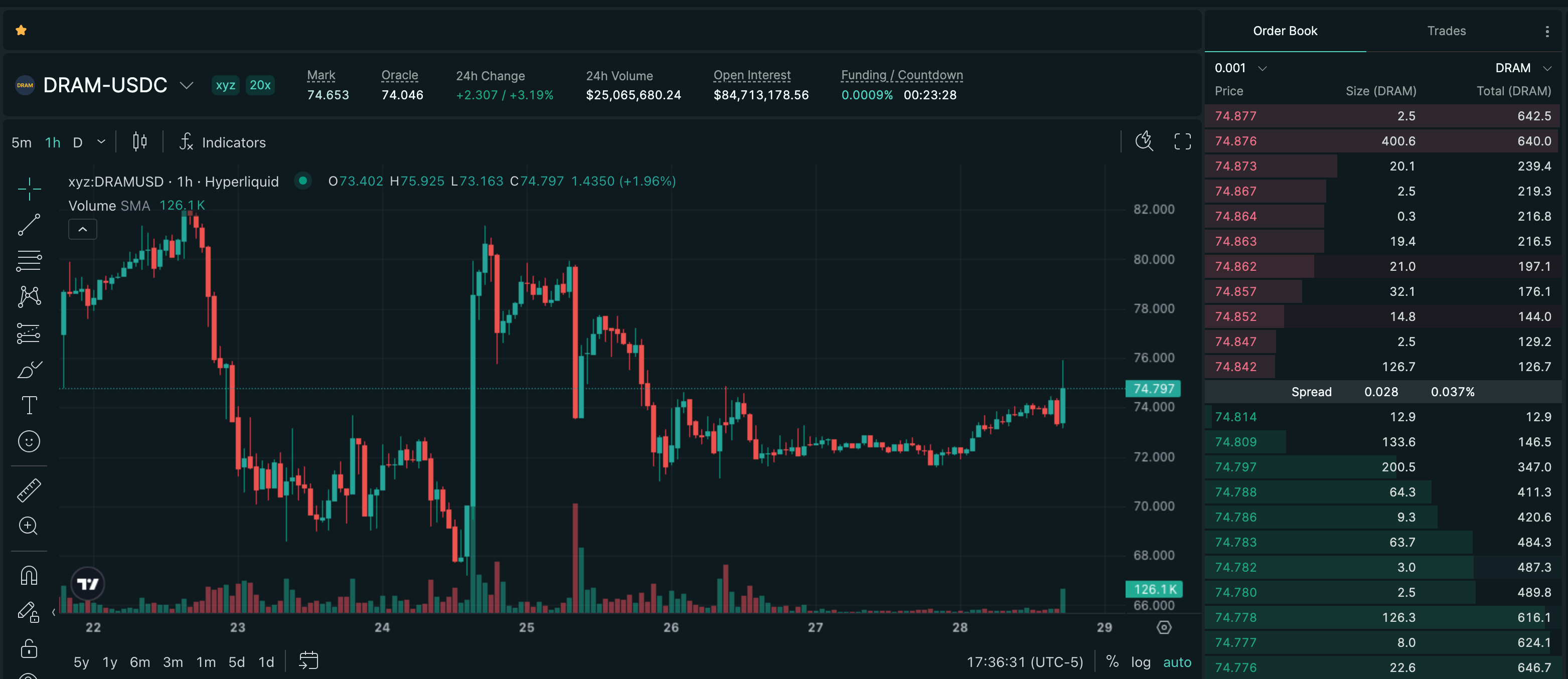
Apple's mid-cycle price hikes on June 25 set off a memory-stock selloff that knocked the Roundhill Memory ETF down roughly 6.5% into Friday's close. Now the Hyperliquid DRAM perp is back at $74.90, up 4.18% over 20 hours and recovering nearly all of that drop — even though the underlying ETF hasn't traded since Friday. The basket holds the memory makers that profit from soaring prices, not the device makers eating them, and traders appear to be fading what looks like a misread before cash reopens. A $29 billion SK Hynix ADR listing on July 10 is the next thing this market has to price.
Mover Brief
The Catalyst That Wasn't
There is no fresh weekend news behind this move. What there is, is a two-day-old panic the perp is now unwinding.
On June 25, Apple raised prices across nearly its entire hardware line — Macs, iPads, home devices, Vision Pro — with no new specs to justify it, explicitly to offset memory costs. Tim Cook called the situation a "hundred-year flood." Apple stock fell about 6% on the news, and the read-through hit the whole semiconductor complex: if the most powerful buyer in consumer electronics is passing memory inflation straight to customers, the next leg is demand destruction.
That fear dragged memory names down hard into Friday's close. Micron fell more than 6%, Western Digital more than 7%, and the broader Asia tech selloff took SK Hynix and Samsung down more than 8% and Kioxia as much as 12%. The Roundhill Memory ETF closed Friday near $71.84, down roughly 6.5% from its prior close of $76.89.
A Bounce on a Closed Tape
Here is the part that makes this move legible: the underlying ETF doesn't trade on weekends, but the Hyperliquid perp never stops.
With cash markets shut since Friday, the DRAM ETF's last printed price is stale — yet the perp has climbed to $74.90, up 4.18% over the last 20 hours and recovering almost all of Friday's drop. This isn't the spot market repricing on new information. It's a 24/7 perp deciding, on a roughly $25M daily book, that Friday's selloff overshot, and front-running where it thinks the ETF gaps when New York reopens Monday.
Thin weekend liquidity cuts both ways. The same shallow book that lets a few traders mark the perp back up will offer no cushion if Monday's cash open disagrees and the basis snaps shut against late longs.
The Basket Holds the Winners
The cleaner argument for fading Friday is that the selloff conflated two opposite sides of the same trade.
The memory squeeze is real and historic — contract DRAM prices rose about 90% in Q1 and another 60% in Q2, leaving memory roughly four times more expensive than three quarters ago as manufacturers divert wafer capacity to AI high-bandwidth memory. But that pricing power is exactly what the DRAM ETF is long. The fund holds the suppliers doing the squeezing, not the Apples absorbing it: roughly three-quarters of net assets sit in just three names — Samsung, SK Hynix and Micron — with Korean exposure alone near half the book.
Selling the memory makers because a downstream device maker raised prices is a strange reflex; high memory prices are the bull thesis for this basket, not the threat. The perp bounce reads as the market correcting that misread — though the open question is whether demand destruction at the device layer eventually loops back to soften the volumes the makers depend on.
What July 10 Puts in Play
The bigger event isn't behind this market — it's two weeks ahead.
SK Hynix, around a quarter of the basket, has scheduled a Nasdaq ADR listing for as soon as July 10, issuing 17.79 million new shares to raise up to roughly $29.4 billion for fab expansion and ASML equipment. That's a concrete supply event landing on the fund's largest single position. As Motley Fool noted on the timing, markets tend to pre-price scheduled catalysts, so the listing itself may matter less than the positioning into it.
For a perp that's already running ahead of its own spot market on a weekend, July 10 is the next hard date where the narrative meets actual share supply — and where this bounce either gets confirmed or faded.
Sources & Provenance
Citations below are preserved as structured Postgres source rows for this brief.
Citations Preserved
7
Reference links carried forward from the published mover record.
Original Signal
Open source tweetMarket Route
Direct route preserved for readers who want to inspect the tracked Hyperliquid market behind this archive entry.
Already onboarded? Open tracked market- 1Bloomberg — Apple raises Mac and iPad prices to counter memory shortagesbloomberg.com
- 2Yahoo Finance — Semiconductor stocks retreat over worries about memory costsfinance.yahoo.com
- 3The Print — Apple price hikes spark Asia tech selloff on memory cost concerntheprint.in
- 4TrendForce — Memory supercycle drives 1Q26 price surgetrendforce.com
- 5Yahoo Finance / Motley Fool — DRAM ETF holds 73% in just three companiesfinance.yahoo.com
- 6CNBC — SK Hynix plans $29 billion Nasdaq ADR listing as soon as July 10cnbc.com
- 7Motley Fool — Is Roundhill Memory ETF (DRAM) a buy before July 10?fool.com
This content is for informational purposes only and does not constitute financial advice. Trading perpetual futures involves substantial risk of loss.
Trade DRAM on Hyperliquid
Use referral code HIPERWIRE for 4% off trading fees on your first $25M in volume.
Live Market Metrics
Monitor real-time open interest and funding for DRAM.