Hyundai Surges 10% as KOSPI Stages Record Bounce After Black Wednesday Crash
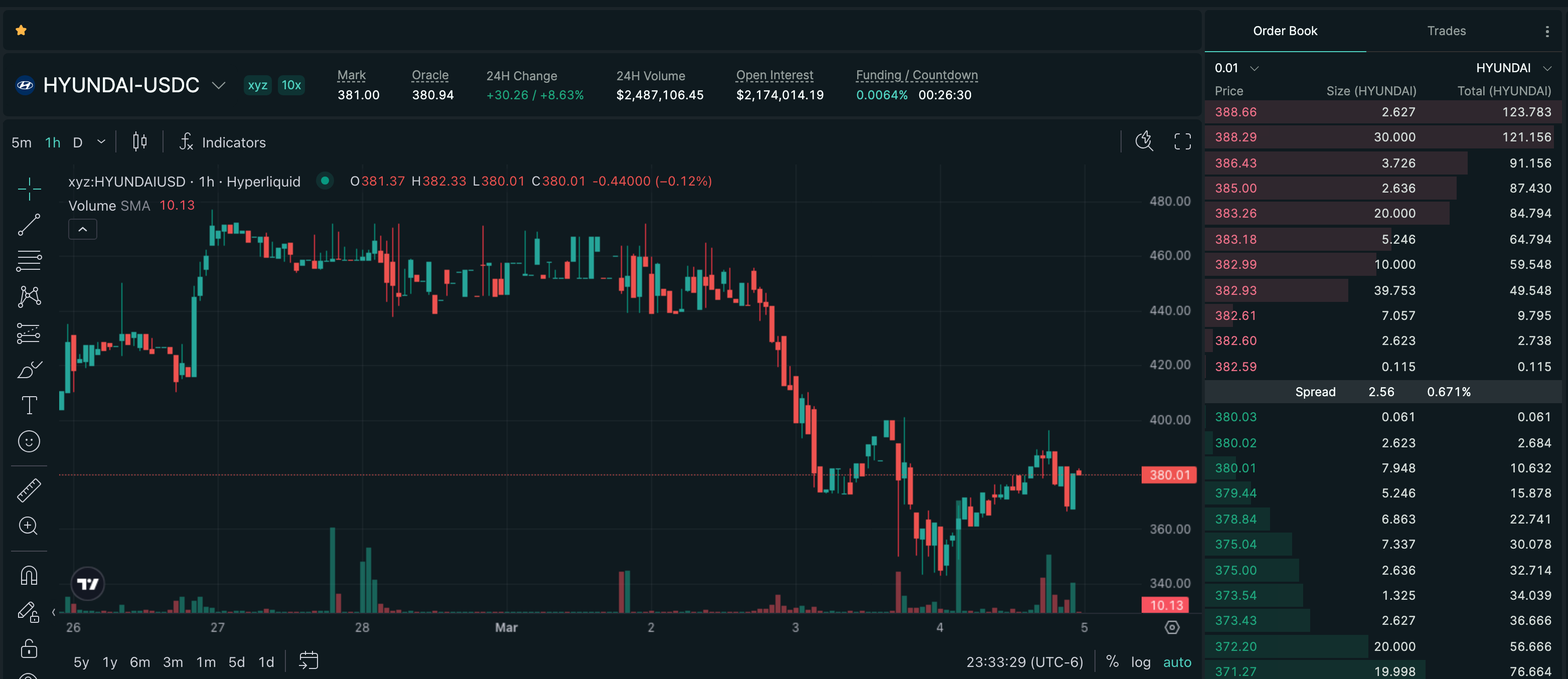
Hyundai Motor ripped 10% higher on its Hyperliquid perp market as South Korean equities staged their biggest single-day rebound in history. The move was pure mean reversion — bargain hunters piled into a market that had just suffered an 18% two-day wipeout triggered by the Iran–Strait of Hormuz crisis and an oil price shock that hit Korea's import-dependent economy squarely in the jaw.
Mover Brief
What Happened
On the Seoul exchange, Hyundai Motor closed up 9.38% at 548,000 KRW on March 5 after touching an intraday high of 582,000 KRW — a swing of nearly 16% from the prior day's close of 501,000 KRW. The Korea Herald reported that Hyundai was up as much as 14.57% in early trading before gains moderated through the session. On Hyperliquid, where the HYUNDAI perp converts the KRX price to USD at the prevailing FX rate, the move printed as a clean 10.03% gain over 23 hours to $381.80.
Hyundai was far from alone. The KOSPI surged 10.99% in the first 20 minutes, triggering a buy-side sidecar that halted program-driven purchases. Samsung Electronics jumped 13.59%, SK Hynix gained 15.19%, and Kia rallied roughly 11%. The Korean won strengthened to 1,461.7 against the dollar. This was a broad-based snapback, not a single-stock story.
For context, the KOSPI had been one of the world's best-performing major indices in early 2026, gaining over 40% in the first two months of the year before the Iran conflict sent it into a tailspin.
Why It Moved
The catalyst is straightforward: this was a violent rebound from the worst two-day crash in KOSPI history. On March 3, the index dropped 7.2%. On March 4 — now being called "Black Wednesday" — it plummeted another 12.06%, eclipsing the 9/11 crash as the worst single session in the index's history. Circuit breakers fired on both the KOSPI and the tech-heavy Kosdaq. The combined ~18% drawdown wiped out hundreds of billions in market cap.
The trigger was geopolitical. Iran shut down the Strait of Hormuz, disrupting roughly 20% of global oil transit. WTI crude surged to $80/barrel and Brent topped $85 — their highest levels since early 2025. South Korea imports approximately 98% of its fossil fuel needs, making it one of the most exposed developed economies to an energy shock. The selloff was indiscriminate.
The bounce came on three legs. First, Wall Street closed higher on March 4 — the Dow gained 0.49% and Nasdaq rose 1.29% — signaling that global panic was stabilizing. Second, oil prices stopped spiking, with prices easing slightly overnight. Third — and most importantly — South Korean President Lee Jae Myung ordered the immediate activation of a 100 trillion won ($68.5 billion) emergency financial package aimed at stabilizing the capital markets. That was a massive signal to dip buyers. As Kiwoom Securities researcher Han Ji-young noted, most market participants saw the crash as a buying opportunity given the government backstop.
What to Watch
The Iran–Strait of Hormuz situation remains the key variable. If oil continues climbing above $85 Brent, the pressure on Korea's energy-import economy comes right back — and the KOSPI rebound could reverse just as fast as it came. Watch for further Iranian attacks on shipping and any U.S. Navy escort operations in the strait.
On the government side, the 100 trillion won stabilization package is announced but execution details matter. Markets will want to see actual deployment — not just headlines. Any signal that the package is slower or smaller than expected could reignite selling.
For Hyundai specifically, the stock had been a market darling in early 2026 on robotics hype around Boston Dynamics and an Nvidia tie-up, but the company also reported a 40% slump in Q4 operating profit and warned that U.S. tariff pressure may intensify. A prolonged energy crisis would squeeze margins further. The stock is bouncing on macro relief, not improving fundamentals.
Sources & Provenance
Citations below are preserved as structured Postgres source rows for this brief.
Citations Preserved
18
Reference links carried forward from the published mover record.
Original Signal
Open source tweetMarket Route
Direct route preserved for readers who want to inspect the tracked Hyperliquid market behind this archive entry.
Already onboarded? Open tracked market- 1KOSPI crashes 12% — worst day in history (Al Jazeera)aljazeera.com
- 2South Korea stocks crashed 18% in two days (CNBC)cnbc.com
- 3Seoul shares rebound nearly 10% (Korea Herald)koreaherald.com
- 4KOSPI surges 12% in rebound (Investing.com)investing.com
- 5WSJ: South Korean stocks rebound after historic routwsj.com
- 6Xinhua: Hyundai Motor spikes 9.38%english.news.cn
- 7Hyundai Motor historical prices (Yahoo Finance)finance.yahoo.com
- 8KOSPI rebound, Hyundai and Kia surge (Chosun Biz)biz.chosun.com
- 9Korea's Lee touts $68B emergency fund (Bloomberg)bloomberg.com
- 10President Lee orders 100 trillion won package (Social News XYZ)socialnews.xyz
- 11Oil surges amid Iran conflict (CNBC)cnbc.com
- 12Asian shares jump as oil prices stop spiking (AP)ksat.com
- 13Hyundai profit slumps 40% on tariff hit (Reuters)reuters.com
- 14Hyundai warns tariff pressure may intensify (Reuters)reuters.com
- 15Hyundai shares rise 15% on Nvidia tie-up speculation (Reuters/Investing.com)investing.com
- 16Economic impact of the 2026 Iran war (Wikipedia)en.wikipedia.org
- 17Seoul shares rebound 10%, won rises (UPI)upi.com
- 18Trade HYUNDAI on Hyperliquidapp.hyperliquid.xyz
This article is for informational purposes only and does not constitute financial advice. Trading leveraged perpetual contracts carries substantial risk of loss.
Trade HYUNDAI on Hyperliquid
Use referral code HIPERWIRE for 4% off trading fees on your first $25M in volume.
Live Market Metrics
Monitor real-time open interest and funding for HYUNDAI.