Micron Guided to $50B. The Capex Line Is the Real Tell.
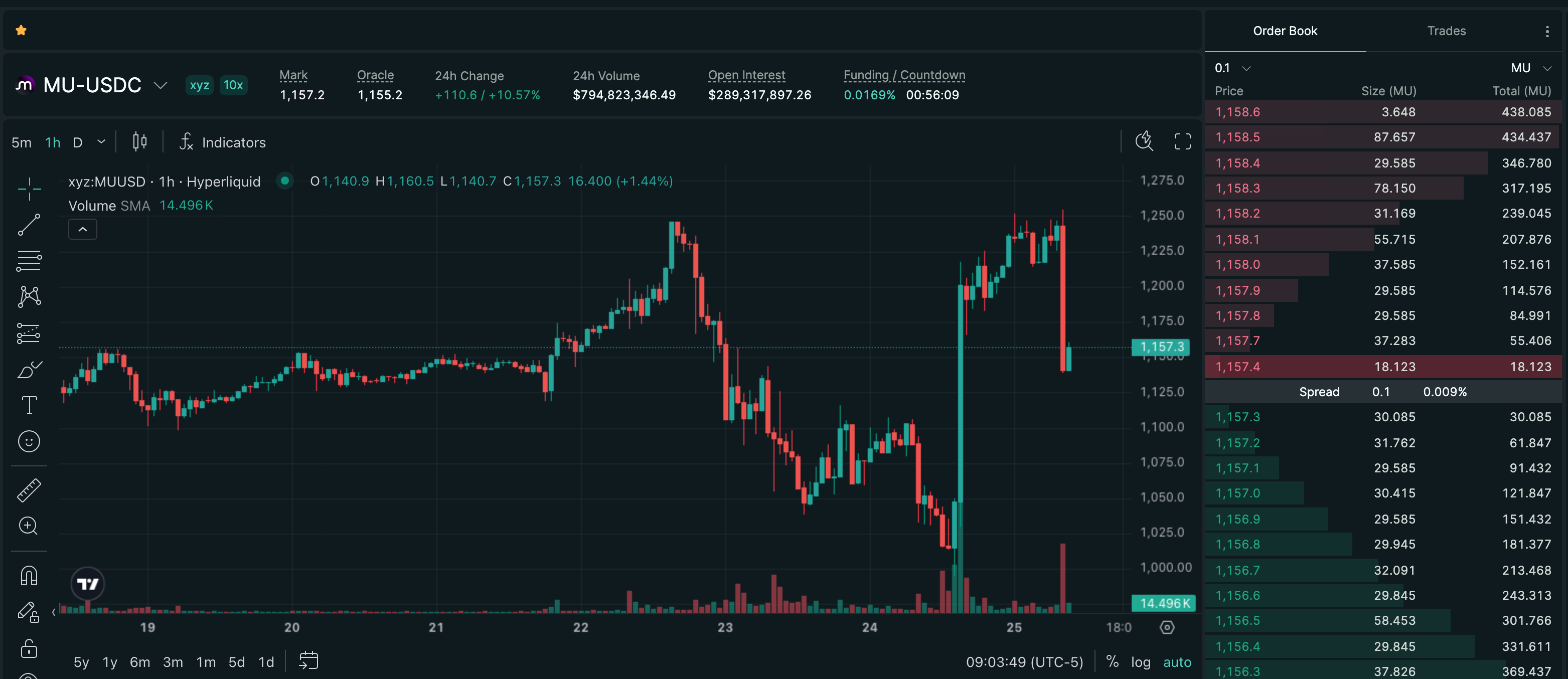
Micron's fiscal Q3 report landed like a regime change: $41.46 billion in revenue, a $50 billion guide for next quarter, and gross margins near 86%. The market took the HIP-3 perp up about 15.7%. But the line that actually decides where this goes is the FY2027 capex plan, set above the mid-$40 billion range, because in memory a supply commitment that big has historically marked the top of a cycle rather than the launch of one. The bull case is that roughly $18 billion in customer deposits and sold-out HBM make this cycle structurally different.
Mover Brief
The Quarter That Reset Memory
Micron's fiscal Q3 report on June 24 wasn't a beat so much as a different business showing up. Revenue came in at $41.46 billion, up 346% year over year against a roughly $35.6 billion estimate, with adjusted EPS of $25.11 versus $20.60 expected. Net income was $28.24 billion, up from $1.89 billion a year ago. The engine is the data center, where sales climbed more than sevenfold to $11.5 billion from $1.53 billion. Then came the guide: Q4 revenue of $50 billion ±$1B at roughly 86% gross margin and $31 EPS — numbers a memory company has never printed. The HIP-3 perp is up about 15.7% to ~$1,159.
The Capex Tell
Here's the line the bulls cheered and the cycle veterans flagged: Micron is taking FY2027 capital spending above the mid-$40 billion range, up from about $27 billion this year. In memory, capex is the tell. Every prior up-cycle ended the same way — demand looks infinite, everyone builds, the new fabs come online into softening demand, and pricing collapses. A supply commitment of this size is historically the signal that you're closer to the top than the bottom. If you read one number from this report as a trader, it's this one, not the revenue line.
Why the Bust Might Not Come
The counterargument is structural, and it's why MU is being repriced rather than faded. Micron now holds 16 long-term Strategic Customer Agreements carrying about $22 billion in cash and financial commitments, including roughly $18 billion in customer deposits already taken. Its 2026 HBM output is sold out, and management says it can fill only part of demand. That inverts the usual glut mechanics: the capacity Micron is spending mid-$40 billion to build is contracted before it's poured, with customers funding it upfront. A deposit-backed, multi-year order book is not how commodity DRAM cycles have ever worked.
The Other Side
The bear case isn't the numbers — it's the multiple and the macro. After a roughly 325% year-to-date run, MU is priced for the AI memory trade to keep compounding, and the 'is this a bubble' debate now sits squarely on the stock. The perp shows the two-sidedness: it touched ~$1,214 intraday before settling back toward $1,159, so even on a blowout the book is willing to take profits. The demand visibility from the SCAs is real, but it's still a bet on AI capex staying vertical — the one assumption underneath the entire thesis.
Sources & Provenance
Citations below are preserved as structured Postgres source rows for this brief.
Citations Preserved
6
Reference links carried forward from the published mover record.
Original Signal
Open source tweetMarket Route
Direct route preserved for readers who want to inspect the tracked Hyperliquid market behind this archive entry.
Already onboarded? Open tracked market- 1Micron fiscal Q3 2026 prepared remarks (Micron IR)investors.micron.com
- 2CNBC — Micron (MU) Q3 2026 resultscnbc.com
- 3Investing.com — Q3 2026 slides: record margins, $100B agreementsinvesting.com
- 4Investing.com — earnings call transcript (shares jump 14.6%)investing.com
- 5TechTimes — $100B contracts signal AI memory cycle breaktechtimes.com
- 6Fortune — Micron rally and the AI bubble debatefortune.com
This content is for informational purposes only and does not constitute financial advice. Trading perpetual futures involves substantial risk of loss.
Trade MU on Hyperliquid
Use referral code HIPERWIRE for 4% off trading fees on your first $25M in volume.
Live Market Metrics
Monitor real-time open interest and funding for MU.