Asset Intelligence / Hyperliquid Context
Micron Technology, Inc. / MU
Archive-backed market intelligence for MU: every HIPERWIRE mover article tied to this asset, plus a client-refreshed live market panel.
MU references 1 share of Micron Technology, Inc. common stock (Nasdaq: MU), quoted in USD. Micron manufactures memory and storage products, including DRAM and NAND.
Live Structure
Market Status
Loading current market structure…
- Builderxyz
- Categorystock
- Tracked Marketxyz:MU
- Latest TweetOpen
No other live markets from this builder in the current screener.
No same-category alternatives are live in the current screener snapshot.
Archive Summary
Latest Archived Thesis
Micron Gives Back Part of Its BofA Bounce as the Memory Bear Market Lingers
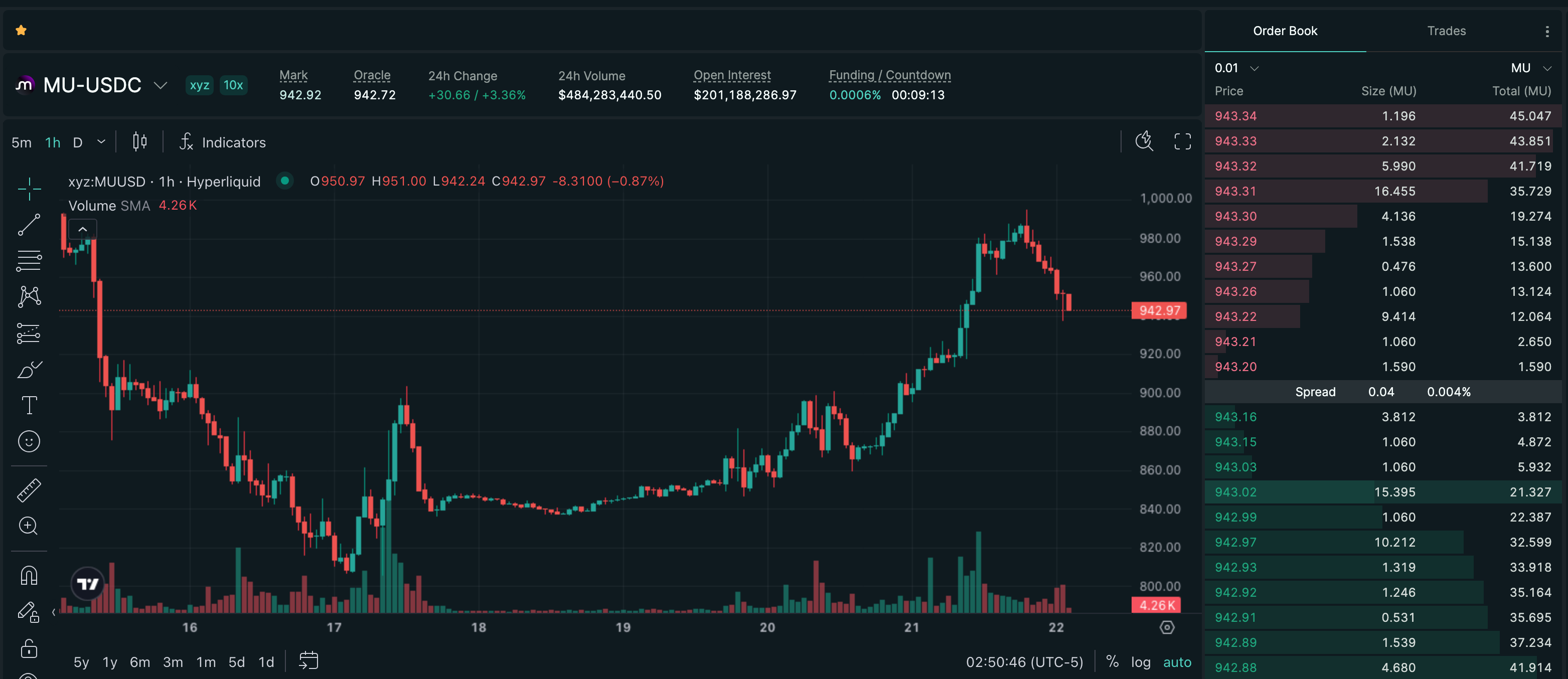
MU is down 4.42% to $943 with no company-specific headline behind the fade — it's the market handing back part of the roughly 12% single-day jump it printed on July 21. That rip was a sector-wide memory bounce plus a fresh Bank of America call, not a Micron print. The real story is the drawdown MU is still climbing out of: memory stocks fell into an outright bear market this month on China supply fears and cyclicality worries, even as HBM stays sold out and analysts stack $1,550-plus targets. This is a two-sided, headline-sensitive tape, and the eight-hour dip is what mean reversion looks like inside it.
Archive
All MU Mover Articles
Micron Gives Back Part of Its BofA Bounce as the Memory Bear Market Lingers
MU is down 4.42% to $943 with no company-specific headline behind the fade — it's the market handing back part of the roughly 12% single-day jump it printed on July 21. That rip was a sector-wide memory bounce plus a fresh Bank of America call, not a Micron print. The real story is the drawdown MU is still climbing out of: memory stocks fell into an outright bear market this month on China supply fears and cyclicality worries, even as HBM stays sold out and analysts stack $1,550-plus targets. This is a two-sided, headline-sensitive tape, and the eight-hour dip is what mean reversion looks like inside it.
Micron Rides a Memory-Led Chip Rally as BofA Pitches Open-Weight AI at $1,550
MU is up 5.79% over the past 24 hours to $953.90, but this isn't a Micron story — it's a sector one. Memory and chip names rallied together on July 21 as strong South Korean export data reaffirmed AI demand, with SanDisk up 14% and the semis snapping a three-session slide. The fresh wrinkle is Bank of America's $1,550 call from Vivek Arya, who argues open-weight models like Kimi K3 widen the pool of memory buyers rather than shrink it. The counter-tell sits in China, where CXMT's rise is starting to look like a real threat to Micron's pricing power.
Micron Rides a Sector-Wide Memory Rebound on Morgan Stanley's 25% DRAM Call
Micron's move on July 21 wasn't a company-specific print. Morgan Stanley told clients memory prices could climb roughly 25% on continued AI demand, and the whole memory complex re-rated together off last week's sell-off. The tell is pricing power, not shipments: if DRAM and HBM stay supply-constrained into 2027, the bull case stops being cyclical.
Wall Street Stacks Micron Targets to $2,000 as It Bets $250B on U.S. Fabs
Micron ripped more than 11% in 24 hours as the sell side moved at once, stacking fresh price targets from $1,400 up to $2,000 and led by a BofA hike to $1,550 built on the counterintuitive claim that cheap open-weight Chinese AI models multiply memory demand rather than kill it. Under the analyst noise sits a real structural shift: Micron is lifting planned U.S. fab and technology spend above $250 billion through 2035 and locking in HBM capacity that is already sold out through 2026. The one voice cutting against the euphoria is SK Hynix's own chairman, who called AI memory prices abnormally high.
Micron Clears $990 as BofA Argues Open-Source AI Multiplies Memory Demand
Bank of America's Vivek Arya reframed the biggest bear case on memory — cheap open-source Chinese AI — as a demand tailwind, and MU tacked on another double-digit day to push past $990. The argument is that open-weight models force every enterprise to load its own high-bandwidth memory, so proliferation multiplies chips sold rather than consolidating demand into a few data centers. It is the third leg of a multi-day repricing that already absorbed a US 1 List addition and a TSMC price-hike read-through, and the stock is still trading below its June high.
Micron Clears $970 as TSMC's 2027 Price Hike Reads Through to Memory
Micron's third straight up-day wasn't sparked by its own news — it was TSMC's plan to raise foundry prices up to 10% in 2027 that handed the entire AI-chip complex a pricing-power read-through, and memory is its tightest link. The move stacks on top of Bank of America's fresh US 1 List add and $1,550 target, and it dragged Western Digital and SanDisk along with it. Even after a roughly 12% day to $973, MU is still about 15% below its June high near $1,150 — this is gap-closing, not a breakout.
Micron Reclaims $946 as BofA Puts It on Its US 1 List
Micron is up 9.26% to $946.30 after Bank of America added the stock to its US 1 List of top investment ideas and lifted its target to $1,550. The move wasn't idiosyncratic — the whole memory complex caught a bid, with Western Digital up 9% and SanDisk up 8% on the same session. Even after three recovery legs in a day, MU still sits roughly 18% below its June high near $1,150. This is gap-fill on a broken chart, not fresh price discovery.
Micron Pushes to $932 as Morgan Stanley Calls the Dip a Buy
MU turned up 7.58% over 19 hours to $932 after a three-day pullback, and the trigger was a pair of July 20 analyst notes rather than any new earnings. Morgan Stanley called the selloff a buying opportunity and flagged memory prices rising roughly 25% quarter-over-quarter, while UBS reiterated its $400 billion cash-flow and buyback thesis. Underneath both is Micron's own guidance that it can meet only half to two-thirds of DRAM demand, with tightness holding beyond 2027. Even after this run, the stock sits well below its June high.
Micron Clears $900 as Analysts Stack $1,400–$1,750 Targets on Its Buyback Math
Micron's HIP-3 perp pushed above $918 as a stack of fresh Buy initiations — KeyBanc at $1,750, Daiwa at $1,700, Citi at $1,400 — landed on top of UBS's case for roughly $400 billion in free cash flow and a 40% cut to the share count by 2028. Morgan Stanley told clients to buy the dip and sees Q3 memory prices up 25% from Q2. The odd part: even after clearing $900, the stock still sits about 20% below the $1,154 high it printed in June, de-rating into the best DRAM pricing in years. This move is the market closing that gap, not chasing a new one.
Micron Reclaims $900 as UBS Puts $400B and 40% of the Float on Its Post-CHIPS Buyback
Micron reclaimed the $900 level it had been failing at, up 6.17% over 24 hours to $907, after UBS put hard numbers on the one thing the stock has not been allowed to do: buy itself back. The bank projects more than $400 billion in free cash flow through 2028 and says Micron could retire over 40% of its shares once its CHIPS Act buyback restriction expires on December 9, 2026. Nothing changed in the business this week — HBM is sold out and DRAM is at cycle highs — so this is a re-rating on capital-return math, not fresh fundamentals. It also lands as the direct counter to Michael Burry's cycle-top short.
Micron Defends the $833 Shelf as Record Memory Pricing Diverges From a De-Rating Stock
Micron ticked up 2.69% to $862, a relief bounce off the $833 support shelf it had ground into over three straight weeks of memory-complex selling. There's no fresh MU-specific catalyst — Asian memory peers firmed and record DRAM contract pricing held the fundamental floor, but this is support defending itself, not a new leg. The real tension is a widening gap: DRAM average selling prices sit at a 10-year peak and fiscal Q3 adjusted gross margins hit 84.6%, yet MU has de-rated roughly 24% from its June high because the market is weighing Michael Burry's cycle short against the AI-broke-the-memory-cycle thesis. The bounce defends the level; it doesn't resolve the argument.
Micron Grinds Into the $833 Shelf as China's DRAM Overhang Extends the Memory De-Rate
Micron dropped 6.16% over 23 hours to $838.50, extending a memory-complex de-rate that has pulled Micron, Samsung, SK Hynix, and the memory ETF more than 20% off their highs. There is no single fresh headline in this leg — it is continuation into the $833 support shelf. The structural driver remains China: CXMT's planned $8.5 billion IPO to scale domestic DRAM and Washington's deliberations over new HBM export controls both take aim at the tight-supply thesis that carried Micron's gross margin from 38% into the low-70s. The business is still printing records; this is a multiple coming down, not demand breaking.
TSMC's Capex Tell and CXMT's Overhang Drag Micron Into the $840s
Micron is down 5.93% over 21 hours to $840.60, extending a memory-complex de-rate that has run for three weeks and pushed MU roughly 26% below its June peak. The fresh pressure traces to TSMC lifting 2026 capital spending guidance to $60-64 billion, a supply signal the market read straight through to memory pricing, while Chinese DRAM maker CXMT lines up an $8.55 billion IPO that hangs over the industry's pricing power. None of it reflects a crack in Micron's business, which posted a record fiscal Q3 and its eighth straight EPS beat. This is the market re-rating the multiple after a 169% year-to-date run, not repricing the fundamentals.
Micron Breaks the $850 Shelf as the Whole Memory Trade Enters a Bear Market
Micron slid 5.36% over 10 hours to $845.70, breaking below the $850 zone that had been holding as support. The move isn't about Micron — the company posted record fiscal Q3 results in June and has beaten estimates for eight straight quarters. It's a sector-wide de-rate: memory names have shed roughly $1.5 trillion in market value since late June and crossed into bear-market territory, dragged down by SK Hynix's soft HBM4 guidance and the growing overhang from Chinese producer CXMT. The tape, not the fundamentals, is doing the talking.
The China Threat Under Micron's Slide: CXMT Comes for DRAM Pricing Power
Micron is down 5.60% over 24 hours to $863.90, and the tape is still treating this as a memory-wide positioning unwind. The more durable story sitting underneath it is China: Apple is testing CXMT's DRAM for its China devices, and the state-backed chipmaker is lining up one of Asia's largest IPOs of the year. That reframes Micron's selloff from a cyclical air pocket into a question about who controls DRAM pricing power over the next three years.
Micron Sheds Nearly $350B as the AI Memory Trade Enters a Bear Market
Micron is down 7.21% over the past 24 hours to $872.20, clawing back above the $869 level it briefly lost earlier in the session. This leg isn't about a single new headline — it's the memory complex repricing in unison, with Micron, Samsung, SK Hynix, and the Roundhill Memory ETF all now more than 20% below their highs. Roughly $1.5 trillion in semiconductor market value has evaporated since June 25, and Micron alone has shed close to $350 billion. The tape is pricing a DRAM glut and an HBM policy hit that the sell-side, still averaging a $1,462 target, refuses to model.
Micron Loses $869 Support as HBM Export-Curb Report Piles Onto the Memory Rout
Micron has fallen 11.66% over the past day to about $862.90, slicing through the $869 level that traders had flagged as key support. The immediate trigger is a report that Washington is weighing unilateral export curbs on high-bandwidth memory, Micron's highest-margin product and a book already sold out through 2026. It lands on a memory complex that is already in a bear market, with Micron down roughly $350 billion in market value since late June. Yet Wall Street price targets still sit far above spot, which tells you the market is pricing a supply glut the sell-side refuses to model.
Micron Sinks as CXMT's $8.55B IPO and HBM Export Fears Crack the Memory Supply Story
Micron fell to about $902 on July 15 without a single company announcement — the whole memory complex de-rated as China's supply threat came into focus. ChangXin's $8.55 billion Shanghai IPO signaled a fresh wave of Chinese DRAM capacity, and renewed talk of tighter US restrictions on high-bandwidth memory exports added a policy overhang. The selloff dragged Intel, AMD and Marvell with it, a sign this was sentiment repricing the memory supercycle rather than anything broken at Micron. The sell-side still models targets north of $1,500; for one session, the tape voted for the glut.
TD Cowen Puts a $1,600 Floor Under Micron's Dip — Burry Is Short at $1,052
Micron is up 4.17% to $951 over the past 16 hours, clawing back off a pre-market low near $926 after TD Cowen reiterated its Buy rating and $1,600 target on a structural high-bandwidth memory shortage. The bounce lands inside a roughly 22% correction from the stock's post-earnings high, so this is dip-buying, not a breakout. It also frames the most-watched pair trade in semis right now: TD Cowen's $1,600 target against Michael Burry's disclosed short from $1,051.87. Whichever side is right, Micron's $50 billion revenue guide and its Anthropic and automaker supply deals are the fundamentals both are trading around.
Micron Fades Below $950 as SK Hynix's Debut Redraws the Memory Trade
Micron is down 3.71% over six hours to $947.10, with the cash market closed for the weekend and no company-specific headline behind the dip. This is continuation, not a break: MU now sits roughly 22% below the post-earnings high it printed in late June, dragged down with the entire memory complex after Samsung's strong Q2 turned into a sell-the-news event and Wall Street's doubts about AI capex durability deepened. The fresh wrinkle is SK Hynix, whose record $26.5 billion Nasdaq debut this week hands HBM bulls a direct alternative to owning Micron. On a thin weekend perp book, the tape is pre-positioning for a soft Monday open.
Micron Pays to Lock Down Its Wafer Supply and Reclaims $1,000
Micron reclaimed the $1,000 level after committing up to $3 billion to shore up its U.S. supply chain, headlined by $500 million in financing for GlobalWafers' Sherman, Texas wafer fab and a 10-year deal locking in raw silicon. Bank of America read the shift to long-dated, non-cancelable contracts as proof that memory is becoming a recurring AI asset rather than a boom-bust commodity. But the real swing factor sits one day out: SK Hynix's roughly $29 billion Nasdaq debut will show whether the entire memory complex re-rates higher or bleeds capital into the new listing.
Micron's $250 Billion Onshoring Bet Runs Into SK Hynix's Nasdaq Debut
Micron raised its planned U.S. investment to more than $250 billion through 2035, a $50 billion bump aimed squarely at AI memory capacity, and the stock pushed toward $1,000 before easing back to $985.50. The added spend points at high-bandwidth memory, advanced DRAM, and packaging, with a stated goal of onshoring 40% of Micron's DRAM output. The harder question is what happens tomorrow, when rival SK Hynix begins trading on the Nasdaq in a listing that could either re-rate the entire memory group or pull capital out of it.
Micron Holds $1,000 as the Whole Memory Complex Reprices Into SK Hynix's Debut
Micron is holding the $1,000 line it reclaimed on July 9, and the move has less to do with any single headline than with the entire memory complex being repriced at once. The proximate spark was Micron's $3 billion U.S. supply-chain commitment, but the real driver is timing: SK Hynix lists on Nasdaq the next day in what may be the largest foreign U.S. offering ever, with a book running roughly seven times oversubscribed. That is institutional money voting on the same high-bandwidth-memory shortage analysts expect to run through 2027. The bull case is no longer that memory is cheap. It is that memory has stopped trading like a commodity.
Micron Ties Up a Decade of Wafer Supply and Lifts Its U.S. Bet to $250B
Micron committed up to $3 billion to shore up its U.S. supply chain, anchored by a $500 million financing package for GlobalWafers' new 300mm plant in Sherman, Texas and a 10-year deal locking in raw silicon wafer capacity. The stock rebounded roughly 8% to reclaim the four-figure handle, clawing back part of a 23% slide from its late-June peak. Buying a decade of raw input is a bet that AI memory demand is durable end-demand, not another cyclical spike, and it lands as analysts push price targets toward $2,000 and SK Hynix preps its Nasdaq debut.
Micron Pulls Its $250B U.S. Buildout Forward and Pours First Concrete at Clay
Micron used its New York megafab as a stage to accelerate planned U.S. investment to more than $250 billion through 2035 and pour first concrete more than a quarter ahead of schedule. It paired that with up to $3 billion for the domestic chip supply chain, and shares jumped nearly 8% on the day. The capex vote lands on top of this week's Citi and UBS DRAM re-rating, turning an analyst-driven bounce into something with a hard signal underneath. The next test is SK Hynix's Nasdaq debut, which gives memory capital somewhere else to go.
Micron Reclaims $1,000 as the DRAM Re-Rating Runs Into SK Hynix's Nasdaq Debut
MU is back above $1,000, up nearly 11% over the past day, as the analyst-driven memory bid that Citi and UBS reignited this week pulls the stock out of a three-week, ~22% post-earnings washout. Citi has MU on a 90-day upside Catalyst Watch with a $1,400 target and sees DRAM prices nearly tripling next year; UBS just lifted its Q3 contract-price forecast to +32%. This is continuation, not a fresh headline — the same re-rating carrying MU back toward its June high. The real test is tomorrow, when SK Hynix lists on Nasdaq.
Micron Rebounds as Citi and UBS Hike DRAM Forecasts Into SK Hynix's Debut
Micron is up 11.36% over 24 hours to $981 after Citi added the stock to a 90-day upside Catalyst Watch and told clients DRAM prices could nearly triple next year. UBS marked its DRAM contract-price outlook higher the same week, giving the memory bid a coordinated sell-side reset. The bounce comes off a three-week washout that had knocked MU roughly 22% below its late-June record. SK Hynix's ~$29 billion Nasdaq debut on Friday is the next real test of whether the AI-memory trade still has a buyer.
Micron Rebounds 10% as Citi Bets DRAM Prices Nearly Triple
Micron is up 10.53% over the past day to $971.40, clawing back part of a three-week memory selloff that had erased roughly a fifth of its value. The proximate trigger: Citi added MU to its upside Catalyst Watch on July 8, arguing DRAM pricing strengthens through the back half of 2026 and nearly triples next year. It's an analyst-driven bounce layered on an oversold tape. SK Hynix's Nasdaq debut on July 10 is the next test of whether the AI-memory bid is real.
Micron Snaps Back Above $950 as Dip Buyers Fade the Memory Washout
MU tore roughly 7.4% higher in about five hours to trade near $952, reversing a morning break below $900 that had it changing hands under $890 at the lows. There is no fresh Micron headline behind the bounce — it is dip-buying into a name that got flushed with the rest of the memory complex and now sits about 22% off its late-June high. The selloff that took it there was about sentiment and peak-earnings fear, not any crack in Micron's own numbers. SK Hynix's $28 billion Nasdaq debut Friday is the next real test of whether the memory trade still has a bid.
Micron Slips Under $900 as the Memory Bear Market Deepens Into SK Hynix's Debut
Micron slipped below $900 on Hyperliquid, down 5.7% on the session and roughly 22% off its late-June peak. The trigger isn't a Micron problem — it's the entire memory complex unwinding after Samsung posted a record ~$58 billion quarter and the market treated the best print of the cycle as the top. Since June 25, chip names have shed around $1.5 trillion in market value, with Micron alone accounting for nearly $350 billion. SK Hynix's roughly $28 billion Nasdaq listing on Friday is now the tape's next real test of demand for memory here.
Micron Bleeds Overnight as SK Hynix's $28B Listing Becomes Memory's Next Test
Micron slid another 2.59% overnight to $930.70, extending a memory-wide sell-the-news move that began when Samsung posted the best quarter in its history and the market treated it as the top. Memory names have now crossed into a bear market, erasing roughly $1.5 trillion in chip market cap since late June, with Micron alone shedding close to $350 billion. The overnight bleed lands two days before SK Hynix's ~$28 billion Nasdaq debut — the next real test of whether anyone still wants to own memory at these prices.
Samsung Booked a Record $58B Quarter. Micron Sold Off Anyway.
Micron slid about 5% to $939.50, bouncing off an intraday low near $920 but finishing red. The trigger wasn't bad news — it was Samsung's record quarterly operating profit, which the entire memory complex treated as a cycle top rather than a green light. Layered on top are a $28B SK Hynix Nasdaq listing days away, a fresh DRAM antitrust suit, and rotation out of AI hardware. The fundamentals are still intact; the tape has stopped caring.
Micron Drops Under $920 as Samsung's Record Quarter Confirms a Memory Bear Market
Micron is down 7.81% to $920.30, and the culprit isn't bad news — it's good news the market refused to buy. Samsung just guided to a record quarter and the entire memory complex sold off anyway, formally dragging the sector into a bear market after roughly $1.5 trillion in semiconductor value evaporated in two weeks. With SK Hynix's Nasdaq debut days away and a DRAM price-fixing suit hanging overhead, the momentum trade that made Micron a 2026 darling is now unwinding on its own strength.
Micron Gives Back Its Record Quarter as the Memory Momentum Trade Unwinds
Micron's overnight slide isn't really about Micron. Samsung reported a record June quarter and the entire memory sector sold off anyway, a sell-the-news reaction that dragged MU down alongside SanDisk, Western Digital and Seagate. The deeper problem is a crowded momentum trade: a stock up roughly 245% on the year that couldn't hold a bid on either Samsung's blowout or its own record quarter two weeks earlier. Now SK Hynix's July 10 Nasdaq debut hangs over the name as the next test.
Micron Falls to $922 as Samsung's Record Quarter Sparks a Memory Sell-the-News Rout
Samsung posted the best quarter in its history and the stock still fell, and that reaction rippled straight through the memory complex. SK Hynix, Kioxia, then Micron, SanDisk and Western Digital all sold off as traders read a fully-priced-in upcycle as a reason to take profits. MU is down 8.71% over 24 hours to $922.80, round-tripping its post-earnings gains back below pre-report levels. The setup is loaded: an SK Hynix Nasdaq listing lands July 10 and oversupply fears are creeping back into the memory trade.
Micron Round-Trips Its Record Quarter as Insider Selling Hits the Fastest Pace Since 2010
Micron's Hyperliquid perp has given back 10.79% over the past 23 hours to $903.90, unwinding the post-earnings gains from the company's record June quarter. The proximate trigger is positioning, not fundamentals: insider selling has hit its fastest pace since 2010, with CEO Sanjay Mehrotra offloading roughly $46 million near the top and the company's ledger showing 36 insider sales against a single buy over the past year. Hanging over it is a cheaper HBM comparable, SK Hynix's $28 billion Nasdaq listing that prices this week, plus a fresh DRAM price-fixing suit. This is what a crowded momentum trade looks like when the easy money starts heading for the door.
Micron Slides to $930 as a CEO Sale and Antitrust Suit Pile Onto the SK Hynix Overhang
Micron is trading near $930, more than 20% below its late-June peak and back under where it sat before the record June 24 quarter. What began as a sector-wide unwind in AI hardware has turned company-specific: CEO Sanjay Mehrotra sold more than $45 million in stock, and a late-June class action accuses Micron, Samsung and SK Hynix of fixing DRAM prices. Underneath it all sits SK Hynix's roughly $29 billion Nasdaq debut, which prices this week and hands US investors a cheaper, direct memory comp right as Micron's premium bleeds out.
Micron Round-Trips Its Record Quarter as SK Hynix's Nasdaq Debut Looms
Micron is down 7% to $943.40, back below where it traded before its record fiscal Q3 report on June 24. The move has nothing to do with the numbers — Micron beat on revenue, earnings and guidance — and everything to do with positioning. Money is rotating out of AI-memory names, and a cheaper, HBM-heavy direct comp is about to land: SK Hynix's roughly $29 billion Nasdaq debut is expected around July 10. Traders are marking Micron down ahead of a listing that finally lets US investors buy the memory cycle another way.
Micron Falls Below Pre-Earnings Levels as the AI-Chip Unwind Deepens
MU is down another 8% to $955.50, a second straight session of AI-hardware selling with nothing new from the company behind it. The stock is now roughly 22% off its June high near $1,255 and trades below where it sat before a record fiscal Q3 that beat on every line. This is a sentiment unwind and a valuation reset, not a numbers problem — and the whole memory group is re-rating at once.
Micron Cracks $1,000 as DRAM Lawsuit and Oversupply Fears Bite
MU is trading at $985.40, down 5.13% on the day and now decisively under the $1,000 line that held through late June. The catalyst stack is legal and structural: a new U.S. class action accusing Micron, Samsung, and SK Hynix of throttling commodity DRAM supply, plus mounting worry about a memory glut as Korean capacity comes online. This is the same July unwind that started with Michael Burry's short and post-earnings profit-taking, now finding a fresh reason to press lower.
Burry's Micron Short Meets the July Memory Unwind
Micron is grinding lower in early July as the post-earnings run from June cools off. The proximate spark is Michael Burry, who disclosed a short near $1,052 and called the stock a destroyer of capital tied to a memory cycle he thinks is topping. Underneath sits a broader rotation out of AI hardware into software, plus a heavy memory-tape calendar: ex-dividend on July 6 and SK Hynix's record $29 billion Nasdaq debut on July 10. The counter-argument is that Wall Street just raised estimates and Nvidia's Jensen Huang says the shortage lasts years.
Micron Grinds Back Toward Records as the GM Supply Deal Anchors the Bid
MU is up 3.85% over the past day to about $1,034, extending the recovery off last week's sub-$1,000 flush without a single fresh trigger in the window. The most tangible fundamental underneath the bid is the July 1 strategic supply agreement with General Motors, one of 16 long-term deals Micron says now underwrite roughly $100 billion in contracted revenue. The near-term marks are on the calendar: the July 6 ex-dividend and SK Hynix's Nasdaq debut on July 10.
Micron Bounces Off the Sub-$1,000 Flush With SK Hynix's Nasdaq Debut One Week Out
Micron is back near $1,024, up 5.90% on the day, but there is no new headline behind it. The move is a rebound off last week's sub-$1,000 flush, with dip buyers defending the post-earnings range against a July 2 scare — a DRAM price-fixing lawsuit, heavy insider selling, and Michael Burry disclosing a fresh short. The bull case is unchanged since the June 24 blowout, and the real repricing event is July 10, when SK Hynix's roughly $29.6 billion Nasdaq debut marks every memory name to market at once.
Micron Reclaims Ground as a $100B Take-or-Pay Backlog Faces Down the Glut Scare
Micron is up 7.46% over the past 21 hours to $1,029, extending its recovery from the sub-$1,000 flush that hit the stock as memory supply-glut fears swept the sector. There is no fresh headline behind this particular candle — dip buyers are simply refusing to fade a post-earnings run built on a record quarter and a multi-year contracted backlog. The near-term question is whether that structural demand story survives July 10, when SK Hynix's $29 billion Nasdaq debut hands the market a second pure-memory name to price against.
Micron Rebounds From the Sub-$1,000 Flush as Dip Buyers Fade the Meta Compute Glut Scare
Micron is up 7.49% to $1,034 on Hyperliquid, clawing back part of a flush that dropped it more than 10% under $1,000 earlier this week. There is no fresh bullish headline — this is dip buyers defending the post-earnings run after a Bloomberg report on Meta Compute lit a memory-glut scare across chip stocks. The fundamental backstop that keeps getting bought is intact: a blowout fiscal Q3, roughly $50 billion in Q4 revenue guidance, and a long-term GM supply deal. The next real test is SK Hynix's $29 billion Nasdaq debut, expected as soon as July 10.
Micron Reclaims $1,000 as Dip Buyers Fade the Antitrust-and-Glut Selloff
Micron reclaimed the $1,000 level, climbing almost 6% over 13 hours to about $1,015 after a sharp multi-day unwind dragged it under $983. There is no fresh company-specific catalyst here — this is a mean-reversion bounce, with dip buyers stepping in after a DRAM antitrust lawsuit and memory-glut fears knocked roughly 20% off the post-earnings high. The bull case that carried MU past a $1 trillion market cap is still intact: management insists demand will outrun industry supply through 2027, with fiscal Q4 revenue guided near $50 billion. The open question is whether that thesis can absorb the wave of Korean capacity now hanging over the entire memory trade.
Micron Breaks Back Under $1,000 as a DRAM Antitrust Suit and Insider Selling Deepen the Memory Unwind
Micron is down 6.28% over the past 22 hours to about $983.50, slipping back under the $1,000 line as a multi-day memory selloff finds a new front. A federal antitrust class action now accuses Micron, Samsung and SK Hynix of throttling conventional DRAM supply to force customers onto pricier high-bandwidth memory, and it landed the same week CEO Sanjay Mehrotra cashed out roughly $33 million in stock near the highs. Layered on the Meta Compute oversupply shock and an Asian chip rout, the move reads as a confidence unwind rather than a demand miss, with a $50 billion Q4 revenue guide still sitting under the tape.
Meta Compute Flips the AI Scarcity Trade and Micron Wears It Worst
Micron slid 8.35% over six hours to $969.60 as a sector-wide semiconductor derisk tore through the memory complex. The trigger was Meta Compute, Meta's plan to lease out idle data-center capacity, which recast years of assumed AI-compute scarcity as a looming supply glut and hit the purest memory names hardest. Underneath sit two specific overhangs: a fresh DRAM price-fixing suit naming Micron and SK Hynix's record $29 billion Nasdaq debut on July 10. None of it dents a blowout quarter, so this reads as a valuation reset on a 4x first-half run rather than a broken supercycle.
Micron Cracks $960 as SK Hynix's Nasdaq Debut Reroutes the Memory Trade
Micron slid back under $960, extending a broad memory-complex derisk that also knocked SanDisk down 11% and Seagate 7% on supply-glut fears. The sharpest new overhang is SK Hynix's roughly $29 billion Nasdaq ADR debut on July 10, set to be the largest ADR listing on record, which hands US institutions direct access to the HBM leader Micron trails. Layer in insider selling and priced-to-perfection downgrades, and a name up more than 300% year to date was primed to give back premium. The record Q3 print and $50 billion Q4 guide say this is valuation compression, not a broken supercycle.
Micron's Supercycle Bounce Fails as a Price-Fixing Suit and Glut Fears Drag It Under $1,000
Micron's morning dip-buy bounce toward $1,068 rolled over, and the stock is back below the $1,000 handle near $968.70, down more than 8% on the day. The selling is a mix of profit-taking on a name up roughly 265% year to date, a memory-wide rotation that also hit SanDisk and Western Digital, and a fresh class action accusing Micron, Samsung and SK Hynix of rigging DRAM supply. The awkward backdrop is a blowout fiscal Q3 and a $50 billion Q4 guide, which makes this look more like premium compression and legal overhang than a break in the fundamentals.
Micron Bounces Back as Dip Buyers Defend the Memory Supercycle
MU is up 6.61% over about five hours to roughly $1,068, clawing back most of a morning flush that hit the entire memory complex on profit-taking, not company news. There is no fresh catalyst behind the bounce — it is dip-buying in the year's most crowded trade, with a record fiscal Q3 and a new GM supply deal as the floor bulls keep pointing to. The open question is whether roughly $100 billion in take-or-pay contracts outweighs an antitrust cloud and dangerously stretched positioning.
Micron Drops 10% in a Memory-Wide Selloff as the Fed Turns Hawkish
Micron dropped about 10% to $1,024, but the move had almost nothing to do with Micron. The entire memory complex de-rated together as a hawkish turn from the Fed gave traders a reason to lighten the year's most crowded trade after a 305% run. What kept the dip from getting bought is the growing list of threats to the scarcity premium behind that run — Apple lobbying to buy cheaper Chinese DRAM, a federal price-fixing suit, and warnings that big buyers may start using memory more efficiently. The business is booming; the open question is whether the scarcity that made it boom will last.
Micron Slides as a DRAM Price-Fixing Lawsuit Targets the Scarcity Trade
MU is down about 8% to roughly $1,047, and the fresh catalyst is legal, not technical. On June 25 a federal antitrust class action accused Micron, Samsung, and SK Hynix of coordinating cuts to commodity DRAM supply under the cover of shifting capacity to AI memory, keeping prices artificially high. That allegation attacks the exact pricing power behind Micron's 267% run and record quarter. SK Hynix's July 10 Nasdaq listing and a sell-the-news unwind are adding to the pressure.
Micron Cools From a 305% Run as Its Pricing-Power Trade Comes Under Attack
MU handed back double digits as the entire memory complex sold off together, with no single clean catalyst behind the reversal. The quarter was a record and Q4 guidance points to $50 billion in revenue, so the fundamentals are not what cracked. What is repricing is the scarcity premium that drove a 305% run, now squeezed from two sides: demand destruction as memory prices quadrupled, and Apple lobbying Washington to route around the oligopoly and buy cheaper DRAM from a blacklisted Chinese supplier. An antitrust suit targeting that same pricing power is the overhang underneath it all.
Micron Slides With the Chip Complex as Wall Street Demands Proof AI Spending Pays
Micron is down 9.34% over 21 hours to roughly $1,052, but it wasn't singled out. The entire memory and semiconductor complex sold off as the market shifted from rewarding AI capex to demanding evidence it earns a return, with rate fears from the Strait of Hormuz closure adding pressure to anything financing a data-center buildout. Micron printed a record quarter a week ago with its HBM sold out through 2026, so what's repricing here is the multiple, not the fundamentals. The SK Hynix Nasdaq debut on July 10 remains a real overhang, but this move is the sector, not the calendar.
Micron Slides as SK Hynix's Nasdaq Debut Threatens Its Scarcity Premium
MU is down 6.43% over 18 hours to about $1,087, extending a fade that started the day before. There is no single breaking July 1 headline behind it. The move is positioning into a known date: SK Hynix begins trading on Nasdaq on July 10, and for the first time US investors get direct access to the high-bandwidth memory leader that Micron has never been. Two legs of the bull case are softening at once, and a stock sitting near record levels is giving some back.
Micron Cools as a DRAM Price-Fixing Suit Hits Its Bull Case
MU is down 2.35% over nine hours to about $1,136, a modest fade after a monster post-earnings re-rate rather than a breakdown. The freshest company-specific headline is a federal class action filed June 25 accusing Micron, Samsung and SK Hynix of restricting commodity DRAM supply to push prices up roughly 700% — the same pricing power now driving Micron's record margins. It is unproven civil litigation and mostly headline risk, but it lands squarely on the narrative the stock has been re-rating on. The dip reads more like profit-taking with a peg than a fundamental crack.
Micron's $1,138 Grind Is Analyst Catch-Up, Not Fresh News
Micron is up nearly 7% to around $1,138 with nothing fresh on the wire — the market is still digesting its blowout June 24 quarter. Record revenue of $41.5 billion, EPS of $25.11, and more than $100 billion in take-or-pay HBM contracts have analysts racing to catch up, with Cantor now at a Street-high $2,000. After a 259% year-to-date run, this move is a positioning fight over how far the AI-memory re-rate runs, not a reaction to new news.
Micron's Bounce to $1,150 Is a Re-Rating Fight, Not Fresh News
MU recovered about 8.82% to roughly $1,150 with no new company headline behind it. The bid is a stack of street-high analyst targets landing after the June 24 record quarter, led by Cantor's $2,000 and Phillip Securities' jump to $1,870 from $530. Underneath sits a record fiscal Q3 and roughly $100 billion of take-or-pay contracts that put a floor under memory pricing through 2030. This is a positioning fight over how far the supercycle re-rate runs, not a fresh fundamentals reveal.
Micron Bounces as Cantor Lifts Its Target to a Street-High $2,000
Micron spent the morning extending a post-earnings fade, then reversed hard — up 5.69% in two hours to around $1,125 — after Cantor Fitzgerald lifted its price target to a Street-high $2,000 and Bank of America defended the Anthropic supply deal. Nothing changed at the company since last week's record $41.5 billion quarter; what changed is that the sell-side stepped in front of the dip. With consensus still near $1,293 and a fresh antitrust suit hanging over the entire memory trio, this bounce reads as a positioning trade, not a new story.
Micron Locked In $100B of Orders. The Market Sold It Anyway.
Micron just reported the biggest quarter in its history — $41.46 billion in revenue, an 84.9% gross margin, and roughly $100 billion in take-or-pay customer contracts — and the stock is still sliding, down 5.45% over the last eight hours to about $1,094. The selloff didn't start with Micron; it started in Seoul, where a regulator's warning on leveraged single-stock ETFs torched Samsung and SK Hynix and dragged every memory name down with them. Now the tape is looking past the record print toward two things it can't price as cleanly: where the cycle peaks, and what happens on July 10, when SK Hynix lists on Nasdaq and hands US funds a direct memory alternative.
Micron's Record Quarter Can't Stop the Memory Premium From Unwinding
Micron's MU perp is down 7.45% over eight hours to roughly $1,070, extending a post-earnings slide even after a record Q3 that printed $41.5 billion in revenue and an 84.9% gross margin. The market is repricing memory's premium: BofA's 'AI memory tax' thesis cuts both ways, and SK Hynix's July 10 Nasdaq debut is about to strip Micron of its status as the only US-listed pure-play on the memory super-cycle. A blowout quarter isn't holding the multiple because the multiple was never really about the quarter.
Micron Sells Off Toward $1,040 as the Memory Trade Rotates to SK Hynix
Micron is down 10.28% over six hours to roughly $1,040, with no fresh company news to explain it. The selling is positioning, not fundamentals: the book is repricing Micron ahead of SK Hynix's July 10 Nasdaq debut, when US funds can finally own the 57% high-bandwidth memory leader directly instead of routing memory exposure through Micron. That rotation is draining out the premium Micron carried as the only US-listed pure-play in memory, and it is happening on top of a record quarter and Street-high price targets the tape is ignoring.
Micron Slides as SK Hynix's Nasdaq Listing Threatens Its US-Memory Monopoly
MU is back under $1,100, extending a post-earnings de-rate that has little to do with Micron's order book. The proximate catalyst is SK Hynix confirming a $29.65B Nasdaq ADR listing on July 10 — the largest Korean ADR offering ever — which hands US funds direct access to the 57% HBM market-share leader. For years Micron was the only US-listed pure-play on advanced memory. That scarcity premium is now being repriced in real time, even as Micron sits on a record quarter and sub-10x forward earnings.
Micron Claws Back as a Record Quarter Outlives the AI-Basket Selloff
Micron is up about 3% off Friday's lows, but there's no fresh news behind the move — this is the tape reconnecting with a record quarter the AI-basket selloff blew past. Q3 printed $41.46 billion in revenue at an 84.9% gross margin, and management guided Q4 to a record $50 billion at roughly 86%. The June 26 drop ran on an OpenAI IPO-delay story that never reached Micron's order book, where HBM is sold out and HBM4 is already shipping for Nvidia's Vera Rubin. At under 10x forward earnings, the selloff priced a cycle peak the guidance flatly denies.
Micron Extends Its Post-Earnings Slide as the Tape Sells AI as One Basket
Micron just printed the best quarter in its history and got sold anyway. The MU perp is down 3.26% over the last nine hours to about $1,139, extending Friday's slide on no Micron-specific news, as the OpenAI IPO-delay scare keeps repricing the entire AI-chip complex as a single basket. After a 325% year-to-date run, the stock now trades near 10x forward earnings on guidance for a record $50 billion quarter. The market is pricing a cycle peak the numbers flatly deny.
Micron's Best-Ever Quarter Gets Sold as the OpenAI IPO Delay Drags Every Chip Lower
Micron just printed the best quarter in its history: $41.5 billion in revenue at a record 84.9% gross margin and roughly $100 billion in contracted customer revenue. None of that stopped MU from sliding 5.35% on Hyperliquid, because Friday's selling had nothing to do with Micron. A report that OpenAI may push its IPO to 2027 dragged the entire semiconductor complex lower, and the tape is now repricing every AI-exposed name as one basket rather than grading them on results.
Micron Can't Hold Its Record-Quarter Pop as the AI-Capex Trade Wobbles
MU is down 6.79% over 24h to around $1,134, giving back most of the 20% pop it got from the best quarter in its history. The seller isn't Micron — it's a market-wide AI-capex selloff on Friday, stacked on top of a Korean memory rout earlier in the week. After a 234% run this year, every macro wobble becomes a profit-taking event, and the tape keeps reading record memory margins as a cycle top rather than a new floor.
Micron's Record Quarter Gets Buried by a 4.1% Inflation Print and a Korean Circuit Breaker
MU is down 4.92% over 23 hours, still giving back the pop it earned from the best quarter in Micron's history. The seller isn't Micron — it's the macro tape. A 4.1% PCE inflation print revived fears that new Fed chair Kevin Warsh restarts rate hikes, tripping a circuit breaker in Korea and dragging Samsung, SK Hynix, and every DRAM name down together. Record margins are being read as a cycle top by a market in a hurry to derisk AI beta.
Micron Round-Trips Its Record-Quarter Pop as Korea Leads a Memory Selloff
Micron just printed the best quarter in its history — $41.46 billion in revenue, a record 84.6% gross margin, and roughly $100 billion in signed customer contracts — and the stock is down 6.80% over 24 hours. The sell pressure isn't coming from Boise; it's coming from Seoul, where a crash in Samsung and SK Hynix is dragging the entire memory complex lower. The market is reading Micron's record margins as a cycle top rather than a floor, and leverage is flushing out of the most crowded long in semis.
Micron Gives Back Part of Its Record-Quarter Pop as OpenAI and Apple Cool the AI Trade
Micron is down 4.82% over 24 hours, unwinding part of the spike that followed the best quarter in its history — fiscal Q3 revenue of $41.46B at an 84.6% gross margin, with guidance to roughly $50B next quarter. Friday's leg of selling isn't the Korean deleveraging that kicked off the drawdown; it's a U.S. AI-cost scare, driven by a report that OpenAI may delay its IPO to 2027 and an Apple price hike blamed on a memory shortage. The irony is hard to miss: the same tight supply that powered Micron's record is being read as a demand risk. Underneath the tape, what's being flushed looks like leverage, not orders.
Micron's Record Quarter Round-Trips Into a Memory-Wide Leverage Flush
Micron just printed the best quarter in its history — record revenue, record margins, and roughly $100 billion in take-or-pay contracts — and the stock gave back nearly all of its earnings pop anyway. The seller isn't demand. It's the same Korea-led deleveraging that tripped a KOSPI circuit breaker on June 23 and is still unwinding leverage across the entire memory complex. MU is the most liquid US proxy for that trade, so it's wearing the spillover.
Micron's Record Quarter Is Losing to a Korean Leverage Flush
Micron just delivered the best quarter in its history: $41.46 billion in revenue, up 346% year over year, at a record 84.9% gross margin, with next-quarter guidance near $50 billion. The stock is selling off anyway, down 8.29% over the last 24 hours on the Hyperliquid perp and back below its pre-earnings level. The trigger isn't Micron's numbers; it's a forced deleveraging that started when South Korean regulators warned on leveraged single-stock ETFs, flushing a memory trade that had run 847% in a year. With HBM capacity sold out and the industry still warning of shortages into 2027, this reads as a repricing of positioning, not demand.
Micron's Record Quarter Couldn't Hold a Bid
Micron just reported the best quarter in its history — $41.46 billion in revenue, 84.9% gross margins, and a sold-out HBM book — and the perp is down 8.09%, giving back almost the entire post-earnings spike. There is no new bad news. After a roughly 300% year-to-date run into a ~50x multiple, with insiders unloading $92.5 million into the print, the market is repricing positioning rather than the business. When the best possible quarter can't hold a bid, the question stops being fundamentals.
Micron Printed a Record Quarter. The Perp Faded Anyway.
Micron just posted the strongest quarter in its history — record revenue, software-grade margins, and roughly $100 billion in multi-year customer contracts — and the perp still gave back 5.40% in 17 hours. There is no new bad news here. After a roughly 300% run into the print and a stretched 50x multiple, a blowout beat ran straight into buy-the-rumor profit-taking. This is a positioning move, not a fundamentals one.
Micron Just Printed 85% Gross Margins. That's Not a Memory Company Anymore.
MU is still grinding higher the day after its fiscal Q3 blowout, trading around $1,206. The headline was $41.46 billion in revenue against a ~$35.8 billion consensus, but the number that actually reprices the stock is the gross margin: 84.9%, up from 39% a year ago, with management guiding to roughly 86% next quarter. DRAM selling prices rose about 60% quarter-over-quarter and Micron's entire 2026 HBM capacity is already sold out. This looks less like a cyclical upturn and more like the memory commodity cycle breaking.
Needham Tripled Its Micron Target to $1,550. The Whole Street Is Catching Up.
Micron's day-after grind to $1,218 isn't new information — it's the sell-side scrambling to reprice a stock that already gapped on its earnings print. Needham took its target from $500 to $1,550, Bank of America reset to $1,500, and a half-dozen firms stacked in behind them. The tell is that even after the run, MU still screens under 12x forward earnings, because the analyst targets are anchored to a much higher earnings base. The risk is that overnight target-tripling is reactive, not predictive.
Micron's 16 Take-or-Pay Contracts Are the Real Story, Not the Earnings Beat
MU is up 15.51% over 24h to about $1,211 after Micron's fiscal Q3 print blew past every estimate. But the number that actually matters isn't the revenue beat or the record margin — it's 16 non-cancellable, five-year take-or-pay contracts worth roughly $100 billion in minimum committed revenue, with customers putting up billions in cash deposits and accepting price floors. That structure strips out the demand-collapse leg that has defined every memory cycle before this one. The market isn't repricing an earnings beat; it's repricing what kind of business Micron is.
Micron Printed an 84.9% Gross Margin. Memory Isn't a Commodity Anymore.
Micron's fiscal Q3 didn't just beat — it printed an 84.9% non-GAAP gross margin, the kind of number a logic or software company posts, not a commodity memory maker that ran at 36.8% a year ago. Revenue hit $41.5 billion against a $35.7 billion estimate, and management guided Q4 to a $50 billion top line at roughly 86% margins. The move that matters isn't the EPS beat; it's the market repricing memory from a brutal commodity cycle into a structurally short AI input. That re-rating is why the stock blew through Wall Street's average target on the print.
Micron Guided Q4 to $50 Billion. The Street Was at $44.
Micron is up 20.84% over 24 hours after guiding fiscal Q4 revenue to roughly $50 billion, well above the Street's $44 billion estimate. The Q3 beat was large, but it's the forward guide — paired with 86% gross margins and HBM capacity sold out for all of 2026 — that actually reset analyst models. After a 285% run off the March lows, the question is no longer whether the memory cycle is real, but how much of it is already in the price.
Micron Locked In $100B of Take-or-Pay Demand. That Breaks the Memory Cycle.
Micron's fiscal Q3 print was a blowout on every line, but the number that matters isn't the 85% gross margin — it's the contract book. The company disclosed 16 take-or-pay customer agreements worth roughly $100 billion in minimum contracted revenue through 2030, backed by about $22 billion in deposits and commitments. For a business that has been the market's definitive boom-bust cyclical for forty years, locking in fixed-price and ceiling-priced demand across nearly half of future revenue is the structural change. That, more than the headline beat, is why the stock re-rated.
Micron Posted an 84% Gross Margin on Memory. That's the Re-Rate.
Micron's fiscal Q3 print was a blowout on every line, but the figure that actually re-rated the stock was the gross margin: 84.6%, with guidance for roughly 86% next quarter. That is software-tier profitability on a DRAM and NAND business that spent decades as the market's definitive commodity cyclical. The take-or-pay floors and a sold-out HBM book are what let a memory maker hold margins this high. The analyst scramble afterward shows how few people were positioned for it.
Micron Blew Past Its Own Price Targets. The Floors Are Why.
Micron's fiscal Q3 blowout — a record $41.46 billion in revenue and an 84.9% gross margin — is the headline, but the durable story sits in the contracts. Sixteen take-or-pay supply agreements worth a minimum of $100 billion put pricing floors under a fifth of Micron's DRAM and a third of its NAND through 2030, the structure memory bulls have wanted for a decade. The MU perp is up 22% near $1,222 while Wall Street's published consensus target still sits below spot, forcing desks to re-rate in real time. The question is no longer whether the cycle turned, but whether anything short of an AI capex stall can turn it back.
Micron Took $22B in Binding Deposits. The Memory Cycle Just Changed.
Micron's fiscal Q3 print was a blowout: $41.46 billion in revenue, up 346% year over year, gross margin near 85%, and a Q4 guide of roughly $50 billion. But the line that actually rerates the stock sits off the income statement: 16 binding take-or-pay contracts worth more than $22 billion, with roughly $18 billion already in the door as cash deposits. Hyperscalers are prepaying to lock memory supply, and that strips out the cyclicality shorts have always priced into MU.
The Korea Glut Scare Lasted 48 Hours. Micron Ended It.
MU is up 17.90% to about $1,181 on Hyperliquid, round-tripping a two-day, roughly 24% drawdown that hit on fears of a memory supply glut. Micron's fiscal Q3 report inverted that thesis: record $41.46 billion in revenue, a record 84.9% gross margin, and Q4 guidance of $50 billion against roughly $43 billion expected. With HBM sold out through 2027, the question was never demand — it was how much the bears would have to cover.
Micron Guided to $50B. The Capex Line Is the Real Tell.
Micron's fiscal Q3 report landed like a regime change: $41.46 billion in revenue, a $50 billion guide for next quarter, and gross margins near 86%. The market took the HIP-3 perp up about 15.7%. But the line that actually decides where this goes is the FY2027 capex plan, set above the mid-$40 billion range, because in memory a supply commitment that big has historically marked the top of a cycle rather than the launch of one. The bull case is that roughly $18 billion in customer deposits and sold-out HBM make this cycle structurally different.
Micron Sold Out 2026 HBM and Locked In $100 Billion of Demand
Micron's fiscal Q3 print wasn't just a beat — it was confirmation that the memory cycle is being replaced by a contracted backlog. Revenue hit a record $41.46 billion, up 346% from a year ago, but the number that matters is the roughly $100 billion in minimum contracted revenue across 16 customer agreements, with about $22 billion already paid upfront. Management says 2026 HBM is sold out and it can fill only half to two-thirds of demand, with no fab relief until fiscal 2028. The MU perp ran 19.54% to roughly $1,214, pressing the prior 52-week high.
Micron Printed an 84.6% Margin and Memory Stopped Being a Commodity
Micron reported fiscal Q3 revenue of $41.46 billion, up 346% year over year, but the number that matters is the 84.6% gross margin — a level a commodity memory maker has never printed. Data center now drives roughly 61% of sales, and management guided Q4 margins higher still, to about 86%. The market read it as confirmation that AI memory is being priced on multi-year contracts, not spot cycles. The catch: at about $1,254 the stock has already run past the blended analyst average, with only the most aggressive desks sitting above spot.
Micron Guided to $50 Billion and the Memory Glut Trade Died With It
Micron's fiscal Q3 beat was never really in doubt — the stock had already tripled into the print. What moved MU was the forward setup: a fiscal Q4 revenue guide near $50 billion, roughly $7 billion above consensus, at an ~86% gross margin, paired with the disclosure of about $100 billion in minimum contracted revenue across 14 customer agreements running through 2030. Together they reframe memory from a cyclical commodity into something closer to a contracted backlog, which is the argument the Street is using to underwrite MU at AI multiples instead of fading the next glut.
Wall Street Is Tripling Its Micron Targets, Not Just Raising Them
Micron's fiscal Q3 didn't just beat — it forced analysts to rebuild the model. Needham took its price target from $500 to $1,550 in a single note, TD Cowen more than doubled to $1,500, and the stock pushed to fresh records near $1,245 on the Hyperliquid perp. The number doing the real work isn't the $41.46 billion in quarterly revenue; it's the roughly $100 billion in minimum contracted customer revenue that lets the Street price memory on visibility instead of the usual boom-bust discount.
Micron's $41 Billion Quarter Validates a Street Already at $1,500
Micron's fiscal Q3 print blew past every line that mattered, but the more telling fact is that Wall Street had already moved its targets to $1,500 before the report landed. TD Cowen and Bank of America both repriced the stock weeks ahead, betting that AI memory had become structural rather than cyclical. The June 24 numbers confirmed it, and the MU perp is now near $1,231, above its prior 52-week high and inside roughly 22% of those targets.
Micron Prints a Record 84.9% Margin and Guides to $50 Billion as Memory Sells Out
Micron's fiscal Q3 landed as one of the cleanest beats the memory industry has produced: $41.46 billion in revenue, roughly four times a year ago, at a company-record 84.9% gross margin. Management then guided fiscal Q4 to $50 billion in revenue and about $31 in EPS, well above a Street sitting near $43 billion. The detail that matters most is structural — 14 of 16 new strategic customer agreements lock in roughly $100 billion of minimum contracted revenue on take-or-pay terms through 2030, reframing memory from a boom-bust commodity into sold-out, priced-in supply. The HIP-3 perp ran 19.09% in eight hours to about $1,209, trading slightly above the after-hours cash quote near $1,200.
Micron Guides to $50 Billion and Record Margins, Repricing the Memory Trade
Micron's fiscal Q3 print beat across the board, but the real reset came from guidance: a $50 billion revenue target for Q4 and gross margins guided near 86%, both far ahead of Wall Street. A record 84.9% gross margin and roughly $100 billion in contracted revenue reframed memory from a cyclical commodity into a supply-constrained AI input. On Hyperliquid, the MU perp ran past $1,207 during extended hours, ahead of the after-hours spot print.
Micron's $100 Billion Backlog Reprices Memory as Contracted Supply
MU is up 17.24% over five hours to about $1,197 after Micron's fiscal Q3 2026 print, headlined by 16 strategic customer agreements representing roughly $100 billion in minimum contracted revenue. Revenue hit $41.46 billion at a record 84.9% gross margin, and management guided Q4 to about $50 billion against a Street near $43 billion. The number that matters is not the beat but the backlog: memory is now being sold like contracted, sold-out capacity rather than a spot commodity, and analysts reset targets toward $1,500 to $1,600 in response. The HIP-3 perp is running ahead of the roughly 14% after-hours spot move, so part of this is extended-hours basis.
Micron's Data Center Revenue Grew 653% and Reset What MU Is
Micron's fiscal Q3 didn't just beat — it reframed what kind of company MU is. Non-GAAP EPS came in at $25.11 against roughly $20.28 expected, revenue hit $41.46 billion, and gross margins pushed near 85% as data center revenue grew more than 650% year over year. Management guided Q4 to $50 billion in revenue and signaled memory tightness running past 2027, and the Street responded by doubling price targets. The Hyperliquid perp is up about 20% as it tracks an after-hours bid in a stock that has stopped trading like a cyclical.
Micron's $25B Cash Quarter and the $1,500 Street Chase
Micron's fiscal Q3 print did more than beat — it generated $25.4 billion of operating cash flow and $18.3 billion of free cash flow in a single quarter, numbers a memory company is not supposed to produce. That is the figure feeding the continuation as MU extends to roughly $1,212, and it is why Wall Street is racing its targets to $1,500. With 2026 HBM sold out and $22 billion of customer prepayments booked, the market is repricing Micron from a boom-bust cyclical into something structural.
Micron's 86% Margin Guide Is the Number That Reprices MU
Micron's fiscal Q3 didn't just beat — it quadrupled revenue to $41.46 billion and guided next quarter to $50 billion. But the line that actually reprices the stock is gross margin: 84.6% printed, roughly 86% guided, with the data center unit alone running at 87%. For a company whose memory business has spent decades whipsawing between boom and bust, those are software-like margins, and the market is treating them as structural rather than cyclical. MU's perp is up nearly 18% as traders extend the move past $1,200.
Micron's $50B Q4 Guide and the Anthropic Lock-In Reprice MU
Micron's fiscal Q3 2026 report did not just beat — it broke the model. Revenue of $41.46 billion blew through the company's own $33.5 billion guide, but the move is really about the Q4 outlook: $50 billion, plus or minus a billion, roughly $7 billion above Wall Street's number. Two days after locking a multi-year memory and storage supply deal with Anthropic, Micron is telling the market that AI memory scarcity now flows straight into its revenue line with no visible ceiling.
Micron Blows Out Q3 and Guides Q4 to $50B on AI Memory Demand
Micron's fiscal third quarter blew past expectations: $41.46 billion in revenue, more than four times the year-ago figure, with gross margin near 85% on AI memory demand. But the number that actually moved the stock was the guide. Micron told the market to expect $50 billion next quarter, roughly $8.5 billion above the record it just reported. The MU perp is up 16.64% as a binary earnings print that had been priced for a 17% swing resolved decisively higher.
Micron Holds the Korea Gap as Options Price a 17% Q3 Earnings Swing
Micron's HIP-3 perp sits at $1,095, down 4.87% over the past 22 hours, working off the back half of a Korea-driven memory selloff rather than anything specific to Micron. The June 23 plunge traced to South Korea's financial regulator warning on roughly $9 billion of 2x leveraged ETFs tied to Samsung and SK Hynix, a retail-leverage unwind that spilled into U.S. memory names. Now the perp is holding most of the damage into a binary catalyst: fiscal Q3 results land tonight after the close, with options pricing a move of roughly 17% in either direction.
Micron Pares Its Korea-Driven Memory Selloff Into Tonight's Binary Q3 Print
Micron is down 8.53% over the past 23 hours to $1,093, dragged toward tonight's fiscal Q3 report by a South Korea-led memory selloff rather than anything the company did. The KOSPI fell hard and tripped a circuit breaker as SK Hynix and Samsung each shed more than 12%, an unwind several reports tie to regulators flagging billions in leveraged single-stock ETFs after a parabolic run. This is sector beta, not deterioration in Micron's book. But it lands the day before a binary print where Wall Street wants record gross margins and sold-out HBM confirmed, so the dip-buyers are sitting on their hands until the numbers clear.
Korea's Memory Selloff Drags Micron Down 13% Into Wednesday's Q3 Print
Micron's HIP-3 perp fell 13.25% over 22 hours to about $1,070, but the catalyst isn't in Boise — it's in Seoul. SK Hynix and Samsung both dropped more than 12% in a KOSPI memory-chip selloff that swept the entire complex, taking SanDisk down 11% and Western Digital down 10% alongside Micron. A hawkish Fed and renewed doubts about the durability of AI spending added a risk-off bid. With fiscal Q3 results due after Wednesday's close, nobody is stepping in front of a binary print.
Micron Perp Extends Pre-Earnings Slide to 12% Before Wednesday's Q3 Print
Micron's HIP-3 perp is down 12.38% over 15 hours to $1,081, extending a multi-day slide into the company's fiscal Q3 earnings report after Wednesday's close. There is no fresh company-specific catalyst — this is pre-earnings de-risking from near-record highs, with the Street modeling roughly $19.72 EPS on about $34.52 billion in revenue. A lingering AI-chip-sector hangover from June's selloff only sharpens the binary: an in-line print risks an implied-vol crush rather than a relief move.
Micron Perp De-Risks 11% Into Wednesday's Binary Q3 Print
Micron's Hyperliquid perp dropped 10.98% over thirteen hours to $1,101, the third sharp leg in a week of pre-earnings whipsaw with no company-specific news attached. Fiscal Q3 results land after the close on June 24, and the options market is pricing a roughly 11% move at 155% implied volatility — a $1,066 to $1,331 cone off the print. The perp has already traveled to the lower edge of that range, which makes this read like positioning into a binary event rather than a verdict on the business.
Micron Sheds 8.6% Into the Print as 10-Day Implied Vol Nears 120%
Micron fell 8.62% over eight hours to about $1,130 on the HIP-3 perp with no fresh bearish headline behind it. This is pre-earnings de-risking and profit-taking two days before a binary fiscal Q3 report, not a fundamentals crack — the only company news this week, a strategic agreement with Anthropic, ran the other way. Ten-day implied vol near 120% and a roughly 17% options-implied move are stretching the tape, and the same dip got bought back toward $1,230 intraday. Wednesday's guide, not the quarter, decides whether $1,130 was a dip to buy or the first leg of an IV-crush unwind.
Micron Adds 8.86% as Three Banks Hike Targets Into the June 24 Print
Micron tacked on 8.86% to roughly $1,228 as Needham, Bernstein and Susquehanna all lifted their price targets in the same June 22 session, two days before the company reports fiscal Q3. This isn't the no-news melt-up of last week — it's a discrete repricing wave from the sell side, with Needham jumping from $500 to $1,550. The Street is now modeling revenue above Micron's own guidance midpoint while options price a roughly 17% move off Wednesday's report. The targets assume the HBM supercycle holds; the print either confirms it or breaks the run.
Micron Melts Up to a Record on No News as the June 24 Print Goes Binary
Micron tagged a fresh record near $1,178, up 4.65% in 11 hours, but there is no discrete headline behind the move — just continued positioning into Wednesday's fiscal Q3 print. A wall of mid-June price-target hikes has pushed the Street to a unanimous Strong Buy, with targets running from $1,100 to $1,625 and HBM capacity sold out through 2026. Yet Micron's own guidance sits at the bottom of a revenue estimate range that spans more than $7 billion, and the options market is pricing a large post-earnings move. After a roughly 290% run this year, June 24 is shaping up as a binary event with almost no room for disappointment.
Micron Hits ~$1,112 as Wall Street Drops the Cyclical Model and Reprices Toward $1,600
Micron pushed to roughly $1,112 as a cluster of analysts stopped valuing it like a memory cyclical and started treating it like an AI growth name. Aletheia Capital jumped its target to $1,600 by abandoning the old peak price-to-book model for a forward earnings multiple, while Deutsche Bank, TD Cowen and RBC all repriced higher in the same stretch. The shared thesis is that AI demand makes the boom-bust DRAM cycle obsolete, with memory set to claim the majority of value inside AI hardware by 2027. It all lands six days before the June 24 fiscal Q3 print that has to confirm the story.
Micron Rebounds to $1,079 as Analyst Repricing Frames a Binary June 24 Print
MU recovered 4.83% to roughly $1,079, clawing back most of Monday's rejection at $1,100 on no fresh catalyst. The bounce is really an echo of last week's Street-wide repricing, when firms like TD Cowen quadrupled targets and reframed Micron from a cyclical into a growth name. With fiscal Q3 earnings due June 24 and options implying a high-teens move, a 200%-plus run now hinges entirely on guidance.
Micron Rejected at $1,100 as Record-High Longs Take Profits Before June 24
Micron's 7.73% drop to about $1,042 followed a record close near $1,088 and a failed push through the $1,100 level — this looks like profit-taking, not a news shock. At roughly 46 times trailing earnings with a stretched RSI, longs are trimming risk ahead of the June 24 fiscal Q3 report, where options imply a post-earnings move of about 20%. The memory-cycle thesis that drove the move is still intact; the open question is whether a crowded long survives a binary print at the top of the range.
Micron's $1,500 Target Wave Pushes MU to $1,077 Ahead of June 24
Micron is up 7.11% over 24 hours to about $1,077 as the analyst repricing that began earlier in June went Street-wide, led by Cantor Fitzgerald doubling its target to $1,500 and UBS telling clients fiscal Q3 will beat guidance on stronger memory pricing. The targets rest on hard pricing data: TrendForce now sees DRAM contract prices rising 58-63% in Q2 on top of a roughly 90% Q1 jump. With fiscal Q3 earnings on June 24, MU has become a crowded long into a binary event.
Micron Reprices to a Street-High $1,600 as the New York Megafab Locks In Bechtel
MU pushed up 3.57% over 12 hours to roughly $995, pressing the $1,000 mark after a two-day run of hard catalysts. On June 10 Micron tapped Bechtel to build the first phase of its New York megafab; the next session Daiwa lifted its price target to a Street-high $1,600 and Wolfe went to $1,250. The whole move sits on a sold-out 2026 HBM book and the memory-pricing supercycle, with fiscal Q3 earnings on June 24 as the binary that validates or unwinds it.
Micron Keeps Grinding as Memory Targets Climb Into June 24 Earnings
Micron's perp is pressing $977, up 8.35% over 15 hours, and the bid is the same engine that has run all week: the memory complex repricing from a cyclical trade into a structural shortage. Wolfe Research lit it with a target reset to $1,250 from $550, but the move has since broadened into a Street-wide markup, and on June 10 Micron committed to a $100B New York megafab that signals tight supply for years. After a 200%-plus year-to-date run, fiscal Q3 earnings on June 24 is the binary gate that either validates the higher-for-longer pricing curve or unwinds it.
Micron Tests $1,000 as Wolfe's $1,250 Call Reprices Memory as a Shortage
Micron is pressing the $1,000 line, up nearly 12% over 24 hours, as Wall Street reprices the memory cycle. The proximate driver is Wolfe Research's 127% price-target hike to $1,250, built on a model that assumes DRAM and NAND pricing rise more than 200% through 2026 on AI-driven high-bandwidth memory demand. Underneath the analyst noise, Micron just handed its $100 billion Clay, New York megafab to Bechtel, hardening the supply-scarcity story. The whole trade now hangs on June 24 fiscal Q3 earnings, with the stock already up 223% year to date.
Micron Snaps Back to $997 on Wolfe's Memory-Pricing Reset
Micron snapped back 11.8% to about $997, reversing a two-day semiconductor selloff after Wolfe Research reset its price target to $1,250 from $550 and rebuilt its memory-pricing model. The call assumes DRAM prices climb 200% and NAND 216% through 2026, with the up-cycle extending into 2028 rather than rolling over on the usual schedule. That pricing math is the entire bull case, and the June 24 fiscal Q3 report is the gate that decides whether it survives contact with reality. Against a 223% year-to-date run and CEO insider sales near these levels, the stock is now priced for the thesis to hold.
Micron Pushes Toward $1,000 as Wolfe's $1,250 Call Reframes Memory as a Structural Shortage
MU is up 13% over 24 hours to roughly $994 after Wolfe Research more than doubled its price target to $1,250 from $550 and reset its entire 2026 memory model. The note's real argument isn't a stronger up-cycle — it's that memory demand outruns supply through 2027 and potentially into 2028, with physical capacity, not appetite, as the binding constraint. The counterweight is a stock already up around 223% this year and a CEO who sold into the run last month. June 24 earnings is the gate that settles which read is correct.
Wolfe Research Lifts Micron to $1,250 After Doubling Its 2026 Memory Pricing Model
Micron is up 11.19% to $973.30 on Hyperliquid, and the proximate cause is a Wolfe Research note that did more than bump a number. Wolfe raised its target to $1,250 from $550 and revised its 2026 DRAM pricing model up 200% and NAND up 216%, calling the memory shortage structural rather than cyclical. It is the third major target hike in a week, stacking on Daiwa's $1,600 and Goldman's $900, with the whole thesis now pointed at June 24 earnings.
Micron Clears Goldman's Doubled $900 Target While Goldman Still Says Hold Into June 24
Goldman Sachs more than doubled its Micron price target to $900 from $400 this week, then kept a Neutral rating because $900 was already below where the stock was trading. MU has since pushed to $925.40, leaving the most cautious bulge-bracket call underwater almost on arrival. The rest of the Street is far higher — Daiwa at $1,600, UBS at $1,625, Susquehanna at $1,750 — all betting Micron's sold-out 2026 HBM book makes the June 24 earnings print a formality. The setup is a stock climbing into a binary event with even the bear case already priced as too low.
Daiwa More Than Doubles Its Micron Target to $1,600 as the Memory Bid Holds Into June 24
Micron is up 4.14% to $911.60, extending its recovery from the early-June chip-sector selloff. The fresh fuel is a note from Daiwa's SK Kim, who more than doubled his price target to $1,600 from $700 while keeping a Buy rating — the loudest entry in a wave of pre-earnings upgrades. Underpinning all of it is supply: Micron's entire 2026 high-bandwidth memory output is sold out under contract into the tightest memory market in years. The real test comes June 24, when fiscal Q3 results are guided to a record $33.5 billion in revenue.
Micron Bounces Back as the Broadcom Sell-the-News Fades Into June 24 Earnings
MU is up nearly 5% to around $914, recovering most of the prior session's drop toward $883 with no fresh company news of its own. The selling that set up the bounce traced back to last week's broad chip rout, not anything specific to Micron. Underneath the chop, the bid is structural: a sold-out 2026 HBM book and the worst memory shortage in roughly 15 years. The real test is fiscal Q3 earnings on June 24.
Micron Slides 5.70% as the Chip-Sector Sell-the-News Reaches Memory Into Earnings
Micron is down 5.70% over 24 hours to $883.20, but the move says more about the tape than the company. The whole AI-chip complex turned risk-off this week after Broadcom's soft data-center guidance set off a sell-the-news unwind across memory and accelerator names, with US-Iran tensions adding a macro headwind. Underneath, the memory cycle is the tightest in years, with HBM demand starving the smartphone and PC supply chain even as it lifts Micron's pricing. With fiscal Q3 earnings on June 24, this pullback is the market deciding whether a stock up roughly 174% on the year has run ahead of itself.
Goldman Doubles Micron's Target to $900 — and the Stock Already Cleared It
Goldman Sachs more than doubled its Micron price target to $900 from $400 on June 10, then kept a Neutral rating — on a stock already trading around $916, above the new target. The bigger tell is the dispersion: Goldman's cautious $900 sits next to UBS's Street-high $1,625 Buy, a gap that comes down to whether AI has permanently broken the memory cycle. With fiscal Q3 earnings due June 24, MU is trading the analyst tape and the HBM narrative more than its own fundamentals.
Micron Grinds Lower Into Earnings as the SOCAMM Cut Gets Misread as Demand
MU is at $925.30, down 6.83% over 24h and still whipsawing in the wide band it carved out after the post-Broadcom unwind off its June 3 record close near $1,080. The driver remains a SemiAnalysis report that Nvidia is roughly halving SOCAMM memory per Vera Rubin rack — but that is CPU-side system memory and reportedly a supply-rationing move amid an LPDDR5X shortage, and it leaves the HBM4 that carries Micron's AI margins untouched. With Q3 earnings on June 24 carrying a roughly 20% implied move, this stretch looks like positioning, not new information.
Micron Fades Another 10% as the Post-Broadcom Memory Unwind Compounds Into Earnings
Micron has dropped roughly 10% over the past 18 hours to about $895, with no company-specific news behind the move. It is a continuation of the unwind that began when Broadcom's AI guidance reset the entire semiconductor complex earlier this month, dragging the highest-beta memory name down with it. The SOCAMM memory scare getting blamed targets system memory, not the HBM4 that drives Micron's AI margins, a distinction the tape is ignoring. Everything now compresses into the June 24 earnings print, where a 260%-growth quarter leaves no room for a soft guide.
Micron Fades a Strong Open and Erases Its Bounce as the Memory Unwind Drags On
Micron opened higher on Tuesday and then gave the entire move back, sliding near $905 after Monday's near-10% snapback — a round-trip on no fresh company news. The selling is the same parabolic memory trade that took the stock above $1,089 last week, now bleeding out, kept alive by a SemiAnalysis report that Nvidia is halving per-rack memory on its Rubin systems. That cut targets SOCAMM system memory, not the HBM4 that drives Micron's AI margins, but a stock priced for perfection is not waiting for the distinction. Everything now points to the June 24 earnings print, where consensus near $19.30 a share leaves no room for a soft guide.
Micron Keeps Bleeding on a SOCAMM Scare That Doesn't Touch HBM
Micron is down another 9% in six hours to $909.20, extending a slide that now sits roughly 16% below last week's $1,089 all-time high with no fresh catalyst on this leg. The unwind traces to two events: Broadcom declining to raise its AI guide on June 4, and a SemiAnalysis report that Nvidia is halving SOCAMM memory per Rubin rack. But SOCAMM is LPDDR5X system memory, not the high-bandwidth memory that anchors Micron's AI margins, and HBM4 per-rack content is unchanged. With the fiscal Q3 print due June 24, the entire parabolic memory trade is compressing into one guidance number.
Micron Round-Trips Its Snapback as the Parabolic Memory Trade Keeps Unwinding
Micron is down roughly 10.83% to about $888.50 over four hours on June 9, erasing nearly all of Monday's snapback without a single fresh headline behind it. This is the parabolic memory trade unwinding again — the same derating that drove last Friday's 13% drop, kicked off by Broadcom declining to raise its AI guide and a SemiAnalysis report that Nvidia halved standard memory per Rubin rack. The catch the tape glossed over is that the cut hit SOCAMM modules, not the HBM4 where Micron's order book is sold out. With the bounce round-tripped, everything now compresses into the binary June 24 earnings print.
Micron Coils Just Under $1,000 With the Whole Memory Trade Riding on June 24
Micron is grinding back toward $1,000 after Monday's sharp snapback, but the move over the last 18 hours is positioning, not news. The real catalyst — Nvidia's memory pact with rival SK Hynix — landed Monday and has already been digested by a tape that reset the entire analyst target ladder from the low $500s toward $1,600-plus. Now everything compresses into Micron's June 24 fiscal Q3 print, where management has guided to a record EPS near $19.15. With the stock up roughly 900% in a year, $1,000 is less a price level than a referendum on whether the AI-memory supercycle can keep beating numbers this large.
Micron Snaps Back Toward $1,000 on a Memory Bounce Bigger Than Its Catalyst
Micron's perp is marking near $997.40, within a percent of a four-figure print, after the memory complex erased most of Friday's Broadcom-driven chip crash in a single session. The loudest fundamental headline — Nvidia's new multi-year memory partnership with SK Hynix — arguably deepens a rival's grip on Micron's biggest customer, yet the whole sector caught a bid on it as proof the AI memory cycle is intact. Strip out the narrative and most of Monday's bounce looks like short-covering after leveraged AI longs were flushed. The real test isn't the tape; it's the June 24 earnings print.
Micron Presses $1,000 as the Analyst Target Ladder Resets Again
Micron is trading near $982.80 and closing in on its first four-figure print after a single session reset the entire analyst target ladder higher. Cantor Fitzgerald more than doubled its target to $1,500 while Wells Fargo lifted its own to $1,220, both pointing at a memory market they see undersupplied for years. The structural bull case is real, but it has also turned MU into a reflexive momentum trade where targets chase the price as fast as the price chases the targets. June 24 earnings are the test that settles which one is leading.
Cantor Doubles Micron's Target to $1,500 and the Memory Bid Extends
Micron's June 8 leg finally has a name on it. Cantor Fitzgerald more than doubled its price target to $1,500 from $700 on a memory-shortage call that runs through 2028, with Wells Fargo close behind at $1,220, and the HIP-3 perp printed up 12% near $975.90. The Street's target race now stretches from roughly $1,100 to $1,750, leaving an increasingly crowded long staring at the June 24 fiscal Q3 print as the thing that settles whether the chase is justified.
Micron Grinds to Records on No Fresh News as the Crowded Long Waits for June 24
Micron pushed to roughly $949.70 with no new company release behind it — just the cumulative weight of a Street-wide price-target race that now runs from Raymond James at $1,100 to UBS at $1,625. The shared thesis is unusually clean: Micron's 2026 HBM capacity is sold out, management says it can fill only 50-65% of key customers' demand, and memory pricing is still climbing into a late-2026 peak. That has turned the long into one of the most crowded trades in semis heading into the June 24 fiscal Q3 print. The report is the binary that either validates the chase or hands a packed position its exit.
Susquehanna's $1,750 Caps a Street-Wide Micron Target Race Into the June 24 Print
Micron added 8.6% to roughly $949 as the analyst upgrade wave that started with Cantor and Wells Fargo turned into a full Street stampede. Susquehanna's jump to a Street-high $1,750 from $600, alongside UBS at $1,625 and a doubled Morgan Stanley at $1,050, reflects one shared call: HBM is sold out through 2026 and the memory shortage runs for years. None of it is fresh company news — it is positioning ahead of the June 24 fiscal Q3 report, which management has already guided to a record $33.5 billion. With options pricing a roughly 20% swing, this is a crowded sentiment trade walking straight into a binary.
Wells Fargo Stacks a $1,220 Target on Cantor's $1,500 as Micron's Memory Squeeze Runs to 2028
Micron's rebound to $942.90 now has two big banks behind it: Wells Fargo more than doubled its target to $1,220 and Cantor Fitzgerald took its to $1,500, both citing a memory shortage they expect to run for years. The shared bet is that AI demand keeps DRAM and NAND undersupplied through 2028 while Micron guides next quarter to a record ~$33.5 billion. After round-tripping last week's 13% chip-sector washout, the stock is climbing back toward its highs on sell-side conviction rather than fresh company news. The June 24 fiscal Q3 print is the binary that either validates the targets or gives a crowded trade a reason to fade.
Micron Reclaims $959 as Cantor's $1,500 Target Reignites the AI-Memory Trade
Micron is up 9.79% to roughly $959 after Cantor Fitzgerald's C.J. Muse more than doubled his price target to $1,500 from $700 and kept an Overweight rating, calling AI memory a new paradigm still in its 'mid-innings.' The move recovers most of last week's Broadcom-driven washout and rides a weekend Nvidia–SK Hynix memory partnership plus Jensen Huang's warning that the shortage could last years. It reads as a sentiment reset more than a fundamental one — the real test is the June 24 fiscal Q3 print, guided to a record $33.5 billion in revenue.
Micron Bounces to $877 After the Broadcom-Driven Memory Unwind, With June 24 the Real Binary
MU is up 3.84% on the Hyperliquid perp, a bounce after a multi-session selloff that pulled it down from above $1,000 earlier in the week. The unwind started when Broadcom held its AI-chip revenue forecast flat instead of raising it, and there is no fresh company catalyst behind today's recovery. The fiscal Q3 print on June 24 is the event that actually settles the debate.
Micron Bleeds to $870 as the Broadcom AI-Capex Reset Keeps the Memory Unwind Going
Micron is down another 3.29% to $870.20 on Hyperliquid, extending a multi-session slide that started when Broadcom guided AI chip revenue below the Street and refused to raise its 2026 forecast. As a core high-bandwidth memory supplier, MU trades in lockstep with AI-capex sentiment, and that guide reset the bar for the whole complex. A hot May jobs print added a macro leg by reviving rate-hike fears. Fiscal Q3 earnings on June 24 are the next real test of whether this is a buyable shakeout.
Micron Slides to $871 as a Hot Jobs Print Extends the Memory Unwind Into a Third Session
Micron fell another 7.42% to $871.20, its third straight down session, as a much stronger-than-expected May jobs report revived Fed rate-hike fears and hit the most stretched AI names hardest. The selling compounds the Broadcom AI-capex scare that knocked the chip complex off its highs earlier in the week. After an ~837% year-to-date run to a record near $1,079, Micron had no fundamental cushion when the macro tape turned. Fiscal Q3 on June 24 is the next real test of whether the memory cycle has peaked.
Micron Holds $861 as the Broadcom AI-Capex Scare Drags Memory Off Its High
Micron is down nearly 11% over the last 19 hours, extending a three-session unwind that began when Broadcom's soft AI-chip guidance recast the entire AI capex story. After ripping 93% in a month to a record close above $1,079 on June 3, the stock had no fundamental cushion when sentiment turned. Friday's hot jobs print piled on a rate-hike bid against high-multiple tech. The June 24 fiscal Q3 report is now the next real test of whether the memory cycle has actually peaked.
Micron Slides Under $850 as the Broadcom AI-Capex Scare Hits a Third Session
Micron is down nearly 14% over 24 hours and leading the S&P 500 lower, extending a chip-sector selloff that began when Broadcom's AI revenue guidance missed and management refused to raise its full-year forecast. The tape is reading it as the first crack in the AI capex story, and memory names levered to high-bandwidth demand are taking the brunt. After a roughly 93% run into this week's all-time high, there was no fundamental cushion to absorb the sentiment flip.
Micron Slides Under $884 as the Broadcom AI-Memory Unwind Hits a Third Session
Micron is down 9.84% over 24 hours to $883.80, extending a sector-wide semiconductor selloff that began when Broadcom guided AI chip sales below consensus and refused to raise its 2026 forecast. The cruelest part: Micron landed HBM4 certification for Nvidia's Vera Rubin platform the same week and the stock still can't find a bid. After a parabolic run that took it up roughly 93% in a month, there was no fundamental cushion left to absorb a sentiment flip. Fiscal Q3 on June 24 is now the real test.
Micron Breaks Below $900 as the Parabolic 7 Unwind Deepens
MU has given back another leg, sliding 13.11% over 24 hours to $899.30 and breaking the round number for the first time since its run to an all-time high. There is still no Micron-specific news. This is a second-session continuation of the basket unwind that started when Broadcom held its AI revenue target steady instead of raising it, and a name up roughly 837% on the year had no fundamental cushion to absorb the sentiment flip.
MU's 11% Slide Is a Broadcom Sympathy Trade, Not a Micron Problem
Micron is down 11.11% to $916.80 with zero company-specific news. The trigger is Broadcom's post-earnings selloff dragging the entire AI-memory complex lower, even after Broadcom actually beat and raised. This is the AI-capex trade getting repriced after a parabolic run, not a break in memory fundamentals — and the bull case got louder this week, not quieter.
Micron Extends Its Memory Derating as Analyst Targets Sit ~$220 Below Spot
Micron has now fallen for a third straight leg, down 7.50% to $946.90, as the memory complex keeps repricing off Broadcom's softer-than-modeled AI guidance. The damage isn't about demand — it's a positioning flush in a stock that ran roughly 266% this year to a trillion-dollar cap. With consensus analyst targets sitting well below spot and insiders net sellers all year, the move looks like valuation catching up to the chart. Fiscal Q3 on June 24 is the next real test.
MU Slides Another 5% as the Memory-Complex Rerating Drags Into a Second Day
Micron is down 5.07% to $971.80, extending the selloff that ripped through memory names after Broadcom's weak AI chip guidance and a Raymond James note calling an early peak in DRAM and NAND pricing. None of it touches Micron's own numbers — revenue is still compounding and HBM order books run into 2027. This is a valuation reset on a stock up roughly 865% on the year, with fiscal Q3 on June 24 the first hard data point either side gets.
MU Bleeds 7% as Broadcom's AI Guidance Miss Drags the Memory Complex
Micron is down about 7% to $963.90 with no company-specific bad news. The trigger came from Broadcom, which guided Q3 AI chip revenue below estimates and declined to raise its 2026 outlook, knocking AVGO down 14% and pulling the entire semiconductor complex with it. On a stock up roughly 865% over the past year, that was all it took. The fundamentals haven't changed, which makes this look like a positioning flush rather than a demand crack.
MU Cracks Below $945 as Raymond James Flags an Early Memory-Cycle Peak
Micron's perp gave back 10.54% over 24 hours as Raymond James warned that DRAM and NAND prices could top out in mid-2026 — roughly a year earlier than the Street had penciled in. The note landed the same session Broadcom refused to raise its AI revenue target, draining sentiment out of the entire chip complex. After a run that briefly pushed Micron past a $1 trillion market cap, the trade got crowded and the first real cycle-peak scare did the rest.
MU Slides Below $725 as China Buyers Quietly Pass on Nvidia's H200
Micron is down 7.66% over 21 hours on Hyperliquid to $722.80 after reports that the 10 Chinese firms cleared by Washington to buy Nvidia's H200 simply didn't place orders. Trump told the WSJ the buyers "want to try and develop their own." That detonates the most important assumption baked into MU's parabolic run: that Chinese AI capex would pull HBM demand straight through to Micron's order book.
MU Fades to $790 as Korea AI Tax Aftershock Bleeds Into Profit-Taking
Micron has slipped roughly 3% in 24 hours to $790, giving back most of the bounce from Tuesday's $100 billion intraday wipeout when South Korea's presidential office floated a windfall tax on AI profits. The recovery came once traders realized Micron manufactures no chips in Korea, but the tape remains heavy below the $815 all-time closing high set Monday. With Samsung's 18-day general strike still scheduled to begin May 21, the next leg likely waits on the union walkout rather than the chart.
MU Grinds to $810 as Samsung Strike Countdown Tightens the Memory Tape
Micron prints another leg higher with the Samsung Electronics general strike now eight days out and analyst targets stacking between $950 and $1,000. The setup is simple: a sold-out 2026 HBM book, an already-tight memory cycle, and a binary supply event on the calendar. Hyperliquid traders are pricing the countdown, not just the BofA upgrade.
BofA Near-Doubles MU Price Target to $950 on $1.7T AI Memory TAM
Bank of America near-doubled its price target on Micron to $950 from $500, the latest in a cluster of Street-high resets that has lifted MU roughly 89% over the past month. The bank now models a $1.7 trillion AI data center TAM by 2030, up from $1.4 trillion, with memory framed as the most structurally constrained piece of the buildout. The print drove MU to a fresh $815.19 intraday all-time high before the perp settled near $804.
MU Extends Rally as DA Davidson Joins Deutsche Bank in $1,000 PT Club
Micron tagged a fresh $815.19 intraday high on Wednesday before settling near $801, extending its bounce from Tuesday's Korea-windfall-tax sell-off. DA Davidson's Gil Luria reiterated his Buy with a $1,000 price target, joining Deutsche Bank's Melissa Weathers and stacking on top of Bank of America's morning reset from $500 to $950. The next live catalyst is Micron's appearance at the J.P. Morgan TMT conference on May 20.
Micron Samples 256GB DDR5-9200 on 1-Gamma as Deutsche Bank Reprints MU at $1,000
Micron started sampling a 256GB DDR5-9200 RDIMM built on its 1-gamma DRAM node on May 12, the first server-class module rated above 9,000 MT/s and the first 256GB part to land at hyperscaler validation desks. The product drop arrives the same week Deutsche Bank reprints its Street-high $1,000 price target and BofA doubles its own to $950 from $500. With CEO Sanjay Mehrotra slotted into Trump's CEO delegation to Beijing, the catalyst stack stretched from silicon to statecraft in under 72 hours.
BofA Doubles Micron's Price Target to $950 as MU Prints $815 52-Week High
Bank of America nearly doubled its price target on Micron to $950 from $500 Tuesday morning, citing a $1.7 trillion AI data center TAM by 2030 and a memory supply elasticity it now considers structurally lower than the last cycle. Cash printed an $815.19 intraday 52-week high before settling back, while the HIP-3 perp holds $790.70 with 24-hour gains of 8.10 percent. The reset arrives eight calendar days before Samsung's 18-day union strike is set to begin on May 21, with TrendForce modeling 3 to 4 percent of global DRAM output at risk over the walkout window.
MU Holds $800 as Trump Lands in Beijing With Mehrotra and BofA Reprints at $950
Trump's plane touched down in Beijing on May 13 with Sanjay Mehrotra inside the executive delegation, and Bank of America printed the long-telegraphed reset to a $950 price target from $500 the same morning. The cash tape printed an $815.19 intraday 52-week high before settling, while the HIP-3 perp holds $799.9, up 11.42 percent over 22 hours. Eight calendar days separate the Xi summit from the May 21 start of Samsung's union walkout, which TrendForce models at three to four percent of global DRAM.
Mehrotra Joins Trump's Beijing Delegation as MU Holds Pre-Strike Bid Through $800
Micron CEO Sanjay Mehrotra was added to the executive delegation traveling with President Trump to meet Xi Jinping in Beijing on May 13, alongside Tim Cook, Elon Musk, Jensen Huang and Larry Fink. The trip lands eight calendar days before Samsung's largest union begins an 18-day general strike that TrendForce models at 3 to 4 percent of global DRAM output, and stacks onto a sell-side reset week that put BofA at $950 from $500 and Deutsche Bank at a Street-high $1,000. The HIP-3 perp is at $799, up 11.82 percent over 20 hours, holding most of the week's bid even after cash printed an $818.67 intraday 52-week high earlier in the session.
BofA Resets Micron's Target to $950 from $500, Stacking Onto Deutsche Bank's $1,000 as Cash Cracks a Fresh 52-Week High
Bank of America took Micron's price target to $950 from $500 on May 13, eight calendar days before Samsung's largest union is set to begin an 18-day general walkout that TrendForce models at 3-4% of global DRAM output. The reset stacks onto Deutsche Bank's $1,000 Street-high from Monday and arrived as cash MU printed a $818.67 intraday 52-week high. The HIP-3 perp is at $813.50, up 13.31% over 20 hours, and the premium to spot has compressed to near zero from the $32 overnight gap that defined this week's session.
MU Perp Prints $797.90 Overnight, Carrying a $32 Premium Above Cash Into Samsung's Strike Countdown
MU on the Hyperliquid HIP-3 perp printed $797.90 overnight, up 11.66% over twelve hours and clipping a fresh high that sits about $32 above where the underlying cash closed at $765.77 on Tuesday. The bid extended through the Asian session as traders front-ran the May 21 start of Samsung's 18-day general strike, a stoppage TrendForce models at up to 3-4% of global DRAM output. The perp premium is the tell — leveraged longs are paying carry into the May 13 cash open rather than waiting for confirmation.
MU Rebound Extends to $761 as Micron Samples 256GB DDR5 for AI Servers
MU on the Hyperliquid HIP-3 perp is back to $761.30, up 6.54% over three hours and reclaiming most of the $706.62 cash low printed during Tuesday's Korea AI tax panic. The bid stacked once Micron used the morning red tape to land its own catalyst — sampling of a 256GB DDR5 RDIMM built on 1-gamma DRAM at 9,200 MT/s, roughly 40% faster than current production modules. That gives the AI memory bull case a fresh receipt while the Samsung labor action that propelled last week's parabolic top is still scheduled to begin May 21.
MU Perp Claws Back to $751 After Korea Softens AI Windfall Tax Stance
MU on the Hyperliquid HIP-3 perp is back to $751.60 after dipping to $706.62 in the cash session, with the 24h candle still red 7.63% off yesterday's record $795.33 close. The bid returned once Seoul's presidential office walked back chief of staff Kim Yong-beom's Facebook proposal as a personal view rather than policy, leaving the AI windfall tax narrative live but defanged for now. The bounce stops well short of the prior high because the basket unwind that made Micron the worst-performing US memory name today hasn't fully reset.
MU Perp Drops 11.24% as Korea Floats AI Profit Windfall Tax
MU on the Hyperliquid HIP-3 perp got cut 11.24% over 22 hours to $717 after South Korea's presidential chief of staff Kim Yong-beom posted a Facebook proposal for a national citizen dividend funded by taxing excess AI profits. The KOSPI tumbled as much as 5.1% on the headline, wiping more than $300B in market value, with Samsung Electronics and SK Hynix both down 4% in Seoul and the contagion sweeping every US memory name. Micron took the biggest cut in the cohort because it had the most beta to give back — a 179% YTD run and a record $795.33 cash close on May 11 left it the single most overbought expression of the AI memory supercycle trade.
MU Perp Fades 3.80% Into the April CPI Print After a Record Week
MU on the Hyperliquid HIP-3 perp slipped 3.80% over 13 hours to $777.10, the back half of a fade from a record $795.33 cash close on May 11 into the April CPI print due at 8:30 a.m. ET on May 12. Pre-market in the underlying ran as wide as a 6.99% drop to roughly $743 before clawing back, with the 14-day RSI still parked near 85 and the put/call open interest ratio sitting at the 87th percentile. With consensus calling for a hot 3.7% headline and 2.7% core print, MU is the most stretched name in the cohort most exposed to a rate-sensitive AI-infra unwind.
MU Cools 5.66% on the Perp After Record Close With RSI Pinned Near 85
MU drifted down 5.66% to $767.70 on the Hyperliquid HIP-3 perp in the hours after a regular-session close at a record $795.33, the back half of a 37.7% run that was the best week in the name's history. The 14-day RSI sat at roughly 84 into the print, the put/call ratio was already in the 87th percentile, and Steve Weiss told the CNBC Halftime tape he was trimming the position the same day Deutsche Bank doubled its target to $1,000. With CEO Sanjay Mehrotra also having sold $21.5M of stock on May 1 as part of $52.4M of three-month insider distribution, the after-hours fade reads as a thin-book unwind of a parabolic move rather than a fundamental break.
Deutsche Bank Doubles Micron Target to $1,000 as Samsung Strike Threat Pulls Memory Tighter
MU traded up 7.64% to $805.40 on the Hyperliquid HIP-3 perp after Deutsche Bank's Melissa Weathers raised her price target to $1,000 from $550, matching the Street high, and reframed memory as a structurally repriced AI input rather than a cyclical commodity. The note landed on the same tape as a Samsung union threat to walk out on May 21 that Jefferies estimates could pull roughly 3% of global memory supply offline. With DRAM contract prices already up 90-95% in Q1 and guided up another 58-63% in Q2, the bear case has to argue against both the analyst revision and the physical supply book at the same time.
Mizuho's Vijay Rakesh Walks Micron to $740 on the Agentic AI Memory Call
MU traded up 14.34% to $731 on the Hyperliquid HIP-3 perp after Mizuho's Vijay Rakesh raised his price target to $740 from $545 — a 36% single-revision lift — and reframed Micron as the primary memory beneficiary of agentic AI workloads. Rakesh pushed his FY2027 revenue model to $181B with $104.74 in EPS, which is a different magnitude of estimate revision than the Street is used to from a sell-side memory analyst. The note landed on top of TD Cowen's earlier confirmation that Micron's entire 2026 HBM book is locked on price and volume, and a tape where DRAM and NAND spot are already running well ahead of last quarter.
TD Cowen Marks Up Micron as the 2D NAND Spiral Hits the Tape
MU added 7.42% to $688.30 after TD Cowen reiterated that Micron's entire 2026 HBM book — including HBM4 — is locked on pricing and volume, and lifted its target to $660. The note hit the same morning Digitimes reported the 2D NAND shortage spiraling as Samsung, Micron, and rivals walk away from mature-process MLC supply. Both ends of the memory stack are bid at once: high-margin HBM sold out through next year, legacy NAND in panic-buy territory.
Micron Ships the 245TB 6600 ION as Memflation Hits the Tape
Micron began commercial shipments of the 6600 ION on May 5, the first 245TB SSD on the market and the only drive built for AI data lakes that hyperscalers can no longer run on hard disks. One rack of the new SSD replaces roughly five HDD racks at 84x the energy efficiency, landing the same week Gartner pegged 2026 DRAM prices up 125% and NAND up 234%. With HBM sold out through next year and hyperscaler capex calls naming memory as the binding constraint, MU pushed past a $700 billion market cap on the move.
Wall Street Catches Up to Micron's $33.5B Revenue Guidance
Micron guided Q3 revenue of $33.5 billion at 81% gross margins, roughly 50% above Street consensus, but the market spent two weeks panicking about Google's TurboQuant algorithm instead. With the stock still trading below 5x the quarterly earnings rate it's about to print, Cantor Fitzgerald and Barclays both raised price targets above $675 on supply constraints that are meeting barely half of demand.
Micron Rebounds 16% After Bernstein Calls TurboQuant Selloff Overdone
Micron's perp ripped 16% after Bernstein analyst Mark Newman told clients the TurboQuant-driven memory selloff was overdone, arguing Google's compression algorithm has zero impact on HDD demand and negligible effect on NAND. The bounce was reinforced by TrendForce's March 31 forecast projecting 58-63% QoQ DRAM contract price increases in Q2 and Micron's successful tender of $4.3 billion in high-coupon senior notes.
Micron Bounces 6% Off TurboQuant Panic Lows
Micron Technology shares snapped back over 6% after touching $311 on March 30, the deepest point of a 30% drawdown triggered by Google's TurboQuant compression algorithm. No new catalyst drove the bounce — this is an oversold rebound in a stock that still trades below 7x forward earnings with its entire 2026 HBM capacity under binding contract.
How to Trade Micron Technology, Inc. (MU) on Hyperliquid
Micron Technology is one of three companies on earth that manufacture the memory chips powering everything from smartphones to AI data centers. MU is now available as a HIP-3 perpetual futures contract on Hyperliquid, giving traders 24/7 leveraged exposure to one of the most important semiconductor stocks in the AI infrastructure buildout.
Micron Beats Every Q2 Estimate and Still Drops 8% — The Memory Paradox in One Chart
Micron posted $23.86 billion in fiscal Q2 revenue and $12.20 in adjusted EPS, crushing consensus by double digits on both lines. The stock sold off anyway. CEO Sanjay Mehrotra warned that PC and smartphone units could decline in the low double digits in calendar 2026 as Micron's own pricing power — the thing printing record margins — chokes downstream device demand. A broader market rout driven by escalating Iran-Israel tensions on March 19 accelerated the move.
Susquehanna Lifts Micron Target to $525 on Accelerating DRAM Pricing
Micron Technology caught a dual analyst upgrade on March 9, with Susquehanna hiking its price target 52% from $345 to $525 and Citi raising to $430. The moves came on rapidly strengthening DRAM and NAND pricing trends, with average selling prices tracking well above January expectations heading into fiscal Q2 earnings on March 18.
Micron Lands in the S&P 100 as Analysts Race to Raise Targets
Micron Technology is up 13.5% in 24 hours after S&P Dow Jones confirmed the chipmaker's addition to the S&P 100 index, effective March 23. The inclusion triggered a cascade of analyst price target increases, with Stifel setting a new street-high $550 target. The move comes just eight days before Micron reports fiscal Q2 earnings that analysts expect to show 137% year-over-year revenue growth.
Micron Jumps 8% as Citi Raises Target Ahead of March 18 Earnings
Micron Technology gained over 8% as Citi lifted its price target to $430, memory-sector peers rallied hard, and the Street positioned for what channel checks suggest could be a double-beat quarter on March 18. HBM supply for all of 2026 is already locked under contract, and the Q2 guide points to $18.7 billion in revenue at 68% gross margins.
Micron Snaps Back as Citi Lifts Target to $430 Ahead of Earnings
Micron ripped over 13% in the past 24 hours after Citigroup raised its price target from $385 to $430, citing memory prices running hotter than expected. The move came alongside a broad sector rebound in memory names — SanDisk jumped 11.6% and Western Digital gained 6.8% — after last week's selloff that took MU down 5.7%. With Q2 earnings on March 18 and 2026 HBM capacity already fully booked, the setup into the print is getting crowded in the best way.
Micron Draws a Wall of Analyst Upgrades Ahead of March 18 Earnings
Micron Technology ripped higher after Susquehanna lifted its price target from $345 to $525 and Citi raised to $430, both citing sold-out HBM capacity and surging DRAM pricing into the March 18 quarterly report. The stock had pulled back 15% from its early-February all-time high near $438, and the coordinated upgrade cycle is resetting expectations for what could be a record revenue print.
Iran's Hormuz Blockade and a Payrolls Miss Put Micron in a Vise
Micron has dropped over 9% in 20 hours as Iran's closure of the Strait of Hormuz triggered a historic selloff in Korean memory stocks, with SK Hynix falling 9.6% and Samsung losing 11.7% in a single session. A worse-than-expected February jobs report compounded the damage, and the combination of spiking energy costs for semiconductor fabs and mounting recession fears has put the entire memory complex under pressure heading into Micron's March 18 earnings.
Micron Snaps Back Nearly 9% as Iran Tensions Cool and AI Memory Demand Stays Red-Hot
Micron Technology (MU) ripped 8.89% over 21 hours on Hyperliquid perps, recovering nearly all of a brutal geopolitics-driven sell-off from the prior session. The bounce came as Iran signaled willingness to negotiate a quick end to the U.S.-Israel conflict, reversing the fear trade that had cratered semiconductor stocks — and it didn't hurt that Micron dropped a landmark AI memory product announcement right into the chaos.
Background reading selected from this asset's symbol, builder context, and archived catalyst coverage.