Micron Clears $990 as BofA Argues Open-Source AI Multiplies Memory Demand
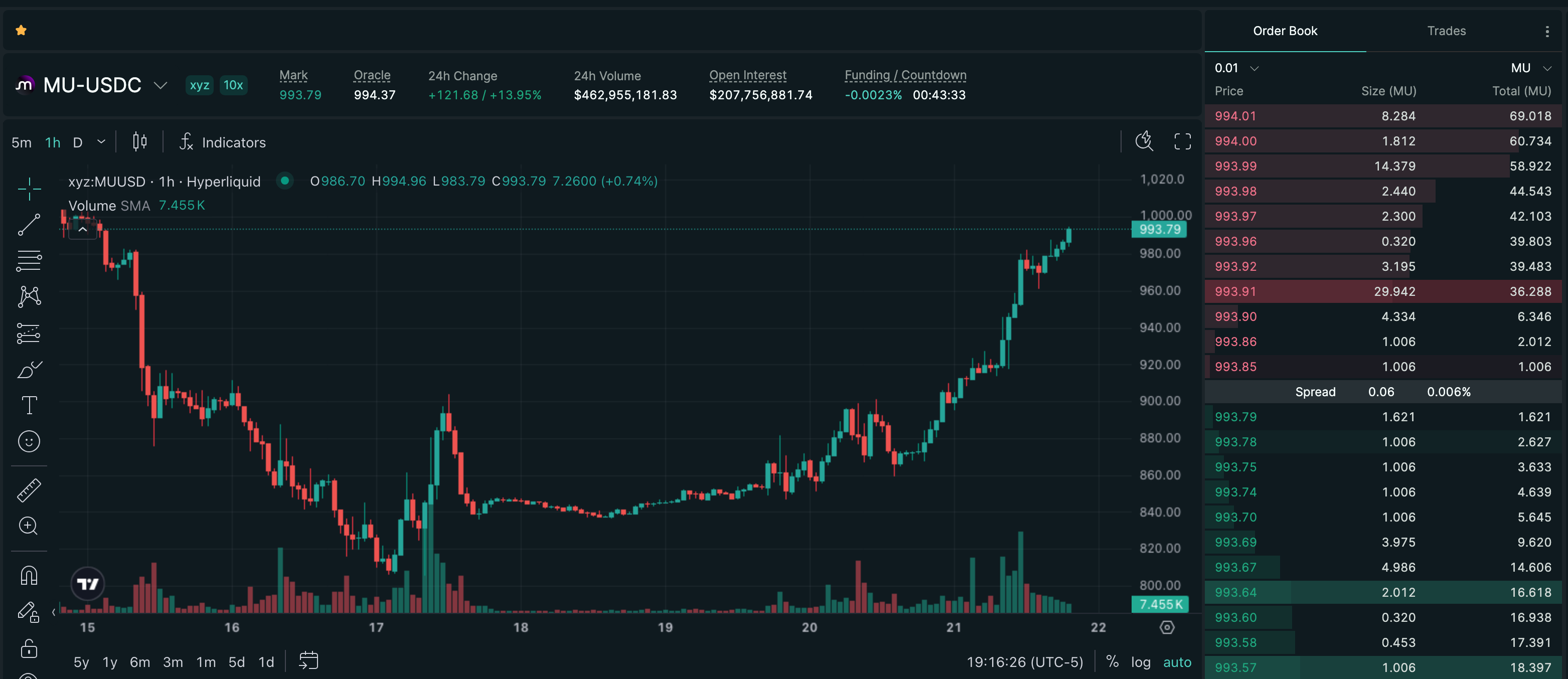
Bank of America's Vivek Arya reframed the biggest bear case on memory — cheap open-source Chinese AI — as a demand tailwind, and MU tacked on another double-digit day to push past $990. The argument is that open-weight models force every enterprise to load its own high-bandwidth memory, so proliferation multiplies chips sold rather than consolidating demand into a few data centers. It is the third leg of a multi-day repricing that already absorbed a US 1 List addition and a TSMC price-hike read-through, and the stock is still trading below its June high.
Mover Brief
The Catalyst
$MU cleared $990 for the first time since June after Bank of America's Vivek Arya reframed the memory bear case around cheap open-source AI. The fear all cycle has been that low-cost Chinese models — Kimi K3 at roughly $3 per million tokens versus ~$15 for Claude Opus — collapse the economics that justify an aggressive memory buildout. Arya's counter is blunt: closed models consolidate memory demand, open models multiply it. He kept a Buy and a $1,550 price target, roughly 56% above the current $993.30 print. This lands just days after BofA added MU to its US 1 List of highest-conviction ideas, so the desk is stacking calls, not just reiterating one.
Why Open Models Multiply Memory Demand
The mechanical point is what makes the note more than a talking point. Closed frontier models keep inference centralized in a handful of hyperscaler data centers; open-weight models get downloaded and run on-prem, and each deployment still needs ~1.4TB of high-bandwidth memory regardless of how the model is priced. Cheap tokens are a business-model choice, not a hardware discount — the silicon bill is the same either way. If open models proliferate across enterprises, that is more HBM sockets in aggregate, not fewer. It is the cleanest rebuttal yet to the 'DeepSeek moment' framing that has periodically knocked memory names, and it lines up with Micron's own read that supply stays tight beyond 2027.
The Setup
This is the third double-digit leg in a compressed window: the US 1 List add reclaimed the mid-$940s, a TSMC 2027 foundry price hike read through to the memory complex, and now the open-source note carries MU past $990. Even here the stock sits roughly 14% below its June high near $1,150, so this is gap-closing rather than a fresh breakout. The HIP-3 perp turned over about $463M in 24h on the move. The structural backdrop BofA leans on — tight supply and multiyear customer agreements extending pricing visibility — is what lets it justify a target ~56% over spot, and Arya flags CHIPS Act buyback restrictions rolling off around December 2026 as a capital-return kicker layered on top of the demand story.
Sources & Provenance
Citations below are preserved as structured Postgres source rows for this brief.
Citations Preserved
4
Reference links carried forward from the published mover record.
Original Signal
Open source tweetMarket Route
Direct route preserved for readers who want to inspect the tracked Hyperliquid market behind this archive entry.
Already onboarded? Open tracked market- 1Benzinga — BofA: open-source AI multiplies memory demand, $1,550 targetbenzinga.com
- 224/7 Wall St — BofA sees Micron rising ~83% from here247wallst.com
- 3Yahoo Finance — Micron joins BofA's US 1 Listfinance.yahoo.com
- 4Investing.com — Why Micron stock is up on AI memory demandinvesting.com
This content is for informational purposes only and does not constitute financial advice. Trading perpetual futures involves substantial risk of loss.
Trade MU on Hyperliquid
Use referral code HIPERWIRE for 4% off trading fees on your first $25M in volume.
Live Market Metrics
Monitor real-time open interest and funding for MU.