Micron Locked In $100B of Take-or-Pay Demand. That Breaks the Memory Cycle.
Micron's fiscal Q3 print was a blowout on every line, but the number that matters isn't the 85% gross margin — it's the contract book. The company disclosed 16 take-or-pay customer agreements worth roughly $100 billion in minimum contracted revenue through 2030, backed by about $22 billion in deposits and commitments. For a business that has been the market's definitive boom-bust cyclical for forty years, locking in fixed-price and ceiling-priced demand across nearly half of future revenue is the structural change. That, more than the headline beat, is why the stock re-rated.
Mover Brief
The Contract Book
Micron's fiscal Q3 print was a clean blowout, but the line that actually moved the stock sits in the slide deck, not the income statement. Management disclosed 16 Strategic Customer Agreements representing roughly $100 billion in minimum contracted revenue, structured as take-or-pay deals with binding volume commitments running through calendar 2030 (three-year terms for the automotive customers).
These aren't soft letters of intent. Fourteen of the sixteen already carry a cumulative floor of about $100 billion at minimum price, and Micron expects to collect roughly $22 billion in cash deposits and financial commitments — about $18 billion in cash and $4 billion in letters of credit — to backstop them. Customers are paying, up front, for the right to buy memory.
Why Take-or-Pay Breaks the Memory Cycle
Memory has been the textbook commodity cyclical for four decades: capacity gluts, price collapses, margins to zero, repeat. The reason MU has historically traded at a single-digit multiple is that nobody could underwrite the next trough — you were always one oversupply quarter from watching pricing crater.
Take-or-pay attacks exactly that. Micron now expects fixed prices or ceilings at or near current levels to cover roughly 40% of total revenue once all planned agreements are live. When that much of your book is contractually price-protected, the downside leg of the cycle gets truncated — the floor stops being a market-clearing price and starts being a contract term. That, not the margin headline, is the entire bull case for re-rating a memory maker off cyclical-trough math. The Street is repricing fast: JPMorgan moved its target from $550 to $1,540, and desks across the board reset by hundreds of dollars in a single session.
What the Print Showed
The underlying numbers gave the contracts credibility. Revenue hit $41.46 billion, up 346% year over year, with adjusted gross margin at 84.9% — software-tier economics on a DRAM and NAND business. The Core Data Center unit did $11.5 billion at 87% margins, up from $1.53 billion a year ago — roughly a sevenfold jump as HBM and high-capacity DRAM absorbed AI buildout spend.
Guidance was the exclamation point. Micron guided Q4 to $50 billion ±$1 billion at about 86% gross margin and $31 EPS, against a Street modeling closer to $43 billion. When the forward guide beats consensus by seven billion dollars, the contracted-demand story stops reading as a slide and starts reading as a run-rate.
The Risk Side
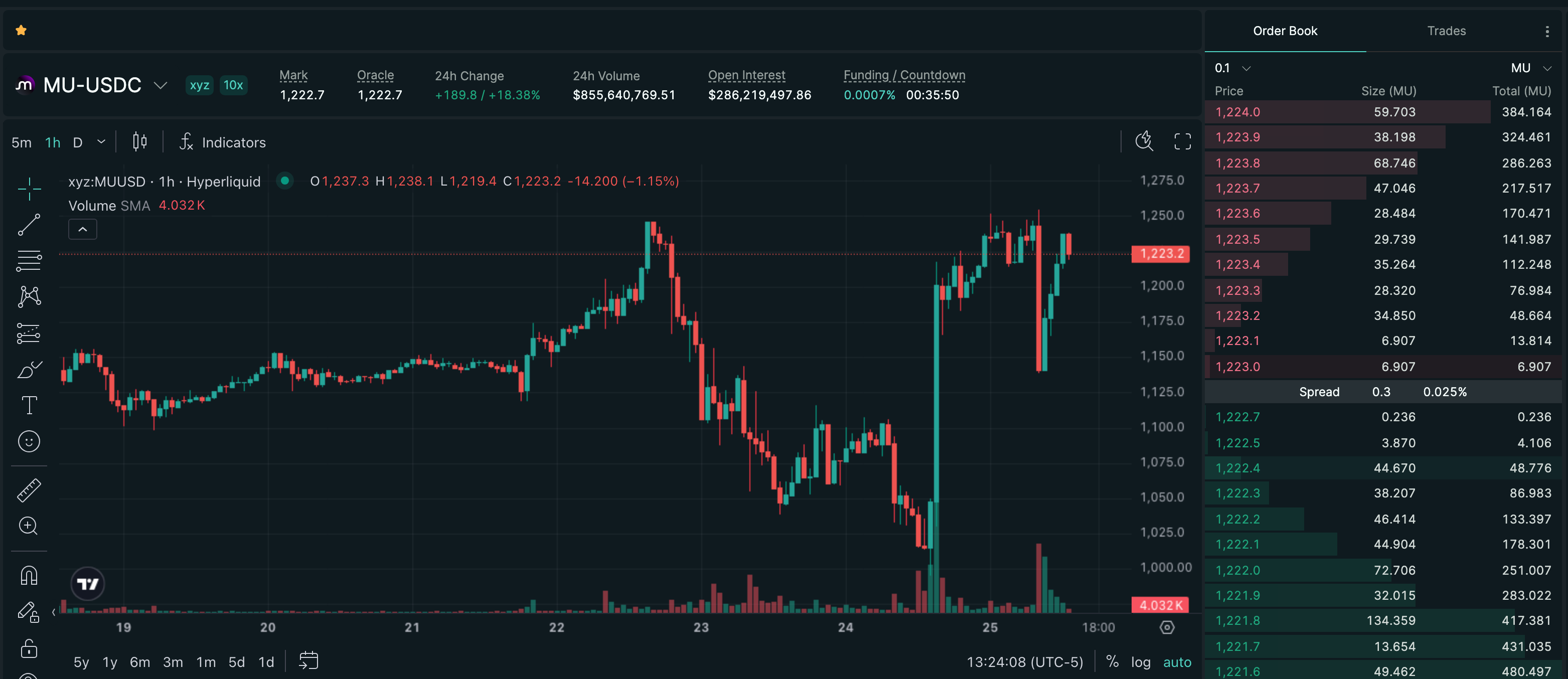
None of this makes MU a one-way trade. The stock is up more than 20% to roughly $1,221 and ran hard into the print, so the easy money on the reaction is already gone; thin after-hours and overnight liquidity exaggerate the percentage move on a perp.
The deeper caveats are structural. Take-or-pay floors protect price, not Micron's own volume bets — if AI capex disappoints, customers still pay the minimums, but Micron's capacity expansion could overshoot the real demand. The contract book is a 2026-2030 story, and execution on the HBM4 ramp plus supply discipline from SK Hynix and Samsung will decide whether those floors ever get tested. The thesis is that this cycle is genuinely different. The risk is that "this time is different" has buried memory bulls before — the contracts are what's supposed to make this round the exception, and they're brand new.
Sources & Provenance
Citations below are preserved as structured Postgres source rows for this brief.
Citations Preserved
6
Reference links carried forward from the published mover record.
Original Signal
Open source tweetMarket Route
Direct route preserved for readers who want to inspect the tracked Hyperliquid market behind this archive entry.
Already onboarded? Open tracked market- 1Micron Q3 FY2026 earnings press release (SEC 8-K)sec.gov
- 2CNBC — Micron Q3 2026 earnings reportcnbc.com
- 3Investing.com — Micron Q3 slides: record margins, $100B customer agreementsinvesting.com
- 4TradingKey — JPMorgan and Goldman sharply raise MU price targetstradingkey.com
- 5TradingKey — Micron reports record $41.5B revenue, guides $50Btradingkey.com
- 6TheStreet — Bank of America resets Micron price targetthestreet.com
This content is for informational purposes only and does not constitute financial advice. Trading perpetual futures involves substantial risk of loss.
Trade MU on Hyperliquid
Use referral code HIPERWIRE for 4% off trading fees on your first $25M in volume.
Live Market Metrics
Monitor real-time open interest and funding for MU.