Micron's 16 Take-or-Pay Contracts Are the Real Story, Not the Earnings Beat
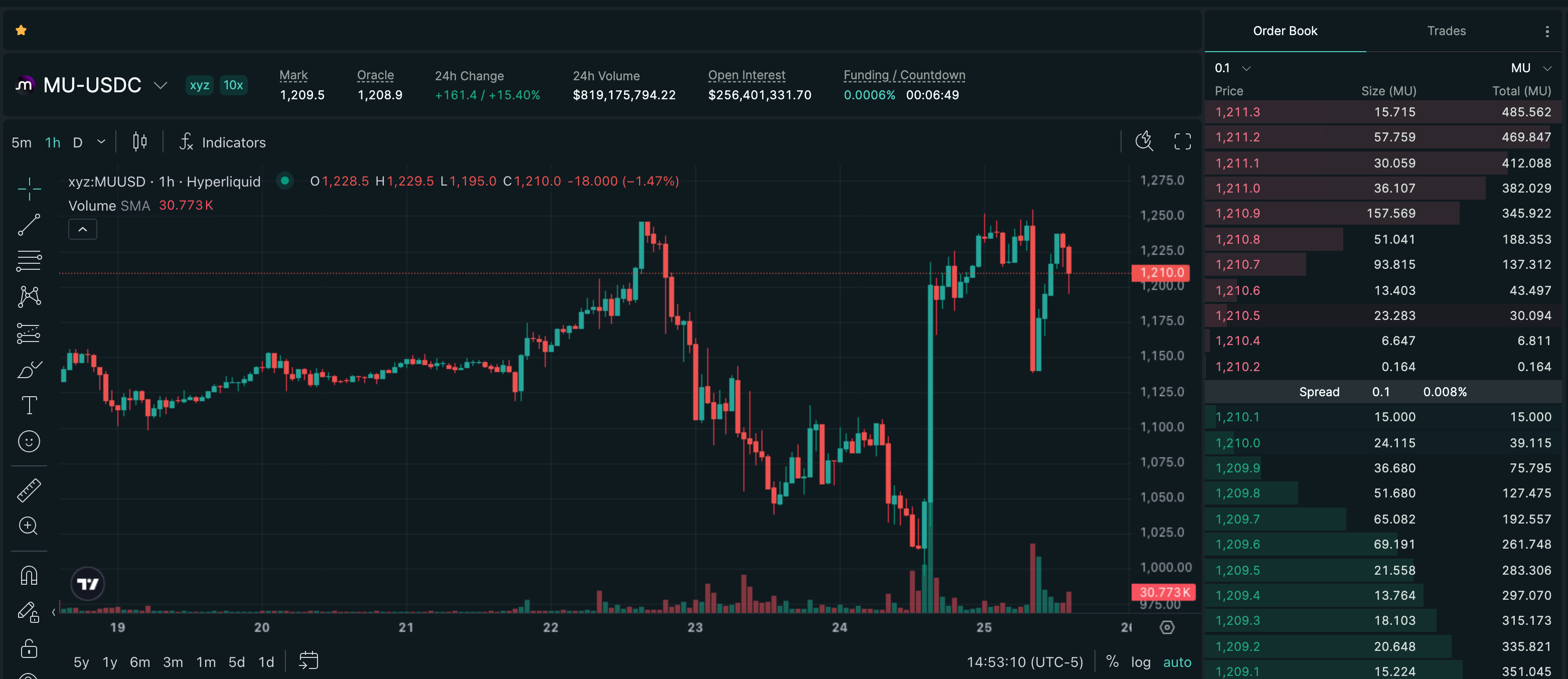
MU is up 15.51% over 24h to about $1,211 after Micron's fiscal Q3 print blew past every estimate. But the number that actually matters isn't the revenue beat or the record margin — it's 16 non-cancellable, five-year take-or-pay contracts worth roughly $100 billion in minimum committed revenue, with customers putting up billions in cash deposits and accepting price floors. That structure strips out the demand-collapse leg that has defined every memory cycle before this one. The market isn't repricing an earnings beat; it's repricing what kind of business Micron is.
Mover Brief
The Contracts, Not the Beat
Strip away the headline numbers and the durable signal in Micron's print is the structure of its order book. Management disclosed 16 signed Strategic Customer Agreements — non-cancellable, five-year, take-or-pay contracts that lock buyers into mandatory annual volume regardless of their own demand. Reported coverage puts the minimum contracted revenue at roughly $100 billion, backed by about $22 billion in cash and financial commitments and roughly $18 billion already sitting on the balance sheet as customer deposits.
The pricing terms are the tell. Each contract carries a band with a ceiling and a floor, adjusted quarterly, with premium pricing on advanced parts like HBM4 and LPDDR6. The agreements span around 20% of DRAM and up to a third of NAND volume. That is not how memory has ever been sold. Hyperscalers prepaying and accepting floor prices to guarantee supply is the behavior of buyers who are afraid of being short an input, not buyers negotiating down a commodity.
Why Take-or-Pay Breaks the Memory Cycle
Memory has always been the most brutal corner of semiconductors — a boom-bust commodity where Micron, Samsung and SK Hynix took turns flooding the market, collapsing prices, and writing down inventory. Micron was a price-taker. The whole short thesis on the stock was simply "the cycle turns."
Take-or-pay contracts with floors attack exactly that downside. If 20% of DRAM and a third of NAND volume is locked under multi-year minimums that can't be cancelled, the demand-collapse leg of the cycle largely disappears for that slice of the book. The reason buyers are willing to sign is supply: management said HBM3E and HBM4 are fully booked through calendar 2027 with demand spilling into 2028, and that HBM4 shipments for NVIDIA's Vera Rubin platform are ramping at roughly twice the pace of the prior generation. When demand far exceeds supply across every HBM variant, the pricing power flips to the seller — and Micron is converting that leverage into contracted revenue while it lasts.
The Numbers Behind the Re-Rate
The print itself gave the contracts their credibility. Micron reported revenue of $41.46 billion against roughly $35.8 billion expected, non-GAAP EPS of $25.11, and a record gross margin around 84.6% — figures that belong to a logic or software franchise, not a memory maker. Data center revenue alone topped $25 billion. Then management guided fiscal Q4 to $50 billion ±$1 billion with gross margin near 86%, well above the ~$43.6 billion the Street was modeling.
Shares jumped about 14.5% after hours to roughly $1,199 on the report. The MU perp on Hyperliquid is tracking the same move, up 15.51% over 24h to about $1,211 on $819 million of 24h volume — the third straight leg higher as the market digests not just a beat, but a different business model underneath it. The risk worth respecting: this is a stock pricing in years of locked demand, so any crack in the AI capex narrative or HBM yield ramp gets repriced fast against a high base.
Sources & Provenance
Citations below are preserved as structured Postgres source rows for this brief.
Citations Preserved
6
Reference links carried forward from the published mover record.
Original Signal
Open source tweetMarket Route
Direct route preserved for readers who want to inspect the tracked Hyperliquid market behind this archive entry.
Already onboarded? Open tracked market- 1Micron Q3 FY2026 results press release (SEC 8-K)sec.gov
- 2CNBC — Micron (MU) Q3 2026 earnings reportcnbc.com
- 3Investing.com — Micron Q3 2026 earnings call transcript (take-or-pay detail)investing.com
- 4TechTimes — Micron's $100B contracts signal AI memory cycle breaktechtimes.com
- 5Investopedia — Micron memory stock soars on AI demandinvestopedia.com
- 6Investing.com — Chip stocks surge after hours on Micron's record quarterinvesting.com
This content is for informational purposes only and does not constitute financial advice. Trading perpetual futures involves substantial risk of loss.
Trade MU on Hyperliquid
Use referral code HIPERWIRE for 4% off trading fees on your first $25M in volume.
Live Market Metrics
Monitor real-time open interest and funding for MU.