Qatar's LNG Blackout Sends NATGAS Above $3.35 as Hormuz Chokes
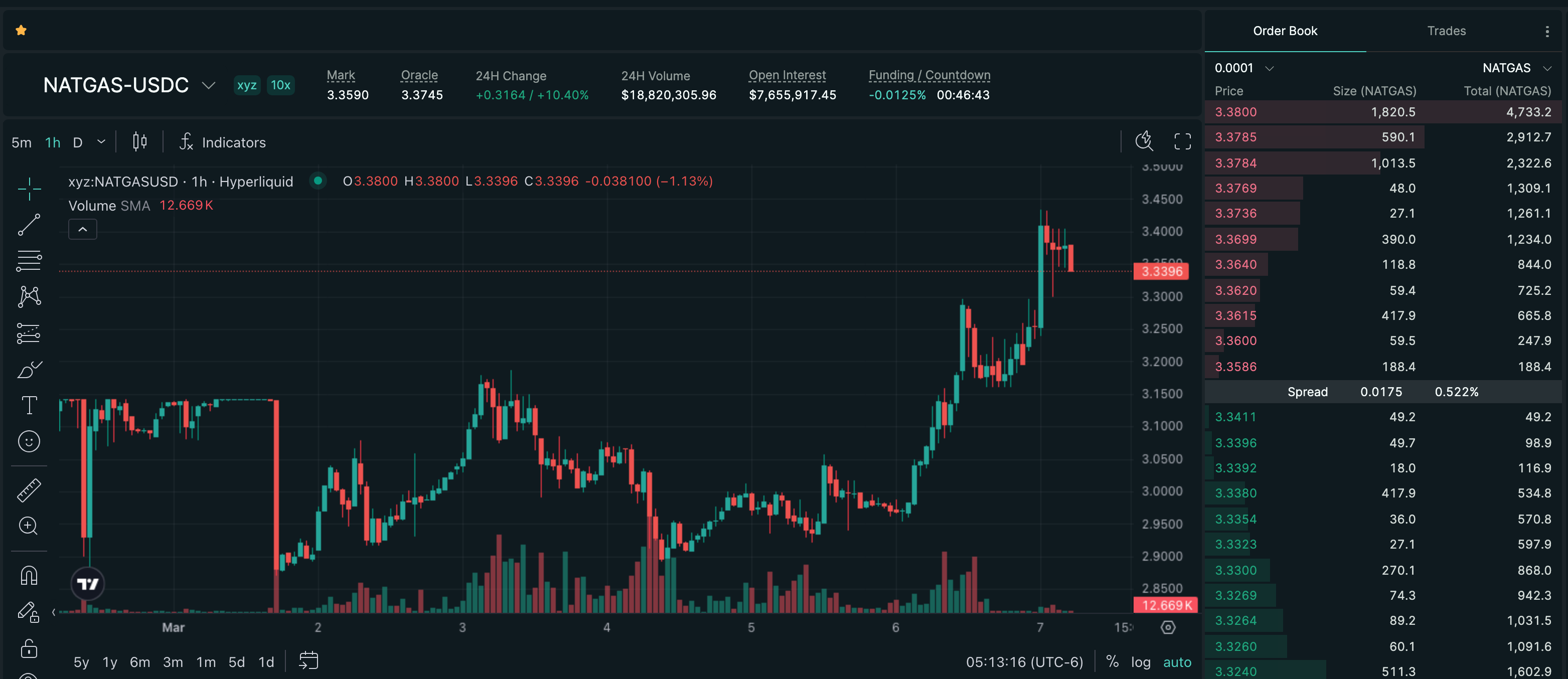
NATGAS ripped nearly 10% in 24 hours after Iranian drone strikes forced QatarEnergy to halt production at the world's largest LNG export complex. The shutdown pulled roughly one-fifth of global LNG supply offline, and traffic through the Strait of Hormuz has collapsed 86%, compounding the disruption. Henry Hub reclaimed $3 despite warm domestic weather as the geopolitical premium overwhelmed bearish fundamentals.
Mover Brief
The Catalyst: QatarEnergy Goes Dark
Iranian drone strikes on QatarEnergy's facilities at Ras Laffan and Mesaieed Industrial Cities on March 2 triggered a full cessation of LNG production. Qatar supplies 20% of the world's LNG — roughly 1.5 million tonnes of weekly exports went to zero overnight.
The attacks were part of Iran's broader retaliation against U.S.-Israeli strikes that killed Supreme Leader Khamenei. Two drones hit Qatar — one targeting a Mesaieed power plant water tank, the other striking an energy facility at Ras Laffan — with no reported casualties but enough operational damage to justify a full shutdown.
The market reaction was immediate and violent. European TTF benchmark gas prices surged nearly 50%. Asian LNG prices jumped 39%. The JKM-TTF spread blew out above $6/MMBtu as Asian buyers scrambled for alternative cargoes, outbidding European importers on the spot market.
Hormuz Is Closed in All but Name
The Qatar shutdown alone would be a major supply event. But the Strait of Hormuz — the 21-mile chokepoint through which the bulk of Qatari gas and roughly one-fifth of global seaborne oil flows — is effectively shut. Sea battles between Iran and the United States have driven transit volumes down 86%.
This double disruption is why the price impact has been so outsized. Even if QatarEnergy could restart production tomorrow, getting cargoes through the strait is a separate and unresolved problem. LNG freight rates recorded their largest single-day jump on record, hitting $300,000/day as shipowners repriced risk.
Asia absorbed 85% of Qatar's LNG exports pre-crisis. China, India, and Taiwan face immediate supply crunches. Europe, which took only 12% of Qatari LNG historically, is getting hit by secondary effects as Asian buyers strip the spot market.
The U.S. Angle: Warm Weather Meets Geopolitical Premium
Domestically, the natural gas fundamentals are mixed. The Commodity Weather Group forecast above-average U.S. temperatures for March 7–11, which should be killing heating demand. Storage sat at 1,886 Bcf as of February 27, still within seasonal norms after a heavy withdrawal season that pulled 132 Bcf the prior week.
But the geopolitical premium is overriding the weather trade. U.S. LNG exporters are now the most important swing supplier to a global market missing a fifth of its capacity. Futures for summer and next winter have moved higher as the market prices in sustained elevated LNG demand drawing on domestic supply. Henry Hub climbed back above $3 earlier this week and has now pushed to $3.35 — a level that looked unlikely when spring weather was supposed to crush near-term demand.
What Comes Next
The key variable is duration. QatarEnergy has given no timeline for restarting production. RTE reported that liquefaction facilities may take weeks to restart even under ideal conditions, and the security situation is far from ideal. As long as the Strait of Hormuz remains contested, restarting Ras Laffan barely matters.
For U.S. natural gas, the open-ended Middle East conflict has structurally repriced the forward curve. Strong LNG pull on domestic supply through the summer could tighten storage heading into next winter, which is why the strip has moved up even beyond the front month. The EIA had forecast Henry Hub to average $4.30/MMBtu for 2026 before this crisis — that number is looking conservative now.
The $3.35 level on the Hyperliquid perp puts NATGAS at its highest since the January cold snap, when Henry Hub briefly averaged $7.72. Whether it holds depends entirely on headlines from the Gulf.
Sources & Provenance
Citations below are preserved as structured Postgres source rows for this brief.
Citations Preserved
8
Reference links carried forward from the published mover record.
Original Signal
Open source tweetMarket Route
Direct route preserved for readers who want to inspect the tracked Hyperliquid market behind this archive entry.
Already onboarded? Open tracked market- 1Al Jazeera: QatarEnergy halts LNG production after Iran attacksaljazeera.com
- 2CNBC: Middle East war sends natural gas prices soaringcnbc.com
- 3OilPrice: Iran War Upends LNG Market and Jolts Gas Pricesoilprice.com
- 4Washington Post: Trump's Iran conflict cut the world off from a crucial energy sourcewashingtonpost.com
- 5TIME: Strait of Hormuz global trade disruption amid Iran wartime.com
- 6Bloomberg: Gas prices surge as Qatar shuts world's largest LNG export plantbloomberg.com
- 7EIA: Weekly Natural Gas Storage Reporteia.gov
- 8RTE: Qatar shuts gas liquefaction, may take weeks to restartrte.ie
This content is for informational purposes only and does not constitute financial advice. Trading perpetual futures involves substantial risk of loss.
Trade NATGAS on Hyperliquid
Use referral code HIPERWIRE for 4% off trading fees on your first $25M in volume.
Live Market Metrics
Monitor real-time open interest and funding for NATGAS.