NATGAS Catches a Bid as EIA Storage Miss Narrows the Five-Year Surplus
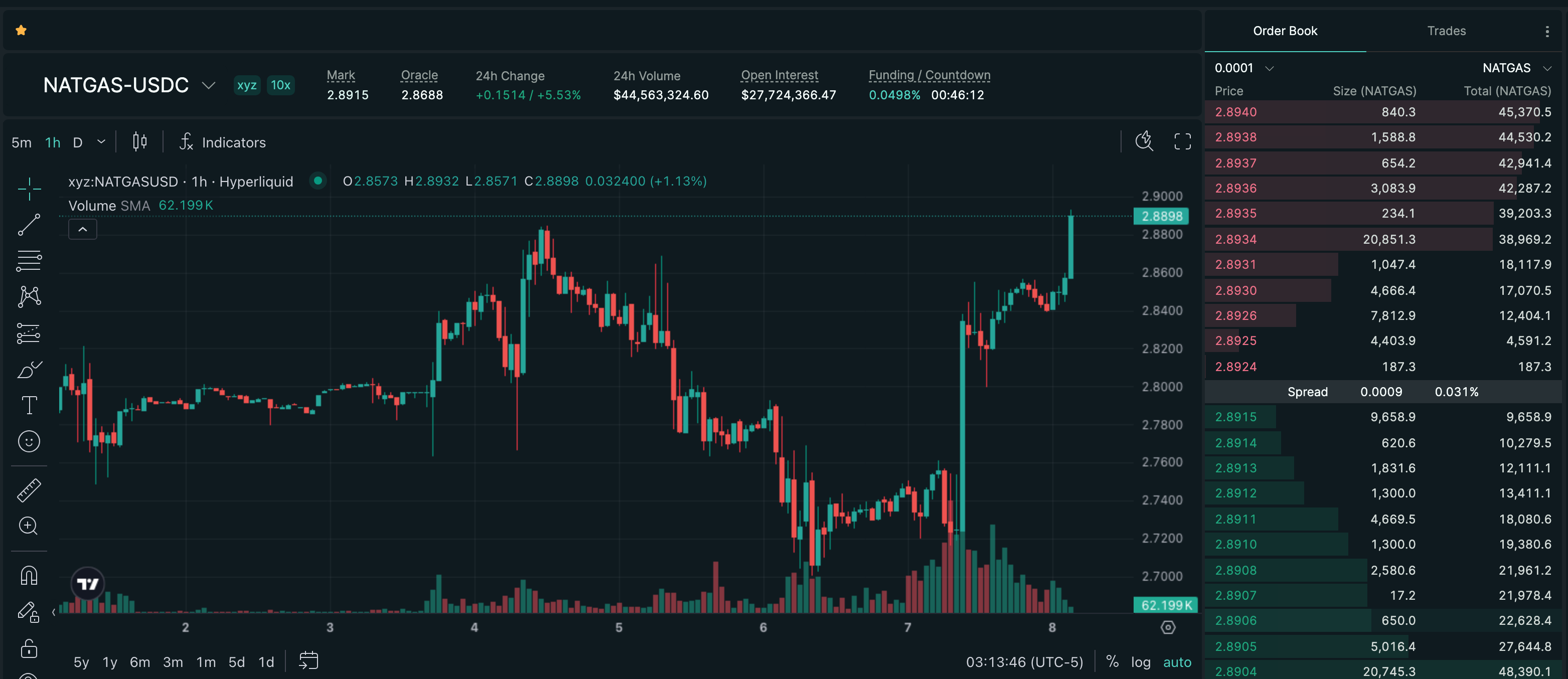
The May 7 EIA storage report came in lighter than the Street expected — a 63 Bcf injection against a 74 Bcf consensus and a 77 Bcf five-year average — and Henry Hub bid up on it. The Hyperliquid NATGAS perp ran 5.81% over the next 18 hours to $2.888 as the surplus to the five-year norm narrowed to 139 Bcf. Behind the print, EQT and other Appalachian producers are curtailing volumes into weak prices, tightening the supply stack ahead of summer cooling demand.
Mover Brief
The Storage Miss
On May 7 the EIA reported operators injected 63 Bcf into US natural gas storage for the week ending May 1, undershooting the Street's 74 Bcf consensus and trailing the 77 Bcf five-year average build. The print broke a tape that had been drifting since LNG feedgas flows softened in early May — front-month NYMEX futures climbed back toward $2.78/MMBtu, and the Hyperliquid perp ran 5.81% over the next 18 hours to $2.888.
The composition is the actual signal. Total Lower 48 inventories now carry a 139 Bcf surplus to the five-year norm, down from a 153 Bcf surplus the prior week. That direction — surplus narrowing rather than widening — is what the bid is pricing. The market was set up short the supply story; this print told it to flatten.
Producers Are Choking the Tape
The miss isn't accidental. EQT, the second-largest US gas producer, has baked roughly 10–15 Bcf of curtailments into Q2 guidance, pulling about 1–1.5 Bcf/d from the supply stack rather than sell into a weak strip. Appalachian operators broadly have leaned on the same playbook through April and May, and it's showing up in the weekly balances.
The output retreat collides with a market that was already structurally tightening. Argus expects US gas balances to tighten through 2026 as new Gulf Coast LNG capacity ramps. May LNG feedgas has cooled to roughly 17.4 Bcfd from April's 18.8 Bcfd record, but that softness reads as maintenance and lingering Hormuz spillover, not a structural demand break — and it's already in the curve.
What's Next for the Tape
Two things to watch from here. First, the cooling-demand handoff: the EIA's Short-Term Energy Outlook has summer power burn lifting through June, which converts a narrowing surplus into an outright deficit faster than producers can re-add wells. Second, LNG normalization — every Bcfd that returns to feedgas through summer is direct upward pressure on Henry Hub spot.
Level math is clean. The June NYMEX contract has been compressed in a roughly $2.60–$2.95 band; today's print pushes the action toward the upper rail. A break above $2.95 puts $3.10 back in play and forces shorts to defend higher. Below $2.65, the storage thesis loses leverage and the trade becomes a pure summer-weather bet.
Sources & Provenance
Citations below are preserved as structured Postgres source rows for this brief.
Citations Preserved
7
Reference links carried forward from the published mover record.
Original Signal
Open source tweetMarket Route
Direct route preserved for readers who want to inspect the tracked Hyperliquid market behind this archive entry.
Already onboarded? Open tracked market- 1EIA Weekly Natural Gas Storage Reporteia.gov
- 2Natural Gas Intelligence — Bullish Storage Injection Props Up Natural Gas Futuresnaturalgasintel.com
- 3StoneX — EIA Weekly Nat Gas Storage Update (May 7, 2026)stonex.com
- 4Argus — US gas market expected to tighten in 2026argusmedia.com
- 5GuruFocus — Natural Gas Prices Rise Amid Production Decline and Strong LNG Demandgurufocus.com
- 6EIA Short-Term Energy Outlook — Natural Gaseia.gov
- 7FRED — Henry Hub Natural Gas Spot Price (DHHNGSP)fred.stlouisfed.org
This content is for informational purposes only and does not constitute financial advice. Trading perpetual futures involves substantial risk of loss.
Trade NATGAS on Hyperliquid
Use referral code HIPERWIRE for 4% off trading fees on your first $25M in volume.
Live Market Metrics
Monitor real-time open interest and funding for NATGAS.