China Sets 110 GW Nuclear Target in Five-Year Plan, Sector Reprices
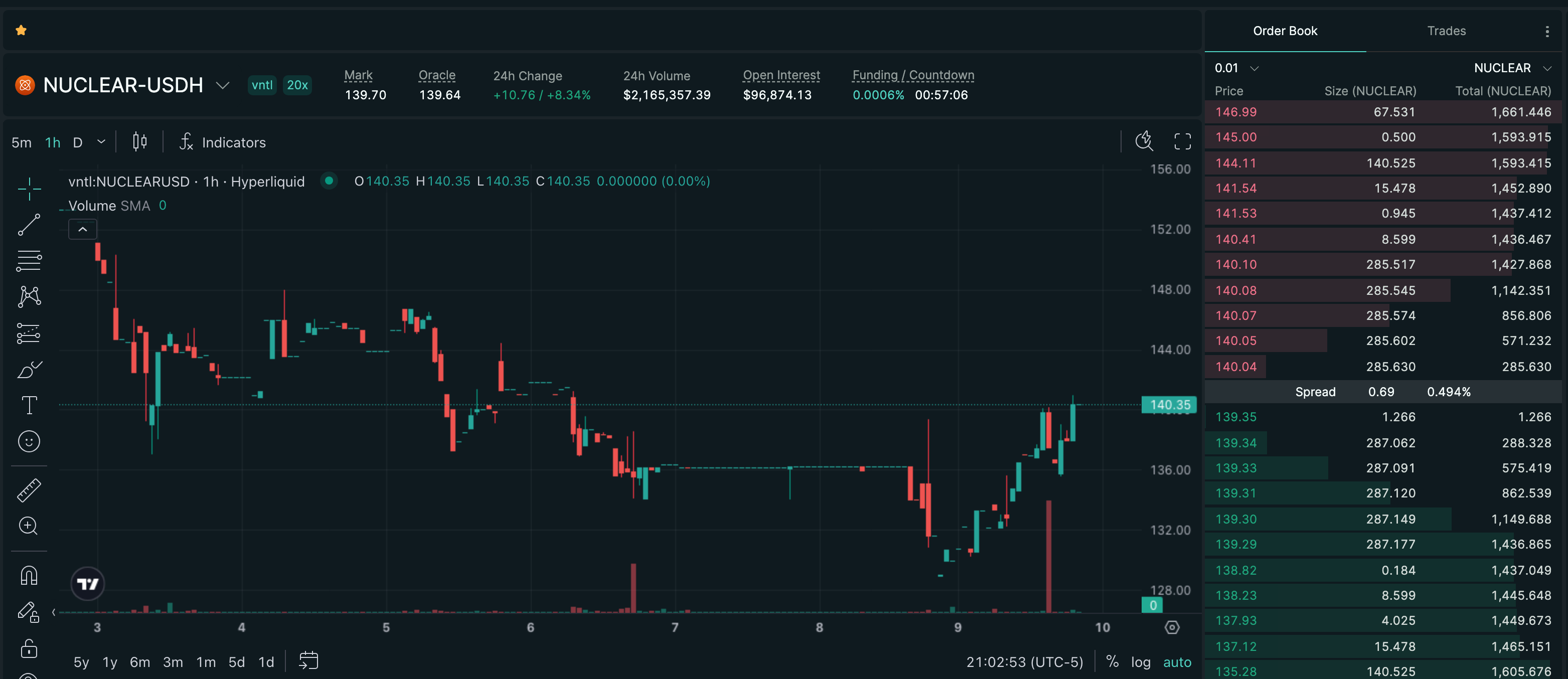
China's 15th Five-Year Plan draft calls for 110 gigawatts of nuclear capacity by 2030, a 76% increase from the 62 GW online at the end of 2025. The target, disclosed at this week's National People's Congress session, implies roughly 10 GW of annual additions — an unprecedented buildout pace that would require nearly doubling the country's reactor fleet in five years. Nuclear-linked assets moved immediately, with NLR up 7.5% as the market prices in a demand shock across the entire value chain from uranium feedstock to reactor construction.
Mover Brief
The Catalyst: Beijing's Biggest Nuclear Bet Yet
China's State Council embedded a 110 GW nuclear capacity target in the 15th Five-Year Plan draft released during the NPC session on March 9. The number represents a 48 GW addition over five years — roughly 10 GW per year — from the 62 GW base that stood at the end of 2025.
The strategic logic is explicit. China National Nuclear Power chairman Lu Tiezhong framed the push around AI infrastructure, calling nuclear the only source of "stable, reliable and zero-carbon baseload energy" capable of sustaining continuous data center operations. The IEA projects 106 GW of cumulative new IT load globally between 2025 and 2030, and Beijing wants nuclear taking a meaningful share of that in China.
The plan also introduces a nuclear-renewable coupling strategy — integrating wind, solar, hydro, and nuclear on a grid level — with a 2 GW Tianwan tidal flat solar demonstration in Jiangsu province as an early reference project. The longer-term target is 150 GW by 2035.
The Credibility Problem
Beijing has a track record of overshooting on nuclear targets. It missed its 58 GW goal for 2020 and its 70 GW goal for 2025, both by meaningful margins.
Francois Morin, China director for the World Nuclear Association, told reporters the 110 GW deadline is unlikely to be met unless partially completed facilities are counted. Chinese reactor construction timelines run five to seven years, which makes a 2030 delivery date arithmetically tight for projects not already underway. Morin also flagged that nuclear's share of total generation has actually been declining in recent years — still below 5% of China's electricity — as coal and renewables additions outpace reactor completions.
The geographic constraint matters too. The 15th Five-Year Plan restricts nuclear development to coastal sites, which limits available locations for new builds and puts a ceiling on how aggressively the buildout can scale.
The Broader Supply Squeeze
China's target lands in a uranium market that's already tight. Spot uranium sits at $86.37 per pound, off the $94.28 January peak but still well above historical norms. Long-term contract prices hit $90 per pound — the highest since 2008. Kazakhstan's Kazatomprom, the world's largest producer, has cut production guidance by 10%, further tightening supply.
On the fuel fabrication side, the U.S. DOE awarded Centrus Energy a $900 million task order in January to expand HALEU production at its Piketon, Ohio facility — a direct response to the advanced reactor pipeline that will need enriched fuel at levels Russia has historically monopolized. Cameco, NLR's largest holding at roughly 9% of the fund, has rallied 25% since mid-December to around $113.
The demand side keeps compounding. Meta's power purchase agreements with Oklo and Vistra validate that hyperscalers are locking in nuclear capacity years ahead. Every new commitment makes the uranium supply math harder.
What the Market Is Pricing
NLR's 7.5% move is the market absorbing two signals at once: the largest nuclear buildout commitment ever announced by a single country, and confirmation that the structural demand story — AI power, energy security, decarbonization — has enough political backing to survive skepticism about execution timelines.
The fund captures the full value chain, which matters here. A 48 GW addition over five years means demand across uranium miners, enrichment companies, reactor builders, and nuclear utilities simultaneously. Even if China hits 90 GW instead of 110 GW by 2030, the procurement cycle is already pulling forward. Fuel contracts get signed years before reactors go critical.
The question isn't whether China builds 110 GW by exactly 2030 — it's whether the intent is credible enough to move procurement timelines. On that front, the institutional money has already answered. CreativeOne Wealth lifted NLR holdings 12.8% last quarter, and Raymond James holds $25.8 million in the fund. The smart money was already positioned before Beijing put a number on it.
Sources & Provenance
Citations below are preserved as structured Postgres source rows for this brief.
Citations Preserved
6
Reference links carried forward from the published mover record.
Original Signal
Open source tweetMarket Route
Direct route preserved for readers who want to inspect the tracked Hyperliquid market behind this archive entry.
Already onboarded? Open tracked market- 1Taipei Times — China's 110 GW Nuclear Targettaipeitimes.com
- 2China Daily — Nuclear Power as Backbone for AI Energy Demandchinadaily.com.cn
- 3CREA — China's 15th Five-Year Plan Energy Implicationsenergyandcleanair.org
- 4Centrus Energy — $900M DOE HALEU Expansion Awardinvestors.centrusenergy.com
- 5Barchart — Can Uranium Keep Rallying?markets.financialcontent.com
- 6CreativeOne Wealth Increases NLR Positionamericanbankingnews.com
This content is for informational purposes only and does not constitute financial advice. Trading perpetual futures involves substantial risk of loss.
Trade NUCLEAR on Hyperliquid
Use referral code HIPERWIRE for 4% off trading fees on your first $25M in volume.
Live Market Metrics
Monitor real-time open interest and funding for NUCLEAR.